
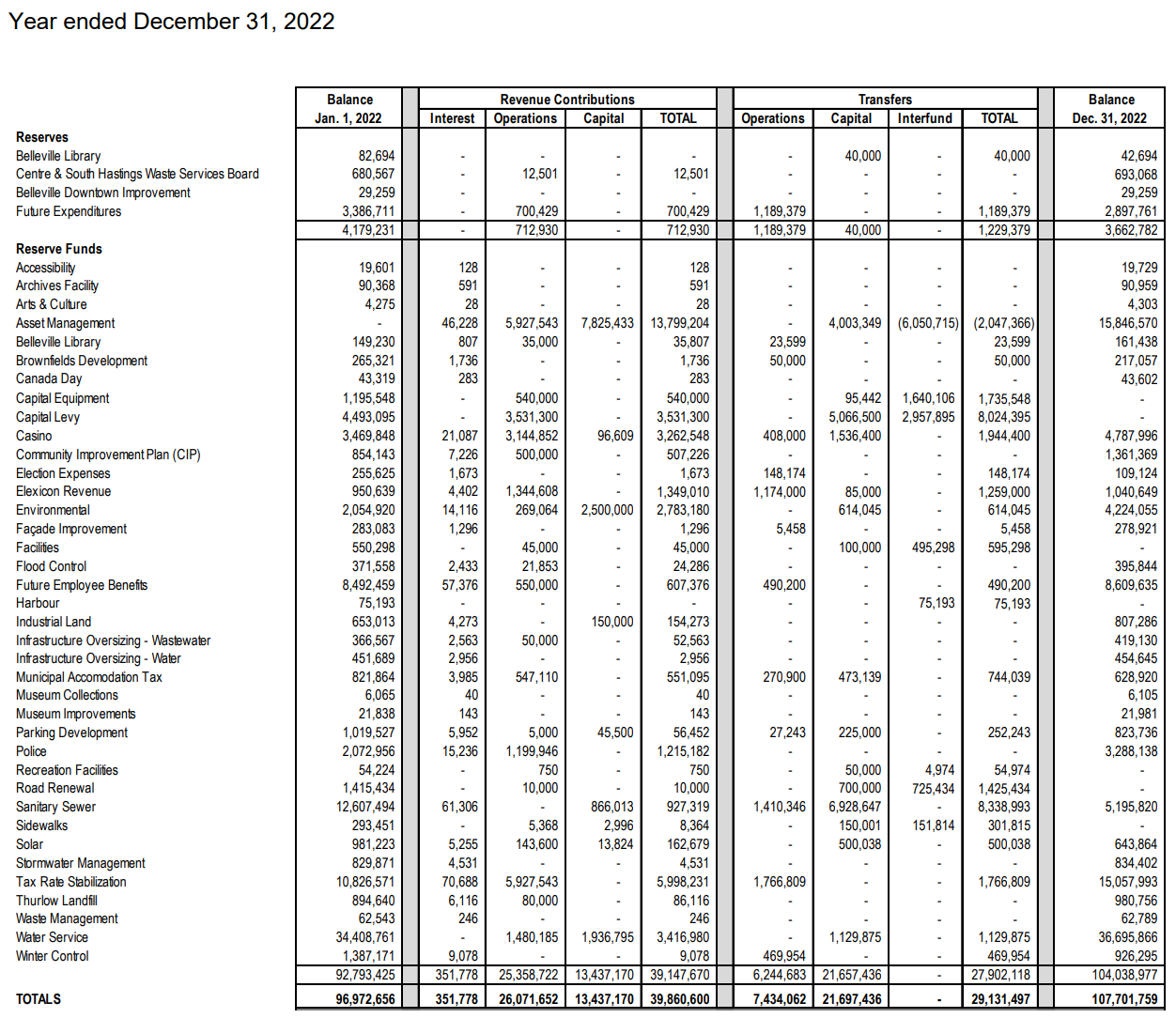
Reserves and reserve funds are money set aside to fund capital expenditures – similar to having personal savings accounts. They are also used to manage unanticipated expenses and to support the City’s long-term financial stability.
A Reserve is an allocation of funds that is not restricted by by-law or legislation but can be related to projects that are of a nature prescribed and managed by approval of Council. Reserves are held in the general bank account and typically do not receive an annual interest allocation.
A Reserve Fund is a fund set aside for a specific purpose as required by legislation, by-law, or agreement and consists of obligatory (externally restricted) and discretionary (internally restricted) reserve funds. Reserve funds receive an interest allocation.
They are an important tool for a municipality’s long-term financial sustainability that can reduce the need for long-term borrowing or imposing sudden tax increases on current or future taxpayers.
They can be used to offset or set money aside money for:
- maintaining/controlling property tax rates if the economy suddenly takes a downturn
- unexpected expenses or revenue shortfalls
- onetime or short-term funding for special purposes
- uncontrollable but often predictable events like floods, forest fires and pandemics
- flexibility to deal with fluctuating cash flows
- capital projects (like road repairs)
Municipal reserve funds are either mandatory (required) or discretionary (optional):
- Obligatory (externally restricted) Reserve Funds are required by provincial or federal legislation, municipal bylaws or contractual agreements and must be collected, set aside and used for their stated purpose. Examples include:
- Development Charge Reserve Funds as per the Development Charges Act
- Tax Rate Stabilization Reserve Fund
- Water, Wastewater & Stormwater Reserve Funds
- Discretionary (internally restricted) Reserves are an allocation of funds established by Municipal Councils through by-laws rather than provincial legislation. They can be specific to projects that are of a nature prescribed and managed by approval of Council for specific purposes. Councils can have flexibility to decide how the money is used. They are held in separately grouped bank accounts and receive an interest allocation. Examples are shown below.
Reserve funds can come from various sources including:
- Government grants
- Transfers from the operating budget
- Budget surpluses
Development Charge Reserve Fund
Section 43 of the DCA requires a municipality’s Treasurer to provide an annual statement of each Development Charge Reserve Fund, including opening and closing balances of the reserve funds and of the transactions relating to the funds. It must be posted the municipality’s website. For example, here is the City of Belleville’s Annual Treasurer’s Statement of Reserve Funds for Development Charges 2022.
Capital reserve funds
Capital reserves are established as a source of saving or allocating funding for future capital programs. Funding for these reserves is obtained annually through contributions from property tax supported and user rate budgets.
The annual reserve contributions are based on forecasted financing requirements and provisions required to sustain reserve balances at appropriate levels to address infrastructure replacement costs in the future and inherent uncertainties in capital funding needs. Reserve contributions are evaluated annually to ensure adequate funds are raised to meet future capital requirements and to smooth out the impact on the annual operating budget. This practice can help to stabilize any annual fluctuations in funding requirements, plan for any major long-term infrastructure investments, and prevent sudden spikes in property taxes, rates, and debt levels.
2022 Belleville Asset Management Plan
For example, contributions to the Asset Management Reserve Fund are required to support current and future capital needs. The Asset Management Plan is updated to meet legislated requirements under O. Reg 588/17: Asset Management Planning for Municipal Infrastructure.



Comments
We want to hear from you! Share your opinions below and remember to keep it respectful. Please read our Community Guidelines before participating.