
If approved by Council, Belleville Police Service’s (BPS) operating budget will have increased 57.6% ($12,256,318) over the past 4 years (2022-2026) for an average annual increase of 12%. Over the last 5 years, the increase has been 62% ($12,878,118) for an average annual increase of 10.2%. Data can be found in this Google Sheet.
Over this time, the increase vastly outpaces:
- Inflation (CPI for Ontario): 22.2% (using a forecast of 2% for 2026)
- Estimated population growth: 14% (StatsCan)
- and the total threshold to maintain real per capita spending (CPI + pop. growth): 36.2%.
The majority of policing costs are paid from property taxes and have risen faster than other expenditures on transit, library, housing or social services.
Police budget has increased from 18% to 23% of the net municipal budget
These increases are significant for residents of Belleville. The police budget would represent roughly a quarter of the city’s total property tax spending.
Salaries, benefits and pensions account for 78% ($9,809,184) of the budget increase over the 5-year period from 2021 to 2026
As with most organizations, the vast majority of the Belleville Police Service’s operating budget (87% in 2026) goes to staffing.
The collective agreement reached between the Belleville Police Association and the Belleville Police Service Board (BPSB) dictates that an officer in Belleville can expect raises each year until the end of the agreement, including 3.5% in 2026. Salary increases for other years are not available as Belleville Police Services Board hasn’t filed their collective agreements with Ministry of Labour since 2019 as required by the Labour Relations Act.
This creates a predictable and constant upward pressure on the police budget each year.
Executive salaries increased by 74%, Operations benefits by 87%
The largest dollar-value increases are:
- $3,507,822 (41%) increase in salaries for Operations Division
- $1,520,270 (58%) increase in salaries for Administration Division
- $1,130,049 (87%) increase in benefits for Operations Division
- $934,350 (29%) increase in salaries for Support Division
- $797,500 increase in Interest on Long-Term Debt (new police station mortgage)
- $642,803 (74%) increase in salaries for Executive Services
Staff benefits increased by 91%
Across all divisions:
- Salaries increased by $6,605,245 (43.5%)
- Benefits increased by $2,110,765 (91%)
- Pensions increased by $1,093,174 (56%)
Contract Services increased by over 141%
Highest percentage increases include:
- 426% ($39,961) increase in Special Presentations
- 290% ($799,429) increase in Records Mgmt IT Operating
- >141% increase in Contract Services
- 200% ($152,254) increase in Investigative Expense
- 175% ($15,916) increase in Insurance Claims
- 131% ($196,624) increase in Training
- 120% ($83,289) increase in Radio
- 65% ($138,014) increase in Vehicle Maintenance
Community Safety and Policing Act added new requirements in 2024
Ontario’s Community Safety and Policing Act (CSPA) came into effect in 2024 and is the first major overhaul of Ontario policing legislation in over three decades. It mandates sweeping changes across police services, including modernizing the process for suspending officers without pay, new board requirements, and – importantly for the budget – significant new requirements for training, certification, reporting, and oversight.
Peterborough Currents
Belleville Police’s budget for Training increased 88% ($162,391) between 2024 and 2025. This accounted for roughly 5% out of the 11% 2025 operating budget increase. Training costs are proposed to be the same in 2026 as 2025 ($346,400).
Ford government’s total funding for police programs increased 5% from 2021 to 2026
Police services receive provincial, and sometimes federal, funding for specific programs or services that align with broader government priorities.
The change in provincial funding by program from 2021 to 2026 is as follows:
- Police Transportation: +15%
- RIDE Grant – Police: +114%
- Court Security Prisoner Transport: -6%
- Community Safety & Policing Grant: +78%
- Membership Support Grant: 0%
- Strategy to Protect Children: +157% ($20,050) increase in 2026
- Strategy to End Human Trafficking: 0%
- Victim Services Grant: 0% (extended by 1 year through 2026)
Ford government downloading Court Security Prisoner Transport to BPS
Municipal police services are legally required to provide court security (Section 243 of the CSPA) and prisoner transport (Section 6 of O. Reg. 392/23).
The Ontario government provides ‘Court Security Prisoner Transportation’ grant funding to the Belleville Police Service to help offset the costs of security around the building and transporting prisoners, but funding has not kept pace with the mandate. This funding represents the majority (75%) of provincial funding received by BPS.
The Ford government has been downloading the costs to the Belleville Police Service by reducing or holding steady the funding provided while inflation and collective agreements put upward pressure on service costs. Provincial funding for 2026 is projected to be 14% ($217,500) lower than in 2025 and 6% lower than 2021 levels. The service is mandatory, so municipal property taxpayers are forced to cover this funding gap.
Our municipality pays the bulk of the costs for the court house – and item that when we add up all our costs and apply the transfer cost from the province – comes up over $800,000 short – all due to a funding formula which has not changed since 2012.
BPSB Chair Heather Smith
Police Service’s own-source revenues have increased 24% in 5 years
While total net operating costs increased 62% from 2021 to 2026, revenues generated increased by 24%, just keeping pace with inflation:
- 29% ($33,132) from Record Checks & Requests
- -3% (-$3,955.00) from Paid Duties
- 0% ($0) from Adult Entertainment Licencing
- 57% ($38,880) from Deep River Services
- 35% ($1,950) from Alarm Program
Does more money for police lead to safer cities?
Police Services often draw a direct parallel between police budgets and public safety and frame it as an investment instead of an expenditure:
Policing is an investment in community safety, an investment in you, your home, your family, and your neighbourhood. It is an investment that delivers value every single day. Our officers provide frontline protection 24 hours a day, 7 days a week, ensuring that Belleville remains a safe and secure place to live.
Belleville Police Chief and Board Chair issue statement regarding 2026 Operating Budget increase
We, our board and service have to do a better job of letting our community know that freedom isn’t free, safety is expensive and justice is invaluable.
We view operational budgets as investments in policing and insurance for our community that when they need a police presence, that we will be there and will be there in a timely manner to support them on what is likely their worst day – it usually is if you have to call the police for help.
BPSB Chair Heather Smith
For many people, it may seem logical and intuitive that increased policing would lead to decreased crime. More police on the streets can complete more arrests.
What’s not clear is whether there’s a general association between increasing police budgets and an overall reduction in crime or increase in community safety.
A major study published in 2023 led by the University of Toronto looked at the police budgets of 20 major Canadian municipalities over 20 years (2010-2021), and compared them to the Crime Severity Index (CSI), a crime statistic that factors in the overall crime rate, severity of the crimes and population. The study found no consistent associations between police budgets and this measure of public safety.
Canadian investment in police services has trended upwards since the 1990s, but does not appear to be associated with a decrease in crime. A growing body of research suggests that instability, crime, and harm to communities is instead perpetuated by socioeconomic inequality, lack of social supports, and the vicious cycle of criminalization involving barriers to employment. Some scholars suggest that investment in public support services that promote health and wellbeing could break this cycle and reduce the overall burden on emergency services, including police.
Reducing the Burden on Police Services Through Investment in Promoting Healthy Communities – University of Toronto (2025)
Applying this same methodology to Belleville up to 2024 yields similar results:
As in the study, it shows no clear association between the two numbers, with significant variance in the CSI across years when budget increases were stagnant and little change in the years when the police received a major budget increase.
Melanie Seabrook, a co-author of the U of T study points out that while comparing budgets and the CSI provides an overall picture, it doesn’t tell the whole story. “There is a lack of research in the area, but we need to be looking at all sorts of other control factors in future research,” Seabrook explains, highlighting the need to analyze city demographics and non-police crime prevention measures.
Similarly, there is no clear association with the clearance rate (percent of crimes solved):
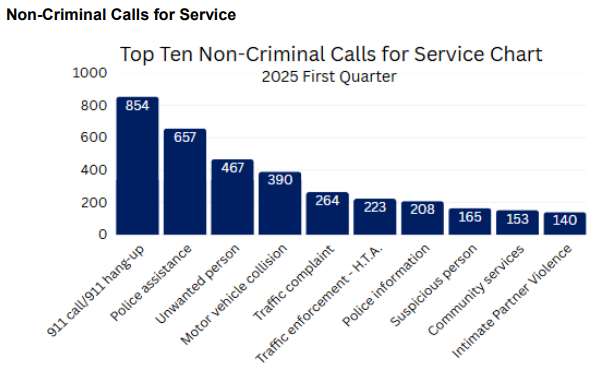
However, there does seem to be an association with the rise in non-criminal calls received:
Belleville Police report the top 10 non-criminal calls in their quarterly reports. For Q1 2025 they were as follows:
Belleville Police point to qualitative feedback based on the public’s perceptions of safety to justify budget increases
Police leadership in Belleville often point to public feedback and surveys to justify budget increases and operational changes, relying on public perception and emotional appeals about safety to secure funding.
Often cited is the survey conducted as part of developing the 2026-2029 Strategic Plan which received responses from 110 police services members and 774 external responses. The results of the survey were used to inform the Strategic Plan, but have not been made public.
The BPSB Chair has stated that the 2026 board-prepared operating budget was based on the results of these surveys:
Residents, neighbourhood associations, and businesses have repeatedly expressed a desire for more police visibility and quicker response times. To meet those expectations, the service must maintain appropriate staffing levels, modern equipment, and mandated training that aligns with provincial standards.
BPSB Chair Heather Smith
So, you spoke and we listened,
Police visibility was the number-one thing that people wanted to have addressed.
Police Chief Murray Rodd
[The public wants] more visibility of the police. They want more communication, more effective interaction and collaboration with our community partners.
Deputy Chief Sheri Meeks
During the council-requested review of the proposed 15% budget increase, the BPSB leaned heavily on the community survey:
Leaning heavily on the board’s newly released Strategic Plan, the board weighed community survey responses citing growing concerns around homelessness, addictions and mental health in a city that is still under a state of emergency requiring more police response and visibility.
To answer the call, [Board Chair Heather] Smith said the top three priorities that need funding are bolstering the police officer complement of officers, new equipment and training.
The Intelligencer
Perceptions of safety impacted by amount and type of crime-related media a person consumes
Media coverage of crime isn’t proportionate to actual crime trends, which “can warp public perception about crime rates, leading people to believe that crime is rampant even when it is on the decline.”
Ted Rutland, an associate professor at Concordia University, has documented trends in Canadian police budgets since 2020 when the Black Lives Matter and “Defund the Police” movements sparked debate and argued that police budgets should be reduced (or, in extreme cases, eliminated entirely), with the funds being redirected towards community and social services.
Rutland argues that the discussions around policing rely more on the “feeling of unsafety” – a general sense that a community is getting more dangerous – than on data, and that the feeling of unsafety is based on how much the media is talking about crime:
Research shows that the biggest impact on people’s feelings of unsafety is how much the media is talking about crime
We could make people feel tremendously safer, like in the next few months, if we just stop hyping up particular kinds of crime.
Ted Rutland, an associate professor at Concordia University
Belleville Police post body-worn camera and dashcam footage of intense incidents to social media
During the 2024 operating budget meeting, Belleville Police Chief said “instead of talking about facts and figures for my portion of the presentation today I’m going to talk to you about our budget and its human impact” and played body cam footage of an officer responding to a homicide call with his gun drawn where two armed suspects were still at large and had just run down a dimly lit l laneway.
Belleville Police regularly posts body-worn camera and dashcam footage to their social media followers, such as:
- test driving an armoured vehicle
- boxing a vehicle in, making contact and smashing its windows
- driving a cruiser into the path of an intoxicated driver
- vehicle pursuit and gunpoint takedown
- gunpoint arrests
- tasing a woman brandishing a knife, referring to it as providing a dose of “Edison Medicine“.
Belleville budget survey results show residents have mixed opinions on police funding levels
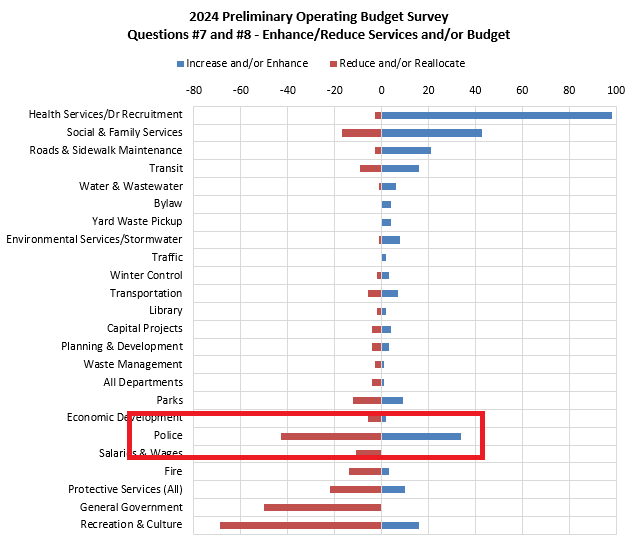
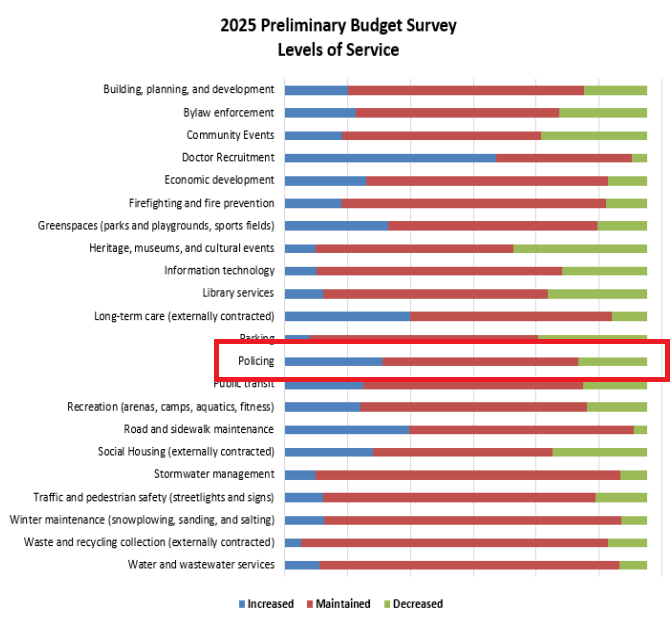
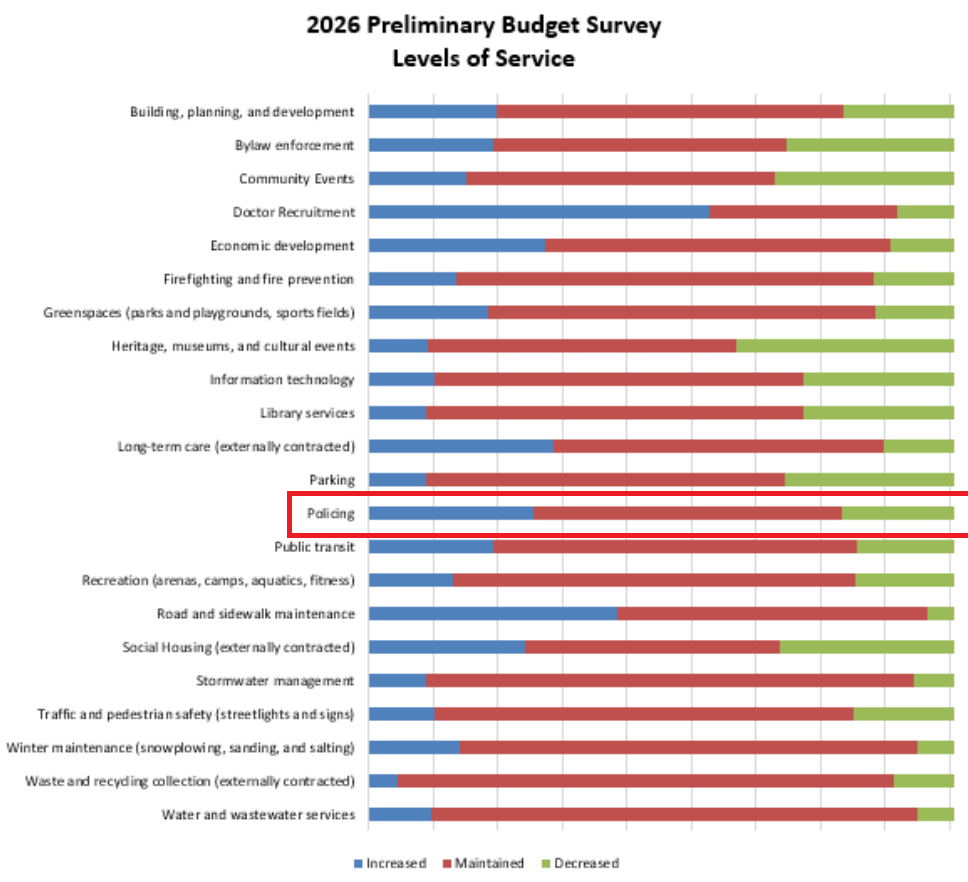
In an annual preliminary operating budget survey the City of Belleville asks residents what services should have their budgets increased or decreased. The results of these surveys have been made public.
In 2024, roughly 42% of respondents wanted police funding to be reduced, while 34% wanted it to be increased based on 707 responses:
In 2025, over 75% of respondents wanted police funding to be maintained or decreased based on 781 responses:
In 2026, roughly 70% of respondents wanted police funding to be maintained or decreased based on 705 responses:
An ounce of [crime] prevention is worth a pound of [policing] cure
Non-criminal calls accounted for 85% of Belleville Police’s calls for service in 2024 and most of the growth in calls for service since 2022. In 2020, 42% involved mental health issues in one form or another. Non-criminal calls are estimated to represent 70-80% of all calls for police services across Canada, and there have been many stories of interactions between police and people with mental health issues that ended tragically.
Research consistently shows that targeted policing (focusing on very specific problems or repeat violent offenders) is more effective than “general” policing (just adding more officers). However, the strongest reductions in crime come from non-police interventions, such as increasing the number of community non-profits, improving street lighting, and funding after-school programs.
Experts often cite US study that found that $1 invested now in crime prevention and early intervention avoids $7 spent on incarceration, victim services and other associated costs in the future. Another study found that $1 allocated for preschool programs provided $10.83 in total return to society in increased earnings and tax revenues, averted criminal justice system and victim costs, and savings for child welfare.
Police services have taken steps in improving mental health training for officers. In December 2021, Belleville’s police force launched the Integrated Mobile Police & Co-Response Team (IMPACT) as a collaboration with Addictions and Mental Health Services – Hastings, Prince Edward (AMHS-HPE). The program pairs a police officer with a mental health professional to respond to calls involving individuals in crisis due to mental health or substance use issues and uses a trauma-informed, strength-based, and person-centered approach. Peterborough and Toronto police have similar Mobile Crisis Intervention Teams.
The CSPA has also mandated annual mental health training for officers.
Creating a fourth response option to 911 calls after police, fire and paramedics: mental health professionals
As in many communities across Canada, Belleville Police are dealing with increases in mental health crises, homelessness, and substance use – issues for which they are often the default, but perhaps not the most efficient, responders.
One way that several cities responded to the calls of the 2020 Defund movement was to establish a so-called ‘fourth response’ to 911 calls, besides police, firefighters, and ambulance.
Toronto
In March 2022, Toronto launched the Toronto Community Crisis Service (TCCS) as a pilot program where calling 211 serves as a direct dispatch/intake for an alternate emergency response team staffed by mental health professionals, who have had significant success providing assistance to people experiencing mental illness, substance use, and unhoused people, without the need to involve police or tie up their expensive resources. It provides free, confidential, in-person mental health supports city-wide from mobile crisis worker teams. TCCS supports Toronto residents 16 years of age or older and is available 24 hours a day, seven days a week.
In its first year, 78% of calls that were transferred from 911 were “successfully resolved” without police involvement.
In November 2023, the program was expanded to operate city-wide.
Winnipeg
In December 2025, the City of Winnipeg is proposing the Winnipeg Community Crisis Response Service (WCCRS), a fourth emergency response service focused on mental-health crises. It would be a citywide, community-led, non-police response model designed to complement existing emergency services.
The proposed service is designed to respond to the growing number of 911 calls involving mental-health crises that often do not require police, fire, or paramedic intervention. By aligning the right response with the right call, the City aims to reduce strain on emergency services while improving outcomes for residents in crisis.
Wellbeing checks are currently the number one call for service for the Winnipeg Police Service, with more than 21,000 last year. A dedicated mental-health crisis team would allow many of those calls to be handled by trained, trauma-informed responders — freeing up police to focus on violent crime, property crime, and other public-safety priorities that require their expertise.
Guelph
In July 2018, Guelph launched the Welcoming Streets Initiative as a pilot project designed to address growing concerns from downtown business owners regarding individuals exhibiting complex behaviors (mental health crises, substance use) to test if the program could successfully divert non-emergency calls. It was initially funded by Downtown Guelph Business Association (DGBA), Guelph Police Service and Guelph Community Health Centre (Guelph CHC).
It was made a permanent program funded by the City in 2019 as a result of recommendations from the Mayor’s Task Force on Homelessness and Community Safety.
This funding was initially removed in the Mayor’s draft 2025 budget but was restored after public feedback and Council deliberation, given 1 year funding of $201,500 and ending on December 31, 2025.
Peterborough downtown businesses fund outreach program for 1 year
In 2024, a group of downtown business owners partnered with One City Peterborough and other community funders to create the Downtown Unity Project. Downtown businesses could call this new outreach team to come and assist with community members in distress, without involving the police. The project only had a one-year funding commitment and closed at the end of the year, but its time included 305 calls for support and served as a new method for community engagement and support.
I wholeheartedly support having the right people respond to those types of calls. It’s not always a police officer, and I don’t think you’ll find a police chief who would say otherwise.
Peterborough Police Chief Betts
Belleville funded a Welcoming Streets program, until they were able to move The Hub out of downtown
In June 2021, Belleville launched the Welcoming Streets Program as a 1-year pilot at the request of the Downtown District BIA and consisted of 2 full-time staff that responded to calls in Downtown Belleville.
The program received positive reviews from community organizations and was backed by a letter of support from Belleville Police Chief Mike Callaghan as the program reduces the number of times police must be called into the downtown core to resolve issues which frees up officers for other matters.
The program received the 2022 Advocacy and Policy Award from the Ontario Business Improvement Area Association, of which the Belleville Downtown District BIA is a member. The Belleville DBIA was approached by 6 different municipalities about the program, including Peterborough.
The City funded the expansion of the program in 2023 to 2 full-time staff with $140,000 from the Tax Rate Stabilization Fund. Hastings County denied a grant application to fund the program in 2023 and 2024 as it could not source government money for the program. The City funded the program again in 2024 from the Tax Rate Stabilization Fund. Belleville Police Services Board (BPSB) grant application to the Office of the Solicitor General was approved for 1-year funding through to March 31, 2025.
The Community Safety and Policing (CSP) grant funding expired on March 31, 2025. The Government of Ontario, City of Belleville, Hastings County, Belleville Police and Downtown BIA did not step in to provide the funding needed to continue the program, so it ended.
The next day, April 1, 2025, the drop-in services (“The Hub”) were scheduled to move from Bridge Street United Church to their new temporary location at 125 Church St. S.
Housing is a major factor
In Belleville, Hasting County’s 2024 Point in Time report found that 60% of unhoused people surveyed had a substance use condition, 69% had a mental health condition, and 44% experienced physical mobility challenges, all of which increase reliance on emergency services and often result in interactions with the police. 20% of respondents reporting they had spent time in jail, prison, or a correctional facility in the past year.
As one report co-authored by Seabrook notes, “Police cannot address [unhoused people’s] needs if they cannot be referred to housing support.
However, Seabrook notes, “we’ve seen a de-prioritization of these types of services in terms of funding over the past 10 to 20 years, and so that’s led to all of these crises and social challenges that we’re seeing right now.”


Comments
We want to hear from you! Share your opinions below and remember to keep it respectful. Please read our Community Guidelines before participating.