
Land banking (or land hoarding) is when land is bought and held without investing in putting it to its best use.
Vacant, undeveloped or agricultural greenfield land, often located near developed lands, is purchased with the intention of holding it for future sale or development (banked), rather than developing it and profiting from its best use.
It is a long-term investment strategy used by investors including individuals, corporations, and even governments.
How it works
The goal is to profit from the land’s anticipated increase in value, which can result from increased demand and community improvements such as:
- Population growth and expansion of urban areas creates an increased demand for housing. As cities grow, rural or peri-urban land becomes more desirable and valuable for development.
- Municipal rezoning and Bylaw updates to rezone from agricultural or rural to higher-value residential, commercial, or industrial use.
- Nearby public infrastructure investments and community improvements (eg. highways, bridges, transit, arenas, etc.) as outlined in Official Plan or Asset Management Plan.
- Policy changes such as reductions in development charges, tax incentives, or changes in provincial housing targets.
The value created by these community improvements is called land lift.
Investors may pursue this strategy to capture the value of land lift and to:
- Speculate (make a bet) on a future events (eg. construction of a new transit line)
- Corner the market
- Execute defensive maneuvers (eg. municipalities ensuring they have enough industrial land available)
- Hedge against inflation (capital preservation)
For example, Ottawa Land Bank‘s strategy is to look for undervalued or underutilized real estate properties:
- Properties just outside the current city expansion area but will be absorbed in future expansion (long-term investments)
- Properties next to existing developments in key locations around the city (short to long-term investments)
- Properties that are zoned and ready for immediate development or construction (immediate to short-term investments)
Passive land ownership has historically offered low effort, strong return on investment
While annual returns on land can vary widely with with interest rates, commodity cycles, and policy changes, before accounting for inflation, farmland in Ontario nominally appreciated at roughly 4.9 % annually from 1985 to 2009, but from 2010 to 2024 that surged to about 11.25 % per year according to Valco Consultants.
More recently, appreciation jumped during the pandemic and then slowed to a modest rate in 2024:
Average cultivated farmland values in Ontario increased by 3.1% in 2024. A reduced rate of growth in cultivated farmland values was observed in all but one of Ontario’s regions. This modest increase followed a 10.7% increase in 2023 and a 19.4% increase in 2022.
2024 FCC Farmland Values Report
Consequences of land banking
Land banking can have significant consequences, including:
- Reduced housing affordability
- Urban sprawl
- Inefficient land use
Land banking can contribute to housing shortages if large areas of developable land are privately held and not developed in response to market demand.
Municipalities can use restrictive covenants when selling publicly-owned lands to developers to prevent them from being banked.
Land is inherently fixed and scarce
Buy land, they’re not making it anymore.
Mark Twain
Capital and labor can expand through human effort; land cannot. The supply of land is inherently limited and scarce, its total quantity and location value cannot be multiplied or manufactured.
The value of land in a city rises as its population grows – with both increased labor productivity (allowing people to afford higher rents) and increased scarcity of land – without any additional investments required from the landowner. (Henry George, Progress and Poverty 1879)
The property is held until the market offers an acceptable price. The land can then sold to a developer and the owner receives a capital gain, of which 50% is taxable.
Land can also be acquired and held for protectionist and hostile strategies that limit fair competition and others’ possibilities. The risk of others doing so results in other participants having to acquire and hold them for “defensive” purposes: preventing others from printing them using the land or technology. (Kinsella 2008, p. 22)
Examples
Ottawa Land Bank
Led by John Liptak, President & CEO of OakWood, their definition is:
Land banking is an essential part of a successful real estate investment portfolio. This is the process of buying land with a long-term view of future redevelopment. Ottawa Land Bank purchases land in the pathway of development and on the cusp of city development boundaries. These land purchases provide you with three primary exit strategies for realizing a return on your investment:
- Sell appreciated land to a developer when inside the urban boundary
- Develop our own off the grid communities
- Sell to a third party for non-building related usages
Our target buy-in on these lands is realized at the most cost-effective price with consideration to location and future City development expansion. Lands further from the urban boundary are increasingly less expensive to purchase however, these lands will take longer to be accepted inside the urban boundary expansion areas. We will target the most desirable market price per buildable acre once the urban boundaries have been moved.
To learn more about examples of land opportunities we are pursuing and historical returns, schedule a confidential call.
There are three major considerations to achieve reasonable rates of return: location, product and time. Each of these needs to be factored into an investment decision, and each product added to the portfolio needs to have a specific purpose and clear understanding of how the asset can assist in reaching long-term goals.
We use our advisors to identify, assess, and recommend land bank opportunities that take into consideration location, product and time. To illustrate, here is a sample land bank parcel that we would consider:
Franktown Road outside Richmond
98 acres
Asking $5,500,000
Offer $3,920,000
Estimated future value in 10 to 20 years – $19,600,000
PT LT 3 CON 1, LOYALIST PARKWAY Prince Edward County (Bloomfield), Ontario K0K1G0
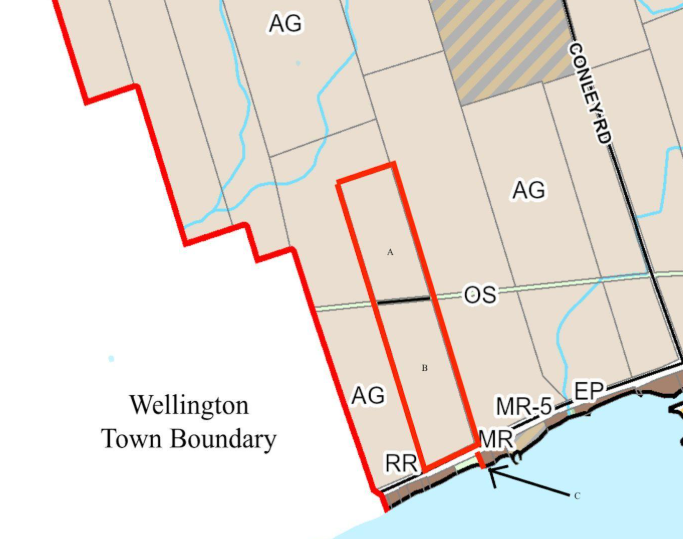
- Sale price: $1,599,000
- 45.207 acres
- Vacant land
- Property taxes $662.86
Rarely offered future land use opportunity with lots of potential – 3 parcels of land amounting to 45.207 acres within 600 feet of Wellington town boundaries! The sale includes 2 parcels of farm land currently farming soybeans and a 3rd parcel with access to Lake Ontario. Expand your farming portfolio, land bank for potential future expansion within Wellington town boundaries – this property presents lots of opportunity for the astute buyer.
Realtor.ca
Statements about investing in land
Winston Churchill on how land monopoly hurts market competition, wages and end prices
In a 1909 speech Churchill argues that landowners capture the value created by public improvements and economic development, forcing municipalities, businesses, and infrastructure projects to pay inflated land prices:
The municipality, wishing for broader streets, better houses, more healthy, decent, scientifically planned towns, is made to pay, and is made to pay in exact proportion or to a very great extent in proportion as it has exerted itself in the past to make improvements. The more it has improved the town, the more it has increased the land value, and the more it will have to pay for any land it may wish to acquire.
The manufacturer proposing to start a new industry, proposing to erect a great factory offering employment to thousands of hands, is made to pay such a price for his land that the purchase price hangs round the neck of his whole business, hampering his competitive power in every market, clogging him far more than any foreign tariff in his export competition, and the land values strike down through the profits of the manufacturer on to the wages of the workman. The railway company wishing to build a new line finds that the price of land which yesterday was only rated at agricultural value has risen to a prohibitive figure the moment it was known that the new line was projected, and either the railway is not built or, if it is, is built only on terms which largely transfer to the landowner the profits which are due to the shareholders and the advantages which should have accrued to the travelling public.
It does not matter where you look or what examples you select, you will see that every form of enterprise, every step in material progress, is only undertaken after the land monopolist has skimmed the cream off for himself, and everywhere to-day the man or the public body who wishes to put land to its highest use is forced to pay a preliminary fine in land values to the man who is putting it to an inferior use and in some cases to no use at all. All comes back to the land value, and its owner for the time bring is able to levy his toll upon all other forms of wealth and upon every form of industry.
Winston Churchill, The Menace of Land Monopoly


Comments
We want to hear from you! Share your opinions below and remember to keep it respectful. Please read our Community Guidelines before participating.