
The City of Belleville has updated its Community Improvement Plan to better support growth, investment, and housing across the community.
Dillon Consulting Limited and Sierra Planning & Management were retained as the consultants for this update budgeted at $100,000.
Program areas
The CIP has three defined program areas:
- City-Wide Community Improvement Project Area (including all Housing and Brownfield Programs)
- Brownfield Priority Area (along the waterfront/riverfront)
- Downtown Improvement Area
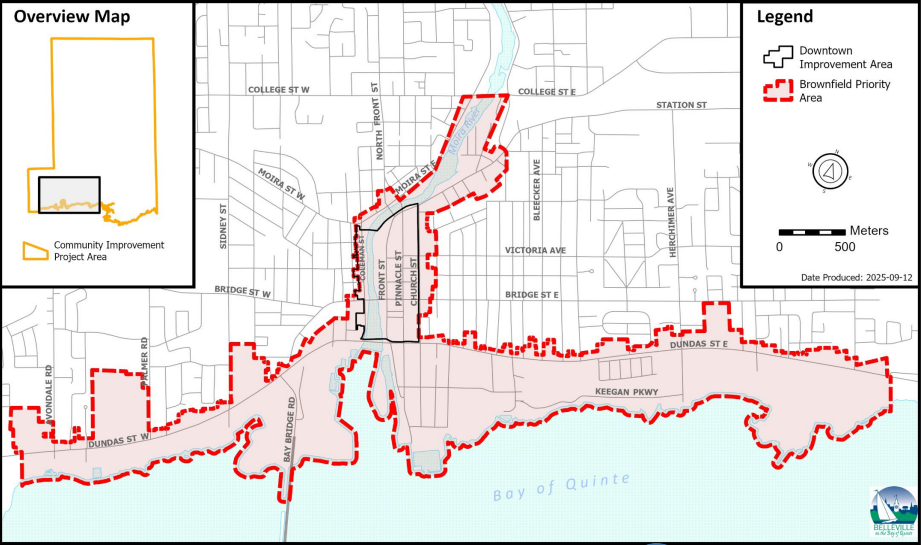
City-Wide Community Improvement Project Area (including all Housing and Brownfield Programs)
With a growing population and increasing demand for residential options, the revised plan introduces incentives that encourage new housing development and leverage support from the federal Housing Accelerator Fund.
Downtown Improvement Area
The plan also continues to strengthen Belleville’s downtown as a cultural and commercial centre. Existing programs that support façade improvements, signage upgrades, and overall building enhancements have been modernized to reinforce the area’s heritage character, improve walkability, and support a vibrant local economy. These refinements build on the downtown’s unique riverfront setting and maintain its role as an important destination.
Brownfield Priority Area
The updated CIP also addresses redevelopment opportunities on older or underutilized properties, particularly in the downtown and waterfront areas. Some sites require environmental review or cleanup before construction can proceed. The revised brownfield incentives will help reduce these barriers and encourage new housing and mixed use development in areas well suited for growth.
Goals
- Facilitate the city-wide development of housing, including affordable and missing middle housing, respectively;
- Support downtown revitalization;
- Remediate and redevelop brownfield sites for economic development and environmental benefits; and
- Improve quality of life and community health.
Creating affordable housing
In December 2024, the City received $10.5 million in Housing Accelerator Fund (HAF) funding from the Canadian federal government, to make progress towards solving the housing crisis through building more homes, faster.
The 2025 Housing Needs Assessment (HNA) – a federal government requirement under the Canada Community-Building Fund (CCBF) – examined the local housing market and demographic trends and identified a need to increase rental and high-density units to accommodate diverse housing needs. Between 2016 and 2021, average house prices rose by 82%, climbing from $252,000 to $460,000, at a significantly faster rate than the province’s 59% average increase over the same period.
Programs
As of March 3, 2026 programs 1, 12 and 14 are not currently running.
Affordable and Missing Middle Housing (Programs 1-6)
Stimulate the development of housing supply to meet the objectives of the Canada Mortgage and Housing Corporation’s (CMHC) Housing Accelerator Fund (HAF).
All housing programs will be eligible to properties located within the municipal boundary.
1. Purpose-Built Rental Housing Tax Increment Equivalent Rebate (TIER) – 100% Municipal Portion
Increase the overall supply of rental housing in the city by reducing the financial burden on new developments through a Tax Increment Equivalent
Rebate (TIER), if the property’s assessed value increased as a result of the creation of purpose-built rental housing. The program provides a baseline incentive for all eligible purpose-built rental projects and offers an enhanced rebate for projects that include affordable rental units.
- Purpose: Provides relief for developers/homeowners from municipal portion of tax increases.
- Eligibility: For new accessory dwelling units or new apartment buildings that result in the creation of affordable rental units.
- Incentive:
- Standard TIER: Market-rate purpose-built rental units are eligible for a TIER equal to 100% of the increase in the municipal portion of property taxes for a 5-year period.
- Affordable TIER: Rental units that meet the CIP’s definition of affordable are eligible for a TIER equal to 100% of the increase in the municipal portion of property taxes for a 10-year period.
- Additional Considerations:
- Affordable is defined based on the Development Charges Act and the Development Charge Bulletin which is updated yearly.
- For purpose-built rental projects with a mix of market-rate and affordable rental units, the City will calculate the TIER based on the proportion of affordable and market-rate units in the development.
2. Accessory Dwelling Units (ADU) Rebate
- Purpose: Helps property owners pay for their home by accessing rental income, while providing much-needed rental housing in the City.
- Eligibility: For property owners building a new accessory dwelling unit.
- Incentive: Up to $5,000 per each new ADU (first and second ADU), and up to $10,000 for the third ADU
- Additional Considerations: ADUs must not be used for short-term accommodations.
3. Accessibility Top-Up Rebate
- Purpose: Increase the supply of accessible rental units in the City.
- Eligibility: For any new rental unit that is designed to be barrier-free, beyond the minimum requirements of the Ontario Building Code (i.e., accessible for persons with disabilities).
- Incentive: Up to $5,000 per new accessible unit.
4. Missing Middle Per Door Grant
- Purpose: Increase the supply of missing middle housing units.
- Eligibility: All missing middle housing units that are 4-storeys or less (e.g. semi-detached, duplex, triplex, fourplex, townhomes, low-rise multi-unit buildings).
- Incentives:
- Ownership Market Rate: Up to $5,000 per unit.
- Ownership Affordable Rate: Up to $10,000 per unit.
- Rental Market Rate: Up to $20,000 per unit.
- Rental Affordable Rate: Up to $30,000 per unit.
- Additional Considerations: Funding up to a maximum amount of $600,000 per project. A project cannot be subdivided at the building permit stage to receive multiple grants for what is functionally a single development.
5. High-Density Residential Planning Fees Grant
- Purpose: To help supplement upfront development costs for high-density developments.
- Eligibility: For new development containing more than forty (40) housing units, is five (5) or more storeys tall, and is located within R3, MX1, or MX2 zones.
- Incentive: Up to 100% of eligible municipal fees, up to a maximum of 20,000 per project.
6. Municipal Lands Program
- Purpose: Offset cost of land for the development of affordable housing.
- Eligibility: For qualified non-profit housing providers, private developers with demonstrated track record in affordable housing, or partnerships between public and private sectors.
- Incentive: City-owned lands that have been declared surplus may be disposed of at a value below the fair market value or for nominal consideration through a competitive and public process (RFP or EOI).
Downtown Improvement Area (Programs 7-10)
Expand and elevate the ongoing revitalization of Belleville’s downtown core, to better establish the area as an economic and social hub.
7. Façade Improvement Rebate
- Purpose: Provides relief for property owners looking to improve the façade of buildings and financially support upgrades to heritage designated properties.
- Eligibility: For commercial, mixed-use, or institutional properties within the Downtown Improvement Area. Only buildings designated under Part IV of the Ontario Heritage Act are eligible for Rebate D.
- Incentives:
- Rebate A: Up to $3,500 for the costs of professional fees related to the design of façade improvements.
- Rebate B: Up to 50% of the cost of construction for the front or side façade improvements, to a maximum of $15,000.
- Rebate C: Up to 50% of the cost of construction for the rear façade improvements (fronting the Moira River), to a maximum of $15,000.
- Rebate D: Up to 25% of eligible costs, up to a maximum of $20,000 per eligible property for additional costs associated with renovations of designated heritage buildings.
- Additional Considerations: Façade improvements must meet the Facade Improvement Program Design an Improvement Criteria.
8. Signage Grant
- Purpose: Supports businesses that invest in their exterior signages.
- Eligibility: For business owners that rent or lease a commercial unit within the Downtown Improvement Area.
- Incentive: Up to 50% of eligible costs, up to a maximum of $4,000.
- Additional Considerations: Proposed signage must meet the signage designs standards within the Facade Improvement Program Design an Improvement Criteria.
Program 9: Built-Form Security Measures Grant
- Purpose: Assist property owners that renovate their property to introduce “safety by design” measures to reduce rates of accidents, injury, crime or nuisances.
- Eligibility: For property owners within Downtown Improvement Area.
- Incentive: Up to 50% of eligible costs, up to a maximum of $10,000.
- Additional Considerations: Ineligible costs include, but are not limited to, security cameras, alarm systems, rolldown security shutters, barbed/razor wire, and costs associated with security staff. Measures such as fencing may not reduce or restrict visibility through an outdoor space.
Program 10: Downtown Accessibility Grant
- Purpose: Increase accessibility of downtown shops, services and housing.
- Eligibility: For property owners with properties with commercial or mixed-use zoning within the Downtown Improvement Area.
- Incentive: Up to 50% of eligible costs, up to a maximum of $10,000.
- Additional Considerations: Exterior improvements must not create unnecessary negative impact on the building’s façade or on surrounding buildings and streetscapes
Brownfield Priority Area (Programs 11-14)
Stimulate the redevelopment of brownfield sites, to support infill development and address environmental limitations.
Program 11: Brownfield Environmental Site Assessment Rebate
- Purpose: Support property owners that require a Phase II Environmental Site Assessment (ESA) and the development of a Remediation Action Plan to proceed with redevelopment.
- Eligibility: For property owners redeveloping a brownfield site where a Phase I ESA was completed and concluded a Phase II ESA is required.
- Incentive: Up to $30,000 per study, or 50% of the cost of the ESA, whichever is less. Maximum eligibility for two studies per property totals $45,000.
- Additional Considerations: Based on the principle of achieving maximum leverage of non-City funds, applicants who identify other sources of financial assistance for environmental site assessments will be given preference in the allocation of funds.
Program 12: Brownfield Tax Increment Equivalent Rebate (TIER) – 50% Municipal Portion
- Purpose: Assist brownfield property owners offset cost of redevelopment.
- Eligibility: For property owners redeveloping or renovating a brownfield site that requires site remediation.
- Incentives:
- Brownfield sites in the City: Up to 50% of the municipal portion of the incremental tax increase or total remediation costs, whichever is less, for a maximum duration of 10 years or when the cumulative rebate equals the total eligible costs.
- Brownfield sites within the Brownfield Priority Area: Up to 75% of the municipal portion of the incremental tax increase or total remediation costs, whichever is less, for a maximum duration of 10 years or when the cumulative rebate equals the total eligible costs.
- Brownfield sites for rental and affordable rental housing in the City: Up to 100% of the municipal portion of the incremental tax increase or total remediation costs, whichever is less, for a maximum duration of 10 years or when the cumulative rebate equals the total eligible costs.
- Additional Considerations: There is a limit of one rebate per property, regardless of whether development is phased.
Program 13: Brownfield Building Permit Fees Reduction
- Purpose: Assist brownfield property owners in offsetting the cost of redevelopment.
- Eligibility: For property owners redeveloping or renovating a brownfield site in need of remediation.
- Incentive: Up to 50% building permit fee rebate, up to the cost of remediation, with a maximum rebate of $60,000.
- Additional Considerations: Although the building permits fees are rebated, they are not waved outright. Fees are to be paid in advance and are to be reimbursed upon successful completion and approval of an application. Fees associated with any other municipal processes, or outside agencies are not subject to the rebate.
Program 14: Brownfield Environmental Remediation Tax Cancellation Assistance
- Purpose: Assist brownfield property owners in offsetting the cost of redevelopment.
- Eligibility: There is a need for remediation, defined as a site with a Phase II ESA which indicates that site conditions do not meet standards (under the Environmental Protection Act) to permit filing of a Record of Site Condition.
- Incentive: Rebate of municipal portion of property tax increase, and provincial cancellation of education portion of property tax increase.
- Additional Considerations: The City of Belleville will not provide property tax cancellation in the absence of matching tax cancellation by the Province. Cancellation of the Provincial education portion of property tax is dependent on an application by the City and approval by the Minister of Finance.
The Brownfield CIP programs provide targeted financial support to help overcome the substantial barriers associated with redeveloping contaminated sites. Phase II Environmental Site Assessments (ESAs) are typically expensive, often high enough that most applications will reach the maximum funding amounts. Historically, the City has received only one or two such requests per year which are funded by allocations approved by Council between 2020 and 2022.
Brownfield sites are often significantly undervalued due to contamination, the financial risks associated with remediation, and the development constraints due to the contamination. Many are no longer suitable for their former industrial uses and cannot be redeveloped for residential
purposes until environmental cleanup is completed.
These properties also tend to be larger lots, which creates a substantial potential increase in assessment value once they are remediated and redeveloped for residential use.
CIP funding helps offset the high upfront costs of remediation and redevelopment, often making the difference between a brownfield site remaining underutilized and being transformed into productive, high-value development.
The projection accounts for one application granted every other year for a total of $242,000 in the HAF period and $315,000 in the post-HAF period. Similar to the housing programs, the post-HAF period would require an initial tax levy increase of $105,000, yielding a 0.2% tax levy increase by 2035. These can provide critical financial relief, particularly for housing-oriented applications that leverage HAF funding.
Housing Accelerator Fund – Top Up
Program 15: Housing Accelerator Fund (HAF) Enhancement
Through the City’s federal funding under the Housing Accelerator Fund (HAF), all allocated monies must be used by December 18, 2028, to achieve the City’s HAF housing targets. To support this objective, an Enhanced HAF Funding Program will provide additional financial incentives beyond the base funding offered through applicable housing and brownfield programs. This enhanced funding is intended to further encourage the creation of new housing units. The program will expire on December 18, 2028.
Eligibility for Enhanced HAF Funding is limited to applicants who have applied for one or more of the following programs:
- Program 2: Accessory Dwelling Unit Rebate
- Program 3: Accessibility Top-Up Rebate
- Program 4: Missing Middle Per-Door Grant
- Program 5: High Density Residential Municipal Fees Rebate
- Program 11: Brownfield ESA Rebate
- Program 13: Brownfield Building Permit Fees Rebate
City Staff will review all eligible applications and allocate HAF funds as available. Funding amounts will vary depending on the applicable program and the number of new housing units proposed. Staff anticipate the use of HAF funds will significantly contribute to the development of new housing units in the City. Access to Enhanced HAF Funding may become unavailable if all funds have been allocated. At their discretion, City Staff may approve only a portion of the requested funding should remaining HAF funds be limited.
Applicants may combine incentives from multiple programs to improve project viability, but stacking is subject to key limits – applicants cannot “double dip” by claiming the same eligible cost under more than one program.
Funding
HOW MUCH IS ALLOCATED TO EACH?
To update and fund the program $3.9 million was approved in the 2025 operating budget (#D4-7). Project award and completion contingent on Federal Housing Accelerator Fund Grant being received.
Staff note that Staff Report no. PP-2025-16 has proposed to modify the budget allocation under this operating issue item to $3,097,272.00, to “better support the City’s housing objectives”.
Housing
Housing and brownfield programs (excluding Programs 1,12, and 14), are proposed to be funded through HAF until December 18, 2028 (the HAF period), with enhanced incentives under Program 15.
$2.9 million remains available to incentivize housing during the HAF period. Funding projected to be required for housing programs makes up approximately $2.6 million of this amount and is expected to support the construction of approximately 195 units for an average cost of $13,333 per unit. This amount includes the temporary activation of Program 15 (HAF top-up), which supplements the proposed programs.
Staff estimate this investment will eventually generate $14 million in property assessment (2016 value) and $256,000 in annual taxation revenue based on 2025 tax rates.
Program 15 (HAF top-up) would offer enhanced financial incentives in addition to base program funding to further encourage housing development, and this enhanced program will automatically expire on December 18, 2028.
If all programs were implemented during the post-HAF period, the average annual tax-funded allocation would be approximately $2.7 million, totaling $19 million by 2035. This is expected to incentivize approximately 1,992 additional units and would result in an initial tax levy increase of 1.4% in 2029, rising to 2.4% by 2035.
Downtown Improvement Area
During the HAF period, downtown programs will rely on the City’s annual operating budget and CIP Reserve Fund as historically approved by Council. The City retains control over program funding, with any request exceeding $100,000 referred to Council for approval.
Staff propose to fund these programs using the existing budget and Council approved CIP Reserve Fund. If these allocations remain in place through 2035, annual payouts would be limited to $62,000, with $35,000 from taxation and $27,000 from the CIP reserve fund. This funding would allow for 21 projects during the HAF period and 49 projects in the post-HAF period for a total investment of $186,000 and $434,000, respectively.
Downtown Revitalization programs will be funded through the City’s annual Operating Budget and the CIP Reserve Fund, as historically approved by Council each year. Following the HAF period, Staff will update its projection for any additional contributions needed to fund some or all of the CIP programs for Council’s review and consideration.
Approvals
City Staff may approve funding requests at their discretion under the HAF period.
Staff clarified that the final approver shall be the Director of Engineering and Development Services except for multi-year financial commitments and those exceeding $100,000 which will be referred to Council for final approval.
The City will retain full control over the allocation of CIP funds with Council having the flexibility to activate or deactivate individual programs as needed based on uptake, performance, housing priorities, and available funding approved by Council.
Results and reporting
Staff will provide quarterly or annual performance reports to Council.
CIP monitoring will track key metrics, for example:
- Program uptake: The number of applications and approvals for each incentive
- Financials: The municipal financial contribution vs. the private investment leveraged
- HAF Targets: Progress on our housing unit goals to ensure all federal funds are used by the deadline (December 18, 2028)
Belleville has not committed to reporting funded projects.


Comments
We want to hear from you! Share your opinions below and remember to keep it respectful. Please read our Community Guidelines before participating.