
Belleville Council voted to start 12 of the 17 programs in the Community Improvement Plan, including only 1 out of the 3 programs designed to create affordable housing units, leaving out the programs that provided building permit and development charge rebates (1, 2, 7, 15, 16):
- Affordable rental units
- 1 Affordable rental units in new mid- or high-rise apartment buildings receive 100% rebate of development charges up to $9,000 per unit.
- 2 Affordable rental units in new apartment buildings or new second units receive 100% rebate of building permit fees up to $2,000 per unit.
- New rental units
- 7 New rental units above commercial ground floors Downtown receive 100% rebate of building permit fees.
- Brownfield properties
- 15 Brownfield sites undergoing redevelopment needing remediation receive rebate of 50% of the building permit fees associated with the development up to the cost of remediation not exceeding $50,000.
- 16 Brownfield sites undergoing redevelopment needing remediation receive deferral of up to 50% of the Development Charge for a period of up to 18 months without interest.
Staff identified affordable rental unit Program 3 (TIER) as the most financially impactful method for incentivizing rental projects and it was the only affordable housing program activated by Council.
During the discussion, Mayor Mitch Panciuk clarified that these rebates are paused because the City is currently reviewing and renegotiating its Development Charge Bylaw with home builders. Once the new Bylaw is finalized (expected by the end of the year), these rebate programs are expected to be activated.
April 2020 – CIP Financial Analysis Memo
To prepare for the implementation of the Community Improvement Plan (CIP), Dillon Consulting Ltd., prepared a financial analysis to help staff understand the financial impact of each proposed incentive program (Attachment #1).
The analysis provided a scenario-test that demonstrated the financial implications of operationalizing the Affordable Rental Housing and Downtown components of the CIP, assuming that all programs would be immediately active. The analysis was broken down by year to show the potential cost of the program for each year of a 10 year cycle. This included the phase-out costs associated with a Tax Increment Equivalent Rebate (TIER) program, which is assumed to last ten (10) years from the date it commences.
Using the Council target of creating 1000 new rental units (both affordable and market rate) by 2025 as part of their considerations, Dillon estimated that ideally, the CIP could directly incentivize the creation of 544 new rental units through its programs. The projected 544 new units consist of a mix of rental unit types, including mid-to-high rise purpose built rental apartments, second units in new houses, second units in existing houses, affordable units in Downtown buildings, and other residential units in Downtown buildings.
The financial model considered that different programs offered by the CIP would be accessed in order to achieve this mix and number of unit types. The model also considered that if an applicant was approved for TIER funding, a ten-year program, the commitment period by Council could extend up to nine years beyond the ten-year lifespan of the CIP. For example, if an approved project entered into an Agreement with Council, and received its first year of funding under a TIER program in the last (tenth) year of the CIP, this cost would be repeated for nine additional years after the completion of the CIP.
In the financial analysis, the key observations were as follows:
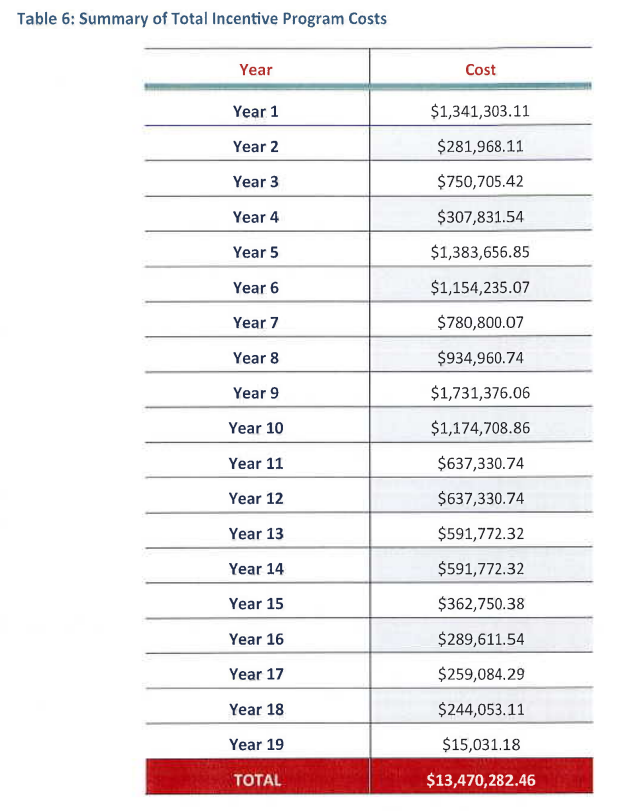
- The Year 1 cost to the City would be $1,341,303;
- The peak cost to the City would be $1,731,376 in Year 9;
- The average cost to the City over the 19-year period would be $708,962;
- The grand total cost to the City would be $13,470,282; and
- The average cost per new housing unit created (an assumed total of 544 new units) would be $24,568.53 (excluding the costs associated with non-residential unit based incentives).
March 2021 – Addendum to Financial Analysis
The April 2020 financial analysis demonstrated that the full suite of CIP programs offered the potential for a significant stimulus of affordable housing and downtown revitalization. It also suggested a potential burden of approximately $13 million dollars over twenty years. The analysis assumed that all programs would be immediately available, which would require significant financial input at the outset of the CIP’s implementation.
Based on input from senior Finance Department staff, and a review of budget allocations previously granted to programs in the former CIP, including the City’s successful façade improvement and brownfield programs, staff requested that the financial analysis be updated to include more consistent budgetary allocations.
Dillon Consulting prepared an Addendum to the April 2020 Financial Analysis Memo, hereinafter referred to as “the Addendum” (Attachment #2).
The Addendum is based on the following assumptions:
- An overall budget of approximately $13 million for the affordable rental housing and downtown CIP programs, which is intended to provide funds to cover the extent of the programs over a duration of ten years;
- The budgetary input will begin with $850K in Year 1 with an additional annual program-specific budget of $85K for the façade improvement programs held in a separate account;
- An existing annual budget of $50K for the brownfields programs is retained, which is held in a separate account that does not draw from the $13 million budget;
- All programs except the building permit and development charge rebate programs (1, 2, and 7) will be initiated in Year 1* and
- Unused funds in any given year will carry forward in reserve for use in future years.
The Year 1 CIP budget of $850K for the housing and downtown programs described in the Addendum aligns with the approved 2021 CIP budget, which includes $350K in reserve funds from 2020, and the 2021 contribution of $500K. Additionally, Council has committed 85K held in a separate account for the façade improvement programs.
The financial modelling process has highlighted two key implementation matters for the CIP which must be addressed, as they will impact how the CIP can be best utilized to achieve its community improvement goals:
- From a cash-flow standpoint, offering all seventeen CIP programs from the onset of the CIP would be financially demanding on the City. It is necessary to understand the potential financial impacts and opportunities of each CIP program.
- Some CIP programs consider complex year-over-year budget implications. In order for Staff to optimize the incentives offered, and provide financially sound recommendations to Council it is essential to have a clear direction that Council is committed to fulfilling the expected $13 million dollar investment in the affordable rental component of the CIP over a ten-year period.
Discussion
Program activation
Based on the findings of the initial financial analysis, from a cash-flow standpoint, offering all housing and downtown programs from the onset would require an investment of over $1.3 million for Year 1 of the CIP. The Addendum highlighted that the TIER programs will have a cumulative impact, and will have a significant draw on available funding.
It is the opinion of Staff that the TIER programs will be the most financially impactful method of incentivizing eligible rental housing projects, and should be the focus for the initial years of the CIP. To ensure sufficient budget is available from the onset of the CIP to award TIER funding, Staff recommend that for the initial years of the CIP, the building permit and development charge rebate programs for the housing and downtown portions of the CIP (programs 1, 2 and 7) be paused. When sufficient funds exist in the CIP reserve funds account to support these programs, they can be re-activated.
As indicated in the Addendum, the Brownfield CIP programs would continue to operate out of a separate budget of $50K. Since the budget is limited, Staff also recommend that the Brownfield building permit fee reduction and development charge deferral programs (programs 15 and 16) also be paused. The Staff Working Group will make recommendations to Council for the remaining brownfield programs, based on the available funding.
Budget Scenario
The financial analysis conducted to date projects a $13 million total expenditure for the lifespan of the CIP. This total expenditure is based on a goal of creating 544 new rental housing units. While it is understood that the financial modelling completed to date will not project the exact budget scenario for the City with respect to the CIP, it does provide a useful roadmap for the City to discuss and plan for the potential financial impacts of meeting the City’s community improvement goals.
Accordingly, Staff recommend that Council approve the recommendations of the Addendum so that the basis for a ten-year funding commitment to the CIP by Council is formally established. This commitment will help staff bring forward recommendations for TIER programs, which require multi-year financial commitments. It will also help Staff provide recommendations regarding program activation.
Should local priorities change, future Councils will still have the ability to cancel this commitment. Although cancellable, this commitment will enable staff to optimize the community improvement opportunities by making effective recommendations that are financially sustainable.
Financial/Analysis
The Addendum provides a budget scenario for the housing and downtown programs, starting with a Year 1 budgetary input of $850K, plus an additional $85K specifically for façade improvement programs. It also incorporates staff recommendations regarding maximum annual allocations for various CIP programs.
The longer term budget scenario provided in the Addendum focuses on the cash flow of programs at a high level. It is intended to help the City understand the availability of funding for the more complex programs to aid with decision-making on whether to offer them or not, and also on how many incentives can be sustainably offered annually, assuming an incremental increase in the annual budget for year of the CIP. Accordingly, the budget scenario discussion included in the Addendum, including the figures presented in Table 2, represent theoretical outcomes, based on hypothetical program uptake.
CIP program uptake may differ from the budget scenario described in the analysis. The City’s CIP Working Group, which will include a senior member of the Finance Department, will update the cash-flow analysis, and provide more specific budgetary recommendations to Council annually, during operating budget deliberation. Staff may also provide recommendations based on maximizing program benefits. For example, if the second unit programs receive strong uptake, more money from the approved budget could be re-allocated to support these programs.
Finance Committee Motion
One May 12th, 2021, the Finance Committee met and considered the financial analysis completed to date for the CIP, as well as Staff Report PP-2021-20. At this meeting, the following Motion was approved by the Committee:
That the Finance Committee recommends the following to City Council:
THAT pursuant to the Manager, Policy Planning Report, Council endorses the recommendations of the Addendum to the April 2020 Financial Analysis Memo prepared by Dillon Consulting Ltd. in principle;
AND THAT all CIP programs except the building permit and development charge rebate programs (1, 2, 7, 15 and 16) shall be initiated in Year 1 of the CIP.
Conclusion
The purpose of this analysis completed to date is to provide a road map and potential funding plan to deliver 544 new rental units and assist in understanding the availability of funding and maximize decision-making in the incentive approval process. The analysis outlined provides a guide for the program, but will vary depending on actual annual application approvals and the approved funding contributions through the operating budget process.
Since the operationalization of CIP programs requires significant and long term financial commitment, Council’s approval of the recommendations in the Addendum will provide a clear direction for staff to manage the total financial burden of the CIP over a ten-year period. The activation of all CIP programs except the building permit and development charge incentive programs (programs 1, 2, 7, 15 and 16) in Year 1 is in alignment with the recommendations of the Addendum.
Mayor Panciuk says other programs will start once Development Charge Bylaw is finalized
Councillor Thompson, who sits on the Finance Committee that recommended council not initially fund the affordable housing incentive programs that would provide development charge and building permit rebates a month earlier asked when those programs would start:
Just a quick question, the development charges [programs] and the [building permit programs] – they will not start in year one. What year will they start? Have we established what year they will start in to this program?
Councillor Garnet Thompson
Well Counselor Thompson development charges are currently under review by city council and so depending on where in the city you are – so for example, in the downtown area you already have a reduction in 50% on your development charges so that will continue, but I’m expecting that Manager McAdam will bring us that information when we finalize our Development Charge Bylaw, which we expect to do by the end of this year.
Mayor Mitch Panciuk
Yes, I know.
So probably within the next year or two we may be including those in this program, then?
Councillor Garnet Thompson
No, I think it will be sooner than that. I think as soon as we finalize our Development Charge Bylaw as you – just for people that are watching we had a significant proposed increase based on the cost the city is seeing and we’ve been having discussions with the Quinte Home Builders in terms of how we will see that increase. And we also had to get a report that was going to be completed dealing with some of those estimated future costs. When that information is all compiled and we’ve had consultations with the Quinte Home Builders the final bylaw will come back and it’ll be a five-year by-law and as soon as that information is approved by Council then we can implement that in our intended development charge relief for rental accommodations at that point.
Mayor Mitch Panciuk
The City of Belleville will be contributing more than $13 million in financial incentives to build additional rental accommodation in our city. This will result in at least 544 additional specific units on top of what we’ve approved to this point. We will do more if the intake on this is so good that we are moving forward our council or our future council will actually put more resources available to allow this to go forward, because we know it is so important.
You know there were a lot of reasons not to do anything, and there are a lot of communities in Ontario that are suffering the same type of stress in their housing market as we are in Belleville and they are not taking these steps. We have been leaders on this – yes – we shouldn’t be doing this – this is 13.1 million dollars that really we should be spending in other areas of our operations – fixing our roads, fixing our sidewalks providing more recreation for people. This is a area of provincial and federal jurisdiction, but they’re not doing it and so we have to.
Mayor Mitch Panciuk
Councillors thanked Desta McAdam, Manager of Policy Planning for her work in developing the Plan and programs.


Comments
We want to hear from you! Share your opinions below and remember to keep it respectful. Please read our Community Guidelines before participating.