
Belleville’s drinking water is filtered using technology proven to remove toxic “forever chemicals” known as PFAS, but the City doesn’t test to confirm how much remains in the water delivered to residents’ homes.
Despite known contamination risks nearby, including a former landfill and wastewater outflow near the water intake, Belleville does not monitor its treated water for PFAS, nor is it required to under Ontario regulations.
Background
Ontario does not require municipalities to do routine testing for per- and polyfluoroalkyl substances (PFAS) in its drinking water regulations as they are not listed in Ontario’s Drinking Water Standards.
Studies link PFAS exposure to cancer, liver damage, immune system disruption, and developmental issues.
Since 2012, Canada has prohibited the manufacture, use, sale, offer for sale, and import of PFOS, PFOA, long-chain PFCAs (LC-PFCAs), their precursors, and products containing them. Limited exemptions apply, such as for aqueous film-forming foam (AFFF) (firefighting foam) containing PFOS at concentrations up to 10 ppm.
On August 9, 2024 the Government of Canada introduced the Drinking Water Objective of 30 ng/L (nanograms per liter) (or 30 parts per trillion or ppt) for 25 different PFAS.
However, there are still many contaminated sites where the chemicals had been:
- manufactured
- used as fire-fighting foams to put out fires
- dumped in landfills
- released from wastewater treatment plants
Belleville’s drinking water intake is near contaminated sites
The City of Belleville obtains their drinking water through surface water intakes located in the Bay of Quinte which flow to the Gerry O’Connor Water Treatment Plant.
We have a large supply of surface water, most of which has arrived in the Bay of Quinte from the Trent River. The water flows south in the Trent River, then eastward through the Bay of Quinte to Lake Ontario. The Bay of Quinte is a relatively shallow body of water. The bay is easily turned over by daily winds, and which in turn, causes changes in raw water turbidity.
City of Belleville’s Water Treatment Operation
The Gerry O’Connor Water Treatment Plant is located at the southern end of Sidney Street at 2 Sidney Street, Belleville, Ontario. Quinte Conservation lists this area (IPZ 1) as a 9/10 vulnerability (10 being the highest) as this zone is the closest to the intake. This is the zone of highest concern because contaminants can reach the intake quickly with little or no dilution.
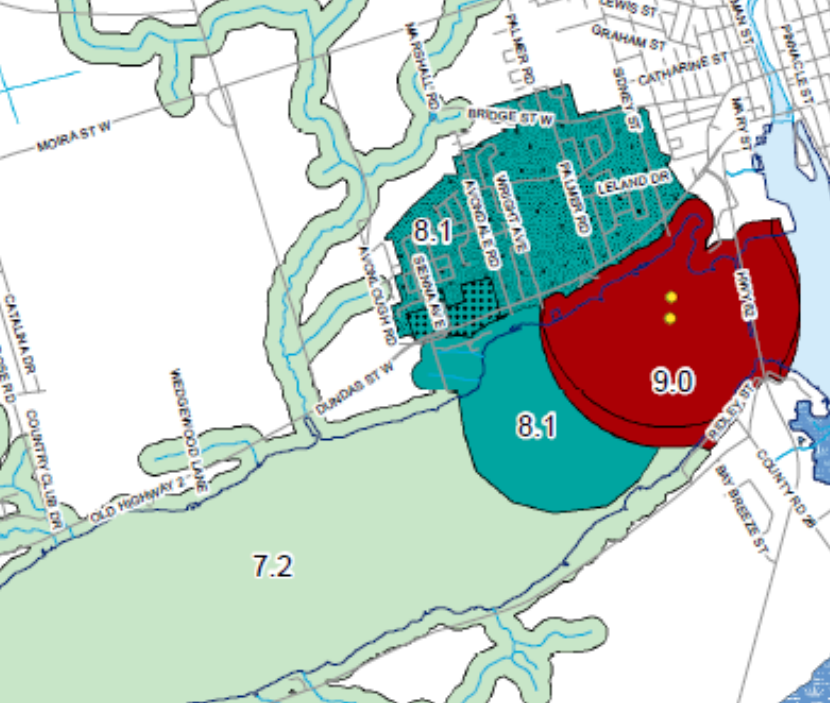
PFAS in drinking water may be higher near landfills, airports, military bases and wastewater treatment plants: Health Canada
The concentrations of PFAS in freshwater and drinking water may be higher near:
Health Canada
- facilities that use large amounts of these chemicals
- locations where fire-fighting foams containing PFAS were used to put out a fire
- landfills and wastewater treatment plants
Zwicks Island Landfill site
Belleville has 2 sites listed in Canada’s Federal Contaminated Sites Inventory:
- 09530001 11 Station Street
- 30246001 Zwick’s East Landfill / 30246002 Meyers Pier Park – Over $9M has been spent in 2008-2010 to remediate an estimated 120,000 cubic meters of contamination.
The Gerry O’Connor Water Treatment plant is located next to Zwicks Park. Historically, this location was known as the Zwicks Island Landfill which is now considered a significant condition based threat in the IPZ 1. Due to the past land use activities, contamination from this condition could affect the drinking water source.
Belleville’s Drinking Water System – Source Water Protection – Quinte Conservation
Belleville Wastewater Treatment Plant
Belleville’s Wastewater Treatment Plant located at 131 St. Paul Street, Belleville, Ontario is located just to the east of Zwick’s Park.
Quinte West
Quinte West has 38 sites listed in Canada’s Federal Contaminated Sites Inventory, including:
Canadian Forces Base Trenton
- Highly contaminated PFAS soils have been contained.
- Pilot study has been completed to assess options to mitigate PFAS groundwater migration into the Bay of Quinte.
- Surface water and groundwater sampling ongoing to document discharge into Bay of Quinte.
- Fish consumption advisories issued for PFAS in Bay of Quinte (cause of fish contamination unknown).
- National Defence has not sampled off-site wells.
In 2025, PFAS were found during environmental testing along the southern section of Meyers Creek at CFB Trenton:
Based on potential off-site PFAS migration along the southern section of Meyers Creek, DND is collaborating with the Ontario Ministry of the Environment, Conservation and Parks, South East Health Unit and the City of Quinte West to complete an off-site water use survey for homeowners in the area to better understand whether private wells are in use along the southern section of Meyers Creek
Department of National Defense
CBC’s map of PFAS Hotspots that sources data from Canada’s Federal Contaminated Sites Inventory which identifies sites under federal custodianship or that the Government of Canada has accepted some financial responsibility for, that are known or suspected to be contaminated with PFAS.
Inner Landfill Site, Canadian Forces Base Trenton – Mountain View Airport in PEC
- Contaminated groundwater, soil and surface water
- National Defence has sampled 67 neighbouring wells since 2021 and 16 of them had PFAS levels above 30 ng/L.
- Monitoring of drinking water is ongoing and remediation plans are under development.
Fish in Bay of Quinte contain PFAS
Trenton’s fish consumption advisory states that bass and white perch have been found to contain PFAS and are only safe to eat in limited amounts.
Belleville Water Treatment Plant filters water with FILTRASORB 300 Granular Activated Carbon (GAC), which has been shown to remove PFAS
GAC is a highly porous adsorbent material made from sources like bituminous coal which has been processed to maximize surface area and pore structure. It removes organic compounds from liquids and gases by a process known as “adsorption”, where organic molecules contaminants contained in a liquid are attracted and bound to the surface of the pores of the activated carbon as it passes through.
We replace the GAC in 3 filters each year (i.e. the GAC is replaced in all 12 filters over a 4-year cycle) to ensure they continue to perform optimally. Our filters are re-bedded with FILTRASORB 300, the filter best suited for our raw water characteristics, and we require the new material to have an iodine number above 900 mg/g which indicates the material’s adsorption ability. An iodine number above 900 is considered high which means the GAC has more surface area and pore volume available for adsorbing molecules, including PFAS. You can find the product spec sheet for FILTRASORB 300 here which speaks to the product’s suitability for PFAS removal.
My understanding is that GAC has been shown to effectively remove PFAS from drinking water when it is used in a flow-through-filter mode. This is how the BWTP is set up, so it follows that our treatment process is removing PFAS. To what extent, I can’t say for sure because we have not tested our GAC filtration process for PFAS removal.
Belleville Environmental Compliance representative
Municipalities install GAC to meet water cloudiness requirements (turbidity) and to remove tastes and odours:
The filters will remove particulate from the water, to ensure the filtered water turbidity is less than 1.0 ntu, as required by law [Section 6-5 of Schedule 6 in Ontario Regulation 170/03 – Drinking Water Systems]. In fact, Belleville’s filtered water turbidity is typically 0.08 ntu. The Granular Activated Carbon filters are also designed to remove tastes and odours.
City of Belleville’s Water Treatment Operation
Between 2017 and 2024, Belleville spent $1.14M or an average of $160k per year on Granular Activated Carbon (GAC) from Continental Carbon Group Inc. manufactured by CalgonCarbon for the Belleville Water Treatment Plant. The plant uses 12 GAC filters, each equipped with backwash surface agitators:
The filtration process consists of twelve (12) parallel granular activated carbon (GAC) gravity filters. These filters receive the water from the dissolved air flotation or sedimentation process. This water arrives on the top of the filter, and then settles through the GAC and sand media by gravity, and any remaining particulate is trapped in this media. The GAC also removes tastes and odours by adsorption. The water settles through the sand media, into the underdrains, and then falls to the chlorine contact chamber. The filters operate in a parallel design and can each filter 6 Mega Litres (ML) of water per day. The filters each have a surface area of 38.5 m2 and contain a layer of GAC over a layer of sand, supported by stainless steel or clay tile underdrains. The filters are monitored for effluent turbidity, head loss and flow. The filters are cleaned by backwashing every 48 hours using treated city water.
2024 Summary and Annual Reports for Belleville and Point Anne Hamlet Drinking Water Systems
GAC filters can reduce PFAS levels of dominant types (PFOA, PFOS) to below detection limits
According to a product brochure, Granular Activated Carbon (GAC) – specifically FILTRASORB® 400 made from bituminous coal – can reduce PFAS levels of dominant types (PFOA, PFOS) to below detection limits (Eurofins = 2.5 ppt MRL, Test America = 2.0 ppt MRL) – significantly below Health Canada’s Drinking Water Objective of 30 ng/L (30 ppt):
Recent Accelerated Column Tests (ACTs) of Calgon Carbon type Filtrasorb® 400 and Filtrasorb® 600 virgin GAC show successful removal of perfluorinated compounds, including Perfluorobutanoic Acid (PFBA), Perfluoropentanoic Acid (PFPA), Perfluorohexanoic Acid (PFHxA), Perfluoroheptanoic Acid (PFHtA), Perfluorooctanoic Acid (PFOA), Perfluorooctane Sulfonate (PFOS), and Perfluorodeconaoic Acid (PFDA).
CalgonCarbon
GAC [filter] is to make sure that the PFOS and PFOA are always below maximum discharge limit of 4 PPT if the outlet after filtering reads 4 PPT or up then the GAC needs to be changed inside the filters.
Continental Carbon representative
23 drinking water Systems voluntarily tested for PFAS, Belleville did not
Belleville participated in Ontario’s voluntary Drinking Water Surveillance Program from 2011 to 2020, but was not one of the 23 municipalities that voluntarily monitored PFAS.
This was a local policy choice. The province allowed municipalities to test for PFAS, Belleville simply didn’t.
Quinte West testing found PFAS to be within the recommended limit
Between 2013 and 2018, Bayside/Trenton Drinking Water System (Trenton) found 13 PFAS compounds including PFOA and PFOS to be at or below 10 ng/L.
Belleville monitors landfill leachate as required by Source Protection Plan, but not PFAS
I reached out to the City of Belleville to ask if Belleville Water tested for PFAS and received the following response from a Environmental Compliance representative:
You are correct that we participate in the province’s Drinking Water Surveillance Program but PFAS is not one of the parameters they test for in Belleville.
We also have a water quality monitoring program in place for the closed Zwicks Island landfill site to monitor for impacts to the environment as well as our drinking water. While PFAS monitoring is not part of that program, various parameters indicative of landfill leachate are sampled for and analyzed. The sampling program at Zwicks is a requirement of the Source Protection Plan – a science-driven plan developed by the regional Source Protection Committee in consultation with the Ministry of Environment and other stakeholders. Results of that program are analyzed by an engineering consultant and reported to the Source Protection Committee on an annual basis.
Belleville Environmental Compliance representative
The Quinte Region Source Protection Plan required by Ontario’s Clean Water Act was approved by the Ontario government July 7, 2023.
Testing for PFAS costs a few hundred dollars
A 14 to 40 component scan for PFAS can cost $400 to $500 plus $3 per sample plus tax and have a turnaround time of 2-4 weeks.
Belleville spends approximately $160,000 per year on GAC filters. In contrast, comprehensive PFAS testing could cost as little as $500 per sampling round – less than 0.5% of that budget.
In the absence of provincial requirements, it’s up to municipalities to ensure PFAS are being removed.


Comments
We want to hear from you! Share your opinions below and remember to keep it respectful. Please read our Community Guidelines before participating.