
A Minister’s Zoning Order (MZO) is a powerful land use control mechanism that enables the Ontario government to unilaterally decide how land is used and developed by bypassing local municipal planning and public consultation processes required under the Planning Act for land development.
Under the Planning Act, the Minister of Municipal Affairs and Housing (MMAH) has the authority to control the use of any land in the province by exercising any of the powers granted to municipal governments by sections 34 (zoning), 38 (interim control) or 39 (temporary use):
The Minister may by order,
(a) in respect of any land in Ontario, exercise any of the powers conferred upon councils by section 34, 38 or 39, but subsections 34 (11) to (34) do not apply to the exercise of such powers; and
(b) in respect of any land in Ontario, exercise the powers conferred upon councils by subsection 50 (4).
Section 47 (1) of the Planning Act
MZOs are similar to local zoning by-laws in that they can:
- permit the use of land (for example, manufacturing, housing, health care, long term care uses)
- prohibit the use of land (for example, to protect an environmentally sensitive feature)
- regulate location, use, height, size and spacing of buildings and structures
but they are issued by the provincial government, override the local zoning by-law (Section 47 (3)) and don’t have to follow the policies in the Official Plan.
The minister may also use the following enhanced authorities (subsections 47 (4.1) to (4.16)), except in the Greenbelt Area:
- remove municipal use of site plan control
- require agreements between municipalities and landowners concerning site plan matters
- require/remove inclusionary zoning (affordable housing requirements)
MZOs bypass processes
MZOs let land developments skip due diligence normally applied to rezoning applications that provide for a transparent public process, including:
- Notifying the public
- Alignment with the Official Plan
- Application for an Official Plan Amendment
- Alignment with the Provincial Planning Statement
- Consultation with the public
Public notice not required
Section 34 (10.7) of the Planning Act and Section 5 (11) of requires municipalities to notify all landowners within 120 metres of the site about the application within 15 days of it being completed to explain the changes and how to get involved to ensure informed participation.
The Minister is not required to notify the public or consult with a municipality before issuing an MZO. Section 47 (5) requires the Minister to give notice of the order within 30 days after it has been made, usually by notifying the municipal clerk and publishing it in the Ontario Gazette. This has been done by posting the MZO on the Environmental Registry of Ontario (ERO) for a 30-day comment period before the Minister signs it.
Official Plan alignment not required
Section 47 (4) of the Planning Act states that MZOs are the same as local zoning by-law passed by Council except for the purposes of section 24 of the Planning Act. Section 24 (1) requires zoning by-laws to follow the Official Plan, which establishes a municipality’s long-term vision, policies, principles for future land use.
MZOs are not required to follow a municipality’s Official Plan.
This can create challenges in processing future approvals to facilitate much of the proposed development including:
- Plan of Subdivision
- Plan of Condominium
- Site Plan Approval
- Consents
- Minor Variances
Official Plan amendment not required
Section 24 (1) of the Planning Act requires zoning by-laws to follow the Official Plan. If a zoning change contradicts the Official Plan, a developer must submit an Official Plan Amendment (OPA) application.
Section 47 (4) of the Planning Act states that Section 24 doesn’t apply to MZOs, which removes the requirement to file an OPA application, pay the fees, or wait for the municipality to update their plan.
Provincial Planning Statement (PPS) alignment not required
Section 3 (5) of the Planning Act requires planning decisions to be consistent with provincial plans and policy statements.
Section 47 (4.0.1) states that MZOs do not have to be consistent with the Provincial Planning Statement, except in the Greenbelt Area.
The Ford government passed Bill 257, Supporting Broadband and Infrastructure Expansion Act, 2021 which added Section 47(4.1) through 47(4.4) to retroactively remove the requirement for MZOs to follow the PPS, except in the Greenbelt Area. At the time, the government was facing a legal challenge regarding an MZO in Pickering (Duffins Creek). By making the law retroactive, it effectively nullified court cases arguing that past MZOs were illegal because they violated the PPS.
Public consultation not required
Section 34 (12) of the Planning Act requires Council hold at least one public meeting to give the public an opportunity to make oral or written submissions regarding the proposed by-law changes and (14.2) requires that every person who attends the public meeting be given an opportunity to make a submission, which Council is legally required to review and consider before making a decision.
Section 34 does not apply to the Minister, so MZOs do not require a public meeting and consultation.
Appeals to the Ontario Land Tribunal not accepted
Section 34 (19) states that any of the following may appeal a Council’s by-law to the Ontario Land Tribunal by filing a notice of appeal with the municipal clerk within 20 days, which must be accompanied by written reasons and the fee required by the OLT:
- Applicant
- Companies (hydro, natural gas, rail, telecom, airports, etc.) who has made a verbal presentation at a public meeting or submitted written feedback prior to the passing of a Zoning Bylaw
- Public body who has made a verbal presentation at a public meeting or submitted written feedback prior to the passing of a Zoning Bylaw
- Registered owner of the land who has made a verbal presentation at a public meeting or submitted written feedback prior to the passing of a Zoning Bylaw
- Minister
The Planning Act does not provide for a right to appeal the minister’s decision to make a zoning order to the Ontario Land Tribunal. Section 34 does not apply to the Minister, so MZOs cannot be appealed to the Ontario Land Tribunal.
Process to request a MZO
MZOs may be initiated unilaterally by the Ontario government to protect a provincial priority or overcome potential barriers or delays to major infrastructure projects like transit or provincial highways.
However, generally the Minister may consider requests submitted by parties such as developers, public agencies (like a hospital or transit authority), municipalities, organizations, businesses, or individuals who have identified a need to “fast-track” a development project.
Eligibility thresholds
The Minister considers requests for MZOs that:
- deliver on a provincial priority that is supported by a minister (for example, long-term care, hospitals, transit-oriented communities, educational facilities, housing priorities, economic development, manufacturing, etc.)
- are supported by a single-tier or lower-tier municipality (for example, through a municipal council resolution or a letter from a mayor where the municipality has been designated with strong mayor powers)
Application requirements
For the minister’s consideration of a request, the following information should be provided:
- a description of the project and how it would support governmental objectives
- a map and description of the subject lands
- a copy of a draft zoning order
- a description of consultation with the public and engagement with Indigenous communities
- for municipally-supported zoning order requests:
- evidence of municipal support for the proposed project
- information related to land ownership and name of the requestor
- rationale on why the project requires ministerial zoning relief rather than following municipal planning processes
- a description of any licences, permits, approvals, permissions or other matters that would be required for the project after a zoning order is made
- justification for the exemption of the application of provincial and local land use policies to downstream approvals, where requested
- anticipated timelines related to applying for downstream approvals (for example, site plan, plan of subdivision, building permit)
- anticipated timing for project completion
- justification for the use of any of the enhanced authorities, where requested
- information related to how and when servicing (water/wastewater) will be addressed
- a commitment that if a zoning order is made, the landowner will notify the minister 30 days in advance of the sale of any land it applies to
As best practice, proponents should consider whether there is a demonstrable need for urgency of zoning relief such as timelines relating to funding or grants, or an emergency public health and safety concern. Proponents should also assess project feasibility prior to making a request, such as anticipated timelines related to applying for downstream approvals, and progress to address water/wastewater and other servicing.
As a discretionary matter, the minister may elect to proceed with a zoning order where some, but not all, submission requirements are fulfilled to address an immediate public health or safety concern, or requests related to a provincial priority with support from a partner ministry.
Municipalities should consult with their communities: Minister
Municipal councils are expected to do due diligence before supporting a request:
The Minister of Municipal Affairs and Housing stated publicly that he expects that before a City Council requests an MZO, they do their due diligence which includes:
- consulting in their communities
- engaging with the conservation authority responsible for regulating the lands on which the zoning order is requested
- engaging with potentially affected Indigenous communities
The minister has also publicly stated that he expects that City Council requests for a zoning order include a supporting Council resolution. As Council meetings are generally open to the public, this expectation is meant to ensure public awareness of a request being made for the minister to consider making a zoning order.
Citizen’s Guide to Land Use Planning – Minister’s zoning orders
In this case Black Bear Ridge GP Inc. has contacted the City to collaborate on the content of the Minister’s Zoning Order (MZO) and to ensure the development occurs in a responsible manner. City Staff has also been advised that the Minister is requesting Council endorsement as part of Black Bear Ridge GP Inc.’s application for a Minister’s Zoning Order (MZO) for this property.
Once signed, the MZO becomes a regulation filed under the Planning Act.
Ford government accused of corruption over use of MZOs
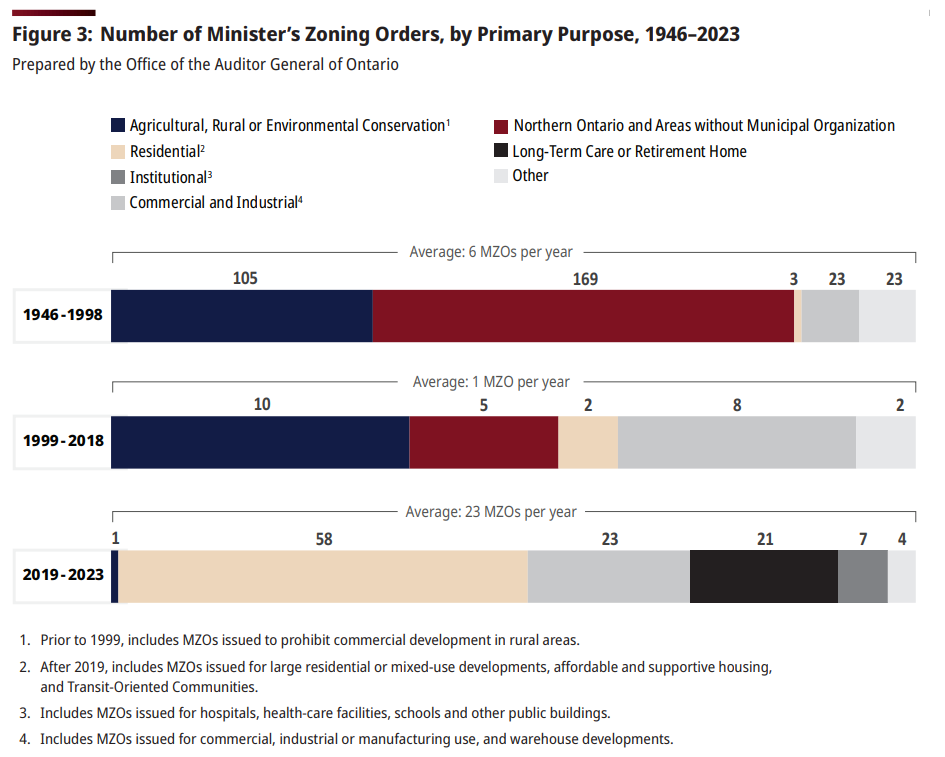
The Ford government has been accused of corruption over its use of MZOs at an unprecedented rate to fast-track developments, many favouring developers close to the PC Party of Ontario. Between 2019 to 2023 the Ford government issued 114 orders over 4 years compared to the Liberal government’s 18 orders over 15 years, a 17x increase.
In December 2020, the Ontario NDP released evidence that at least 19 of 38 MZOs issued by the government since March 2019 predominately benefited developers with links to the PC Party.
Some approvals were granted for sites where construction could not start for years or at locations where key utilities would not be present for potentially decades after the MZO approval.
The government also did not track if the MZOs would result in more affordable housing and ignored the advice of experts, municipalities, and other government ministries.
A December 2024 report by the Auditor General of Ontario found the MZO process was “unstructured” and “gave the appearance of preferential treatment”.
MZOs increase land values
Changing land zoning to a higher-value use or relaxing development requirements can significantly increase a property’s market value by making it more attractive to developers. This instant appreciation, which enriches the property owner even before any construction begins, is known as land lift.
The Auditor General found that agricultural land rezoned to residential increased in value by 46% based on an assessment by MPAC.
Municipalities can receive a share of this increase in value by applying Community Benefits Charges.
Developments still require additional approvals
Zoning orders address the zoning of a site. They do not provide approval to start construction and do not exempt them from getting other downstream approvals such as:
- Plan of subdivision approval
- Environmental approvals
- Building permits



Comments
We want to hear from you! Share your opinions below and remember to keep it respectful. Please read our Community Guidelines before participating.