
Hastings and Prince Edward Counties (HPEC) is the area that Hastings Prince Edward Public Health
(HPEPH) is responsible for, including:
- Hastings County
- Belleville
- Quinte West
- Prince Edward County
- Tyendinaga
Population growing faster than Ontario average
HPEC’s population growth of 6.4 per cent seen between the 2016 and 2021 Census, is outpacing that of Ontario’s 5.4 per cent growth. A quarter of HPEC’s population is 65 years of age or older and is projected to account for one-third of HPEC’s population in 2031. This aging population has a wide range of implications, including increased demand for health care services. This may already be apparent based on the high usage of the Ontario Seniors Dental Care Program in HPEC.
1 in 3 residents will be older than 65 by 2031
A quarter of HPEC’s population is 65 years of age or older and is projected to account
for one-third of HPEC’s population in 2031.
Social determinants of health compared to Ontario
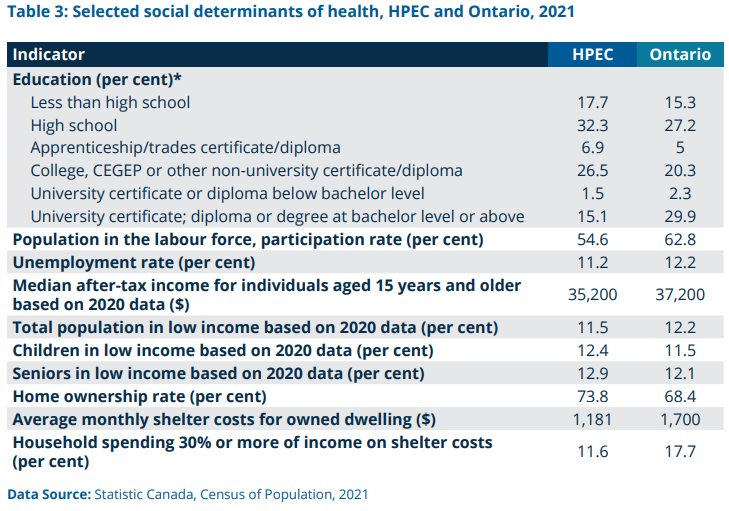
Compared to Ontario averages:
- More residents have completed a non-university level program (i.e., apprenticeship, trades, college, CEGEP, or other) rather than university level programs, which is the opposite to that of Ontario.
- Lower labour force participation rate
- Lower unemployment rate
- Higher portion of the total population, children, and seniors that live in low income
- Higher percentage are homeowners
Life expectancy (80.1) is lower than Ontario average (82.6)
The life expectancy at birth for someone living in HPEC from 2015 to 2017 is estimated at 80.1 years overall, 77.8 years for men, and 82.4 years for females. These life expectancies are less than that of Ontario by about 2.5 years overall, 2.7 years for males, and 2.2 years for females. The life expectancies for HPEC and Ontario residents have not changed significantly since 2011.
1.4-1.8x more hospitalizations for respiratory disease (COPD)
HPEC residents are experiencing higher rates of hospitalization and deaths related to chronic disease compared to the rest of Ontario.
HPEC respiratory illnesses (i.e., respiratory disease, lower respiratory disease, chronic obstructive pulmonary disease (COPD)) hospitalizations are 1.4 to 1.8 times greater than Ontario as a whole. Some of these chronic diseases could be prevented by health screening or lifestyle changes including quitting smoking, being active, and eating a healthy diet.
23% of residents experience food insecurity
HPEC residents are being adversely affected by high food costs. Approximately one-quarter of HPEC residents are food insecure and can spend up to 48 per cent of their income on healthy eating. This calculation is based on a monitoring tool called the Nutritious Food Basket, which measures the cost of basic healthy eating by calculating the cost of food choices that are recommended by Canada’s Food Guide and that reflect Canadian eating and purchasing patterns. After factoring in the cost of food and rent, this can lead to little or no money
for remaining costs.
Lyme disease is on the rise
Climate change continues to be a serious threat to health outcomes. Climate change may have led to an increased number of heat-related illnesses and could be contributing to the surging number of Lyme disease cases reported in the region from 68 cases in 2020 to
135 cases in 2021.


Comments
We want to hear from you! Share your opinions below and remember to keep it respectful. Please read our Community Guidelines before participating.