
Adequate & Effective Policing (Legal Threshold)
1. What is the minimum standard for adequate and effective policing under the CSPA? Please provide a detailed itemization of which areas the BPS is not meeting, meeting or exceeding this legal requirement.
While the legal standard is presently being upheld, we do have a concern regarding long-term sustainability. The ongoing inability to consistently reach and maintain authorized complement creates operational strain on existing personnel.
BPS asserts it currently meets the legal threshold for “adequate and effective” policing under the CSPA, citing no outstanding action items, meeting their own response time targets, and a low complaint rate (0.13% of calls for service).
Simultaneously, they cite a “concern regarding long-term sustainability” due to staffing shortages and a declared state of emergency dating back to 2024.
The Belleville Police Service (BPS) did not provide an itemized list as requested.
2: The minutes of the Police Board meeting on November 20, 2025 read, “Many of the costs are related to training and other obligations that are mandatory under the Community Safety and Policing Act that came into effect in February 2024.” Can you identify the new training and “other obligations” that are required under the CSPA and provide the direct link in the law and / or regulations as well as a breakdown of costs?
The training budget for 2026 remains unchanged from 2025, totaling $346,400, which represents 0.97% of total expenditures.
BPS pointed to the Training Regulation (Ontario Regulation 87/24) Guidance Document as per the Community Safety and Policing Act, 2019, referencing a 20-page regulation. This is not the same as identifying which specific sections are driving the local budget.
The question explicitly asked to identify the new training and “other obligations”. The response instead generalizes all training as “operationally necessary and/or legislatively required,” failing to distinguish between standard recurring training and the specific new mandates imposed by the CSPA.
The request asked for a “breakdown of costs”. BPS provided only a lump sum of $346,400. From an oversight perspective, this lack of detail makes it impossible for Council or the public to determine if these funds are being used efficiently or if specific programs are over-funded.
BPS points out that training accounts for only 0.97% of total expenditures. While this is a small fraction of the overall budget, the principle of accountability requires that even small line items be transparently justified when they are cited as primary drivers for budgetary pressure.
BPS utilizes a “total-sum approach” that obscures the specific financial impacts of the CSPA. For a municipality to effectively manage its resources, it needs to know exactly what it is paying for.
True transparency would involve a table listing each training module (e.g., De-escalation, Use of Force, CSPA Administration), the number of members being trained, and the specific cost per program. Without this, Council is essentially being asked to “trust the process” rather than verify the expenditures.
3. Please break down your calls for service by type. How many calls for service are mental health related? Out of the mental health calls, how many were impact team responded versus officer only? How many calls would be considered non-core police functions?
In 2025 there were 342 Mental Health Act call types and 216 attempt suicide call types. This is not an exhaustive list of all calls for service involving mental health.
- 2024
- IMPACT: 616
- Victim Services: 182
- HealthIM
- Calls: 351
- Individuals: 234
- 2025
- IMPACT: 695
- Victim Services: 215
- HealthIM
- Calls: 328
- Individuals: 223
100% of calls received are answered by a BPS member. 100% of calls received are considered core to our mandate, as each requires professional assessment and action by a BPS member.
Officer’s average wait time in the hospital was 1 hour and 3 minutes.
The top ten non-criminal call types in 2025 were:
- 911 Call/911 Hang-up – 3,416
- Police Assistance – 3,334
- Traffic Enforcement (Highway Traffic Act) – 2,110
- Unwanted Person – 2,051
- Traffic Stop – 1,688
- Motor Vehicle Collision – 1,524
- Traffic Complaint – 1,483
- Police Information – 1,121
- Suspicious Person – 889
- Property Check – 881
The top ten criminal call types in 2025 were:
- Theft – 796
- Bail violations – 377
- Assault – 376
- Fraud – 361
- Mischief – 285
- Shoplift – 263
- Breach of Probation – 210
- Harassment – 209
- Break and Enter (Business, Residential, Other) – 169
- Threats – 159
BPS refuses to categorize any call as “non-core” and insists that because 100% of calls require professional assessment, 100% are “core” to their mandate. By claiming that everything from “Property Checks” (881 calls) to “911 Hang-ups” (3,416 calls) is a “core” police function, BPS effectively shuts down the conversation about whether alternative, lower-cost service providers could handle these tasks.
Interestingly, the Integrated Mobile Police and Co-Response Team (IMPACT) managed 695 crisis calls by the end of October 2025. Since this number is higher than the identified “Mental Health Act” calls, it suggests that a significant portion of police work involves social crises that do not necessarily fall under specific legal statutes but still require intervention.
Non-criminal service calls dwarf criminal calls by a large margin. Belleville police are primarily operating as a general “emergency service”. If the city is to find savings, it must be able to ask which of the 3,416 “911 hang-up” calls or 881 “property checks” must be answered by an armed, sworn officer versus a civilian or alternative responder.
Staffing Levels and Growth
4. What empirical evidence demonstrates that Belleville requires additional sworn officers to remain CSPA-compliant?
BPS points to:
- Widening gap between population growth and “boots on the ground”
- Impact of burnout and stress of increased complexity of calls
- Feedback from a community survey on their Strategic Plan
Front line sworn complement:
- 2012: 47
- 2026: 52
Members are responding not only to a higher number of incidents, but also to calls that require greater time, specialized skills, interagency coordination, and enhanced documentation. Many incidents now involve multifaceted social, mental health, or risk-related components that demand careful assessment and sustained engagement.
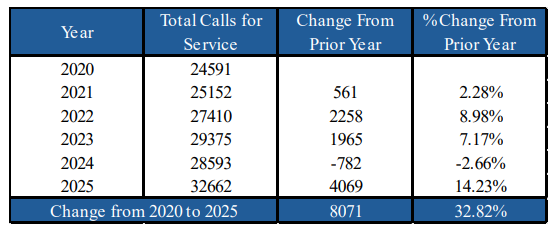
Sustained increases in call volume, greater incident complexity, staffing pressures, and ongoing community demands contribute to cumulative
stress on members. This can elevate the risk of burnout, fatigue, and impacts to both physical and mental health resulting in a negative impact on staffing retention.
Of the 1010 responses to the Strategic Plan Survey, BPS points to:
- 41.57% focused on the need for improved communication with the public
- 22.47% emphasizes the importance of officers actively engaging with the community
- 19.10% of responses emphasized the importance of foot patrols and community events
While the data provided supports the need for more capacity, it does not necessarily prove that the capacity must come from sworn officers.
5. How many sworn officers are currently assigned to non-frontline or administrative functions? What is the annual cost of those positions?
The Belleville Police Service has 32 sworn members that are currently deployed to specialty units that equates to approximately $5,957,000 (includes
salary, pension and benefits) or 20.34% of total compensation in 2026.
Overtime Control
6. What percentage of total compensation costs is overtime?
4.17% of total compensation costs is overtime.
7. What has been the total annual cost for overtime in the past 5 years?
- 2025 – $1,148,271
- 2024 – $1,299,358
- 2023 – $1,050,733
- 2022 – $1,063,118
- 2021 – $872,744
8. What is the overtime budget for 2026?
$1,222,000 (includes salaries and benefits)
9. What formal overtime reduction target has the Board approved for the coming budget year? If none, why not?
A central priority for 2026 is the continued rightsizing of the organization to ensure alignment between staffing capacity and service demand. Addressing this enables the organization to create sustainable conditions that enable and support ongoing overtime reduction and mitigation.
The introduction of Team Policing strategies in 2026 will further support these efforts. In conjunction with continued optimization of deployment models, enhanced operational scheduling flexibility, and maximized use of existing staffing resources, these initiatives are expected to improve service delivery efficiency and reduce reliance on overtime where operationally feasible.
While the BPS mentions this will improve “service delivery efficiency,” they have not provided a specific percentage or dollar-value reduction they expect this move to generate in 2026.
Budget Accountability and Tax Impact
10. What specific cost-containment instructions had the Board issued to the Chief for the 2026 budget year?
Our direction emphasized compliance with the Community Safety and Policing Act (CSPA), prioritization of core and legislated policing services, and the protection of current service levels to ensure public safety remains uncompromised.
We advised that any new spending be limited to demonstrated necessities, with all proposed additions clearly justified through operational requirements, risk assessments, and measurable outcomes.
The Board’s guidance set a budget floor: keep the status quo – no changes to the the current service level.
By setting “current service levels” as a floor, the Board effectively removes the most significant tool for cost-containment: service redesign. If you cannot change the way service is delivered because it might “compromise” the current model, you are locked into the current cost trajectory.
The Board did not provide a specific percentage target for the Chief to aim for.
The Board’s response indicates a passive oversight approach. They let the Chief self-regulate through “demonstrated necessities”.
For a community facing significant financial pressures, this style of governance raises concerns about accountability. It places the “stewardship of public funds” in the hands of the person requesting those funds, rather than the body appointed to oversee them.
What budget reduction options were explicitly considered and rejected? Please list them and the rationale for each rejection.
- Removal of Interest and Principal on Long Term Debt (LTD) – Operating budget includes principal and interest for police station in the amount of $1,179,800. Removing this not permitted and rejected following collaboration and consultation with City of Belleville finance staff. Although this would not represent a budgetary offset to the municipality, interest and principal on LTD relate to a City of Belleville-owned asset, not the day-to-day operations of BPS. Excluding these costs from the operating budget provides a clearer view of the Service’s true operational expenditures while maintaining full municipal accountability for capital financing.
- Increased Provincial Offense Revenue Sharing budget
- Removal of Parental Leave, WSIB Leave or known employee vacancy salaries, pensions and benefits from the budget
- No increase to Overtime Budget
- No additional or reduced Sworn or Civilian staffing increases
- Elimination of downtown office presence – not a recommended reduction and rejected based on the importance of relationships with community partners. The feedback received from downtown businesses in 2025 because of the new office space and from the Downtown Community Oriented Responsive Enforcement (CORE) initiative was overwhelmingly favorable and aligns with the Strategic Plan. The significance of this initiative is demonstrated through the waiving of all rental costs, as well as the coverage of construction and renovation expenses for the space.
- Defer investigative expenses for human trafficking and cryptocurrency to 2027
- Elimination of recruitment, marketing and advertising initiatives
- Removal of cyber security monitoring expense
What was the Board’s threshold for tax impact?
As previously stated, our shared mandate with the Chief was to bring forward a budget that reflects responsible stewardship of public funds. This includes a continued commitment to efficiency, recognition of the financial pressures facing the municipality, and ensuring that the Police Service remains properly resourced to meet the community’s safety needs.
The Board reaffirms that they did not provide a specific percentage target for the Chief to budget toward.
In the last 5 years, annual budgets included funds for hiring. Please outline the annual planned hiring versus actual hiring as well as corresponding expenditure amount for the past 5 years. If there were unused funds due to the lack of hiring, please advise the amount of unused funds and where those funds were reallocated to?
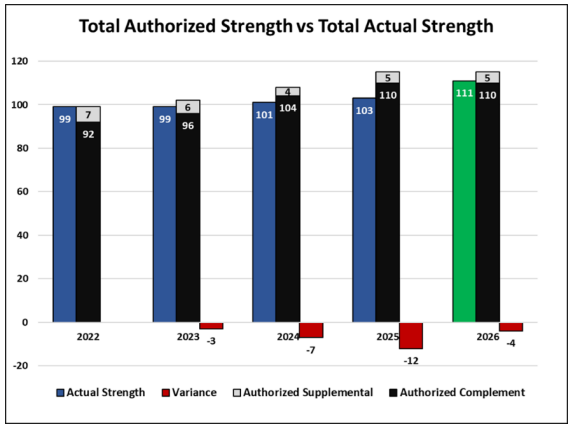
- 2022 – Authorized strength = 99; Budgeted strength = 99
- 2023 – Authorized strength = 102; Budgeted strength = 102
- 2024 – Authorized strength = 108; Budgeted strength = 108
- 2025 – Authorized strength = 115; Budgeted strength = 109; 6 deferred to 2026
- 2026 – Authorized strength = 115; Budgeted strength = 111; 4 deferred to 2027
Without breaching the CSPA, what specific changes could the Board make to reduce the budget? If the answer is “none”, please explain
how every dollar in the current police budget is legally unavoidable by providing direct links (identifying specific sections of the act and regulations).
Budget reduction changes that were explicitly considered and rejected have been provided above along with the rationale for each. Our shared mandate with the Chief was to bring forward a budget that reflects responsible stewardship of public funds. This includes a continued commitment to efficiency, recognition of the financial pressures facing the municipality, and ensuring that the Police Service remains properly resourced to meet the community’s safety needs.
The Board was asked to identify changes that could be made to reduce the budget without breaching the Community Safety and Policing Act (CSPA).
Instead of identifying new possibilities or areas of flexibility, the Board referred back to the list of 11 options they had already rejected and provided zero specific legal citations in their answer.
This circular reasoning fails to address the core of the inquiry: Is there anything else? By essentially saying “we already looked at 11 things and said no,” the Board avoids admitting whether any other discretionary spending exists within the nearly $34.7 million budget.
While “commitment to efficiency”, “shared mandate” and “responsible stewardship” sound fiscally responsible, they are not measurable. Without the data or legal links requested by Councillor Carr, these statements function as platitudes rather than a rigorous financial defense.
By stating that “all training expenditures are considered operationally necessary and/or legislatively required” , the Board is essentially labeling policy choices as legal mandates to protect the budget from cuts.
For a public agency to claim its entire budget is legally required while refusing to cite the specific laws that make it so is a significant failure in transparency.



Comments
We want to hear from you! Share your opinions below and remember to keep it respectful. Please read our Community Guidelines before participating.