
The price of Belleville Transit monthly passes will increase again on January 1, 2026.
In one year (December 31, 2024 to January 1, 2026) fares have increased:
- Adults
- Monthly pass: $70 to $90 (+28.5%)
- Single ride: $3 to $4 (+33%)
- Seniors, children under 12 and riders with disabilities
- Monthly pass: $65 to $85 (+31%)
- Single ride: $2.75 to $3.75 (+36%)
The Transit Operations Advisory Committee recommended, and council approved previous increases on:
Federal international student cap greatly reduced transit revenues
Between October 2024 and October 2025 ridership decreased by 66,651 rides to 103,487 due to the federal government’s cap on the number of international students permitted to attend post-secondary institutions including Loyalist College in Belleville.
Belleville Transit dropped one of its express buses running to the college and replace it with another one for north-south on Sidney and North Front.
Councillor Brown says US tariffs are increasing maintenance costs
Parts to repair and maintain them (buses) are all coming up out of the States. That’s the only place that they’re manufactured. So on conventional transit we’re paying 10% and on our mobility transit for vehicle parts we’re paying 25% tariffs.
Councillor Kathryn Brown
Belleville chose to increase fees instead of cutting reducing service levels, with the cost to operate transit system funded 35% by riders and 65% from general taxation (mostly property taxes)
There’s no public transit system anywhere that can exist on riders’ fares alone, they’re all subsidized. Our goal is to have the cost shared 35% by riders and 65% from general taxation. With the effects of the tariffs and ridership drop, fares were only bringing in around 25% of the system’s cost. This increase brings us to around 30% from riders, closer to our goal. We didn’t want to put more of the cost onto the tax bill
Councillor Kathryn Brown
In 2018 and 2019, pre-pandemic, Belleville Transit had a fare revenue to cost ratio of 43% and 39%, respectively. The recovery ratio fell to 16% in 2020 and 14% in 2021. As ridership recovered post-pandemic the recovery ratio reached approximately 30% in 2022 according to the Transit Master Plan (2023).
The average user fee support is generally higher in larger transit agencies, especially those with Colleges and Universities, and lower in smaller transit agencies.
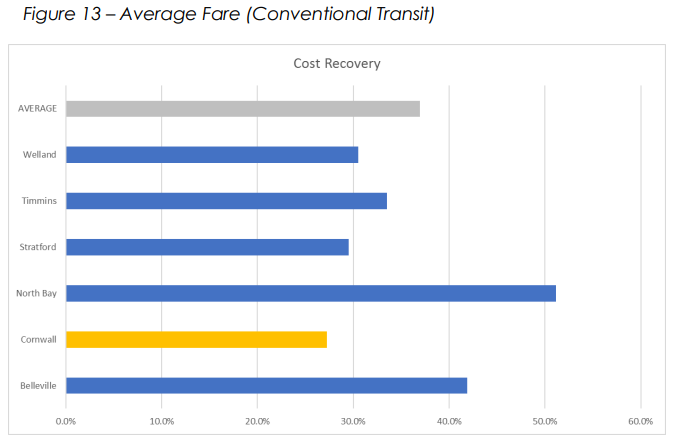
In 2017, percentage of transit operating costs paid for by riders in other municipalities were around:
- Cornwall: 27%
- Welland: 31%
- Timmins: 33%
- Stratford: 29%
See how this split compares to other services in the User Fee Study.
Ontario average was around 31% in 2022
- Toronto: 36%
- Ottawa: 19%
- Metrolinx: 28.1%
Overall, in 2022, about one-third of transit agencies’ operating expenses were funded by own-source revenues, with the remaining two-thirds supported by government subsidies. This was a significant change from 2019, when 52.4 per cent of transit agencies’ operating expenses were funded by own-source revenues and 47.5 per cent were supported by government subsidies.
In 2022, of the largest transit agencies, the TTC was near the average, with 35.9 per cent of its operating expenses funded by own-source revenues and 64.1 per cent supported by government subsidies. OC Transpo funded 19.0 per cent of its operating expenses by own-source revenues, with 81.0 per cent supported by government subsidies, while Metrolinx funded approximately 28.1 per cent of its operating expenses by own-source revenues with 67.2 per cent supported by subsidies.
Financial Accountability Office of Ontario
In 2019, the $2.5 billion in government operating subsidies was funded by the Government of Ontario (the Province) (27.6 per cent) and municipalities (72.4 per cent). In 2022, the $4.1 billion in government operating subsidies was funded by the Province (38.9 per cent), municipalities (53.6 per cent) and the federal government (7.5 per cent).
Financial Accountability Office of Ontario



Comments
We want to hear from you! Share your opinions below and remember to keep it respectful. Please read our Community Guidelines before participating.