
Municipal police budgets are often one of the largest single expense categories for municipalities and are funded primarily by property taxes.
Police budget approval process
Police budgets are approved through a joint process involving the Police Services Board (PSB) and municipal council, governed by the Community Safety and Policing Act, 2019 (CSPA).
Typically, boards vote on their budget first, then forward it to council for final approval.
- PSB identifies operational needs and approves the need for specific expenditures, including capital projects.
- Council then reviews these estimates and establishes the final funding envelope for the police service’s budget.
Police service board approves operating and capital estimates
Police Service Boards are required to submit operating and capital estimates to the municipality:
(2) A [Police Services Board] shall submit operating and capital estimates to the municipality that will show, separately, the amounts that will be required to,
(a) comply with this Act and the regulations, including the amounts required to provide the police service with required equipment and facilities, having regard for the various ways that the board can discharge this obligation; and
(b) pay the expenses of the board’s operation, other than the remuneration of board members.
(3) The format of the estimates, the period that they cover and the timetable for their submission shall be determined by the municipality
Section 50 of the CSPA
Municipalities have some control over police budgets
The municipality has the authority to approve the estimates submitted by the Police Service Board or establish a different overall budget total:
Upon reviewing the estimates, the municipality shall establish an overall budget for the municipal board for the purposes described in clauses (1)(a) and (b) and, in doing so, the municipality is not bound to adopt the estimates submitted by the municipal board;
Section 50 (4) of the Community Safety and Policing Act
Other communities have pushed back on police budgets and seen reductions. For example, Peterborough in 2025:
As part of its efforts to reduce the tax requirement for residents and businesses, Council asked Peterborough County/City Paramedics and Peterborough Police Services Board to reduce their requested increases for 2025. Peterborough Paramedics reduced its funding request to $7,299,067, which is an increase of $488,270, or 7.2%, from 2024. Peterborough Police Services Board responded with a request for $37,802,241, which is an increase of $2,727,054, or 7.8%, from 2024 – after initially requesting an 8.8% increase.
Connect Peterborough
Municipal councils cannot veto line items in police budgets
The municipality does not have the authority to approve or disapprove specific line items in the estimates:
(4) Upon reviewing the estimates, the municipality shall establish an overall budget for the municipal board for the purposes described in clauses (1) (a) and (b) and, in doing so, the municipality is not bound to adopt the estimates submitted by the municipal board. 2019, c. 1, Sched. 1, s. 50 (4).
(5) In establishing an overall budget for the municipal board, the municipality does not have the authority to approve or disapprove specific items in the estimates.
Section 50 of the CSPA
Budget disputes go to provincial binding arbitration
If both sides disagree on the total, it goes to arbitration by a third party.
If a municipal council refuses to approve the total budget requested by the Police Service Board, and the Board believes the approved amount is insufficient to provide “adequate and effective policing,” the dispute may be referred to conciliation or arbitration.
Both parties may jointly apply to the Commission Chair to appoint a conciliation officer to attempt to resolve the matter, or the board may give the municipality written notice referring the matter to arbitration.
Binding arbitration is provided by the Ontario Police Arbitration and Adjudication Commission (OPAAC) under the Community Safety and Policing Act, 2019 authorized the continued existence of the Arbitration and Adjudication Commission under section 147 and regulated by O. Reg 403/23.
Police budgets can separate wants from requirements (CSPA)
Peterborough’s Chief of Police says that providing detailed information on the costs to maintain adequate and effective policing is a best practice:
The best practice for making a budget submission in the policing sector is for the Chief of Police to provide the Police Service Board with detailed information about the cost to maintain and provide adequate and effective policing in accordance with statutory requirements. Furthermore, this best practice includes providing the Board with service and staffing level options aligned with the organization’s Strategic Plan. It is not uncommon for a request to exceed the Board’s tolerance, or that of the Municipal (City) Council. This underscores the critical importance of presenting a range of options.
Peterborough Chief of Police 2025 Budget Report to the Board
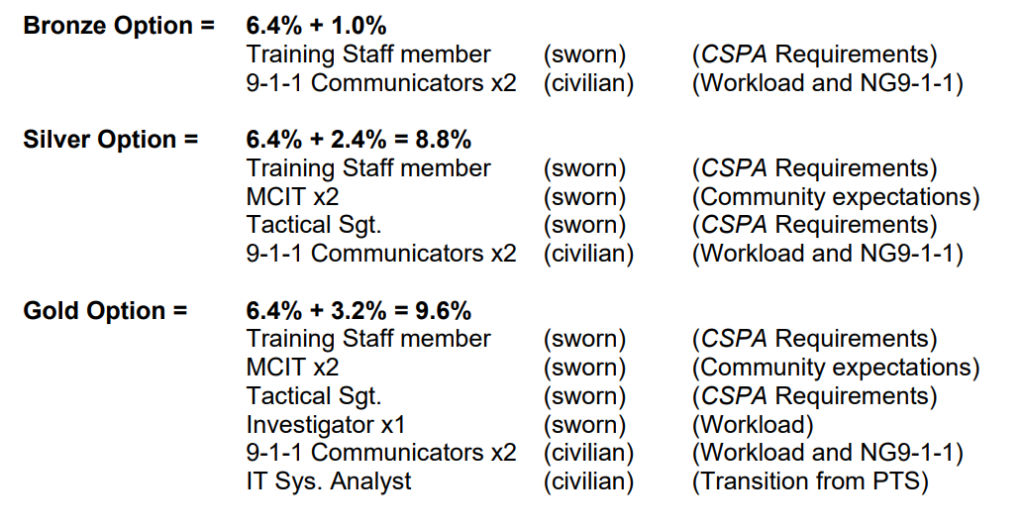
As part of this, the Peterborough Police Service Board gives Council 3 options. Bronze is the minimum required to meet the added policing requirements in the Ford government’s Community Safety and Policing Act (CSPA).
Three Budget options are being presented to the Board: Bronze, Silver and Gold.
These options account for costs related to the recently settled Collective Agreements, inflationary pressures, increased service agreement costs, and the provisions of the new Community Safety and Policing Act. Although the exact costs of the new Act were uncertain at its enactment, both the Board and City Council were notified of the anticipated high expenses.
Staffing cost increases in the Bronze, Silver and Gold options represent a 1.0%, 2.4% and 3.2% increase, respectively, on the base budget needed to maintain service delivery per the Community Safety and Policing Act.
…
Three tiers are labeled Bronze, Silver and Gold, each differentiated by the number of additional staff members required to meet service demands and enhance public safety.
It should be noted that the Chief believes the Service can maintain its required delivery standards with the Bronze level of support, though this would necessitate internal adjustments (some affecting the frontline). Anything below this level would result in a reduction of public safety services, making it challenging to meet the statutory requirements of the Community Safety and Policing Act.
Choosing the Bronze level would require redeploying personnel within the Organization, potentially discontinuing the Community F.I.R.S.T. program to maintain minimum service delivery.
At the Silver level, the community would benefit from enhanced services, including additional Mobile Crisis Intervention Teams and a reduction in frontline service impacts, ensuring compliance with the Community Safety and Policing Act.
The Gold level of support includes all the benefits of the Silver and ensures that the Board and Service remain aligned with the goals outlined in the 2024 – 2027 Strategic Plan. This level relies heavily on annual investments in key equipment and personnel.
Peterborough Chief of Police 2025 Budget Report to the Board
Ontario has the highest policing costs in Canada
Ontarians pay the highest policing costs in the country. Per capital [sic] spending on police by regions has Ontario spending $362 dollars per person which is $34 dollars above the national average. If Ontario paid the national average, it could save nearly $500 million per year.
To understand how this came to be, the average annual growth of police spending between 2002 and 2011 was 6.3%. This compares to the inflation rate over the same period of 2.1%. In other words, police spending had been growing at three times the rate of inflation. More
Association of Municipalities Ontario (2023)
recently, an analysis of net operating budgets has revealed that many large Ontario municipalities are paying roughly 15-20% of their net spend on policing services.
Salaries account for the vast majority of police service budgets
Salaries, wages, benefits and pensions account for the vast majority of police expenditures.
In Canada, most of the money in police budgets ends up in officers’ paycheques. Salaries, wages, benefits and pensions accounted for 77 per cent of overall Ontario police expenditures in 2018, a rate that has stayed more or less unchanged since 2009, according to The Globe’s analysis. Even then, some cities spend far more than others. In Hamilton and Thunder Bay, 90 per cent of police funds went to salaries in 2018.
The Globe and Mail
Collective agreements between Police Service Boards and Associations determine salary increases
For most municipal police officers in Ontario salaries and benefits are determined through collective bargaining by negotiation between the Police Service Board (the employer) and the Police Association (representing the employees) they are members of as per Section 223 of the CSPA. The Police Association functions as their exclusive bargaining agent to negotiate a Collective Agreements regarding:
- Salary grids (based on rank and years of service)
- Benefits (health, dental, pension contributions)
- Working conditions (shift schedules, overtime rates)
Agreements are often split into uniform (sworn) members and a separate agreement for civilian members.
Police are considered an essential service and do not have the right to strike or withhold services (Section 196 of the CSPA). Collective agreement negotiation disputes must go to mandatory interest arbitration to ensure continuous service.
Boards and Associations are required the CSPA to file their Collective Agreements with the Ontario Police Arbitration and Adjudication Commission. Many Collective Agreements in Ontario can be found in the Ministry of Labour’s e-Library Portal, but filing there is optional for police services.
Ontario Provincial Police (OPP)
The Ontario Provincial Police Collective Bargaining Act, 2006 governs how the OPP can negotiate with the province for a collective agreement.
The OPP has 5,800 uniformed officers, 2,600 civilian employees and 600 Auxiliary officers.
The OPP Association (OPPA) represents members’ interests in negotiations with the employer (the Ontario government) and has over 6,200 uniform and approximately 3,600 civilian members.
On March 26, 2024 Ontario Provincial Police Association (OPPA) employees overwhelmingly ratified a five-year collective agreement negotiated by their union, Healthcare and Service Workers Union, Christian Labour Association of Canada (CLAC) Local 304.
Ontario Provincial Police (OPP) serves 16.3% of the population and 74% of municipalities
The OPP is a division of the Ministry of the Solicitor General, the largest operational ministry in the province with a presence in every community across Ontario. They are the largest police service in Ontario and the second largest in Canada.
In 2020, the OPP provided municipal policing services to 327, or 74%, of Ontario’s municipalities, and is responsible for patrolling over 1 million square kilometres across the province, from remote northern and First Nation communities to rural and urban centres.
The OPP’s operating expenditures totalled more than $1.2 billion in the 2020/21 fiscal year, an increase of 26% since our last audit in
2011/12. Salaries and benefits costs represented 88% of these expenditures.The OPP’s efforts to monitor and measure the quality and effectiveness of the police services it provides is limited. In addition, the OPP does not use performance indicators with targets to measure its effectiveness.
Value-for-Money Audit: Ontario Provincial Police – Auditor General of Ontario (2021)

Suspended police officers in Ontario earned $134M between 2013-2024
CBC News investigation (2024)
- Less than 2% of the approximately 25,140 officers currently on duty in 61 communities.
- Nearly half of all officers suspended and convicted of a crime returned to work. Just under one in 10 were fired.
- Police officers in Ontario must comply with the Code of Conduct in the Community Safety and Policing Act.




Comments
We want to hear from you! Share your opinions below and remember to keep it respectful. Please read our Community Guidelines before participating.