
CAMSafe is a voluntary web-based security camera registry and centralized, borderless database of closed-circuit (CCTV), security video cameras and doorbell camera locations across Ontario that thousands of residents, businesses, schools and municipalities have added their own security cameras to.
CAMSafe is a not-for-profit program started by Sgt. Jeremy Ashley, a Forensic Identification Officer with the Belleville Police Service who took inspiration from similar projects in Red Deer Alberta (reddeercapture.ca) and Philadelphia (safecam.phillypolice.com). It is owned and operated by Belleville Police Services.
It launched in June 2021 in created with primary sponsor Alarm Systems (260 Adam Street Belleville, ON K8N 5S4), a local family owned and operated Security Integration company and local web designers Floating Point.
Self-described as “Neighbourhood Watch 2.0”, police say registries are meant to provide a starting point for officers to quickly and easily find video footage of an incident from community members that may be able to assist with an investigation, leading to quicker response times and investigations.
Police services across the province can use a map-based lookup tool on their phone, in their vehicle, or in their work station to search if there are any cameras near an incident and use the contact information in the registry to request video from the owner.
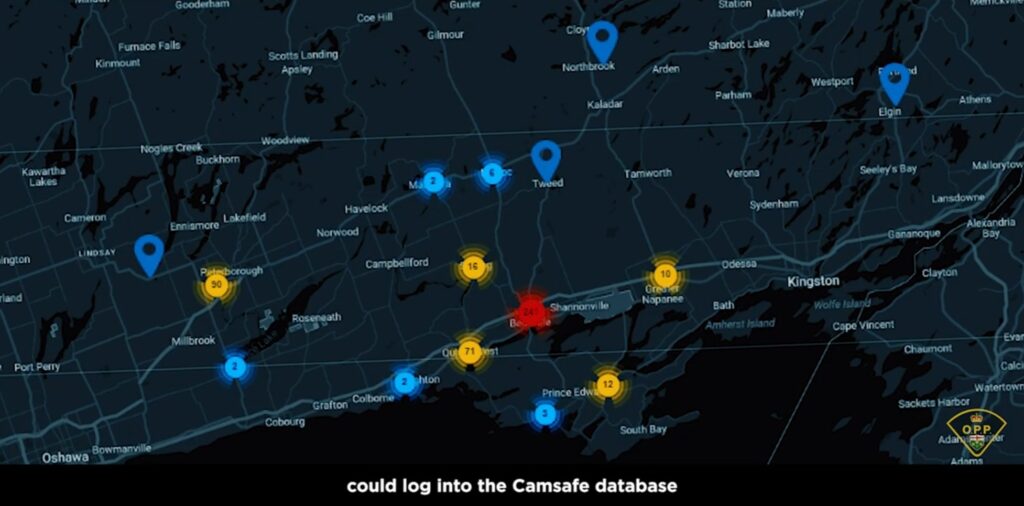
CAMSafe does not charge police services to use the database, but there is a a $500 administrative fee to join the program.
CAMSafe timeline
- In 2020, Alarm Systems partnered with Belleville Police Service and a local web designer to develop a separate, innovative website to house the initiative.
- July 16, 2021 – Belleville Police Services Board sent a letter to Belleville Council requesting that they add City operated security cameras to the Belleville Police Service CAMSafe program.
- September 13, 2021 – Council received the letter and referred it to staff.
- May 18, 2022 – Pembroke Police Services Board discussed possible partnership with local insurance companies to see if residents who register their cameras could receive a discount from the company.
- 2022 – Program’s expansion outside of the Belleville area picked up speed as word spread about the impact it was having on community safety and security.
- June 26, 2025 – Insp. Jeremy Ashley receives award from the Ontario Association of Chiefs of Police.
What police services in Ontario are using CAMSafe?
- Peterborough Police Service
- Lakefield
- Cavan-Monaghan
- Kawartha Lakes Police Service (November 9, 2023)
- Pembroke, Petawawa (April 27, 2022)
- Quinte West OPP (December 9, 2021)
- Prince Edward County OPP (January 18, 2022)
- OPP formally rolls out CAMSafe to all detachments across the province (2023)
- Hanover (October 19, 2023)
- Woodstock (November 10, 2023)
- Brockville Police Service (January 26, 2024)
- Collingwood/Blue Mountains OPP (April 2024)
- Cornwall Police Service (May 15, 2024)
- Greater Sudbury (October 9, 2024)
- Barrie Police Service (December 22, 2024)
- Ottawa Police Service (March 17, 2025)
- Kawartha Lakes (March 26, 2025)
- London Police Service (May 9, 2025)
- Waterloo Regional Police Service (May 15, 2025)
- Owen Sound (May 21, 2025)
- Selwyn Township (May 26, 2025)
- South Simcoe Police (October 1, 2025)
- North Bay Police (October 7, 2025)
- Kingston Police Service (November 4, 2025)
- Durham Police Service (November 5, 2025)
How many cameras are in the registry?
5,640 public users have 10,293 cameras registered across the province, located at 6,172 addresses including residents, businesses, schools, and municipal facilities.
- Belleville is the leading participant with more than 400 cameras registered, 237 of those in its downtown core.
- Kingston has 50-60
Where are the cameras in the CAMSafe directory located?
A Freedom of Information request has been filed to answer this question and this section will be updated with the response received.
Other security camera registries in Ontario
Guelph Police asks residents and business to give them access to their live camera feed and implement AI
Connect Guelph is the Guelph Police Service’s own security camera registry.
We are building an interactive map of security cameras in Guelph that will:
- Be accessible only to the Guelph Police Service
- Increase the efficiency of direct video evidence collection
- Provide immediate contact information to investigators for camera owners
- Enable communities to work together to create a safer Guelph
Unlike other camera registries, they invite residents and businesses to give them live access to their cameras:
Integrating your camera system takes community security one step further, helping you get more out of your security camera investment.
Camera sharing allows the Guelph Police Service access to your camera feed in case of an emergency near your location. All your cameras or some of them. You set your preferences. Sharing your feed can improve response time and help keep you safer by providing advanced details of the situation.
To share your cameras, all you need is a small Axon FususCORE device that plugs into your camera system. Once it’s set up, it enables camera sharing based on your settings without impacting your network.
Will the Guelph Police Service have a real-time streaming option?
Yes. In partnership with Axon Fusus, a real-time option is available through the Axon FususCORE device with conditional access. Camera owners have the ability to choose how and when their cameras are accessible to the police department. For example, private businesses and schools may choose to only have their cameras accessible to Guelph Police Service officers when an emergency situation arises and they activate the live streaming capability via a panic button. Private residents and neighborhoods can also have the option to do so or completely opt out.
Does Axon Fusus utilize artificial intelligence?
Axon Fusus utilizes artificial intelligence to rapidly search video provided to the system by users in order to mitigate criminal activity. All AI use cases exclude facial recognition, but may be utilized to automatically recognize weapons, vehicles of interest, etc.
How does a security camera registry work?
When the police receive a call about an incident, the investigating officer use an app to see if there are any registered security cameras nearby. They can then request the footage using the contact information provided by the registrant.
Each registered camera has a profile including:
- location
- contact information
and optional details provided like:
- direction it faces
- what it can see
- footage retention details
- screenshots of the camera view
Registrants can view their information and delete or change their information at any time.
According to the police, registries are helpful with:
- break and enters
- theft
- kidnappings
- homicides
- robberies
- assaults
There is no cost to the municipalities or police services who use CAMSafe.
Signing up with CAMSafe does not give police direct access to your video
The police can only see the camera location, contact and other information you provide. If a crime happens nearby, police can reach out to you directly and request your footage.
Police can get a warrant to make you provide the footage
Participating in a camera registry removes the police’s biggest hurdle: knowing the camera exists.
According to the Canadian Civil Liberties Association (CCLA) the police can produce a warrant to compel you to provide the footage from your camera.
If a crime occurs and the police see on the registry that you have a camera, they will first ask you to share the footage voluntarily. If you say “no,” and they have probable cause to believe your camera captured evidence of a crime, they can go to a judge and obtain a warrant to seize the footage (or the device itself).
A spokesperson for the Toronto Police Service told CTV News Toronto if a home or business has a video doorbell or security camera, police may request for its footage for their investigation, but the property owner does not have to provide it.
Police can get a corporate warrant to get the footage from the company
This is where the practice is most active. If you own a cloud-based camera (Ring, Nest, Eufy, Arlo) and refuse to share footage, police can bypass you entirely and request it through the company without your consent. They can serve a warrant directly to the tech company (Amazon, Google, etc.) to demand the footage. In this way, security camera registries can act as a sort of directory of potential sources of data to produce a warrant for.
Terms and conditions vary by company:
- Ring (Amazon) – Does not disclose customer information in response to government demands unless required to do so to comply with a legally valid and binding order. They publish Law Enforcement Information Request reports on their website.
- Nest (Google) – May provide information to government agencies without a warrant if they reasonably believe that we can prevent someone from dying or from suffering serious physical harm, we may provide information to a government agency – for example, in the case of bomb threats, school shootings, kidnappings, suicide prevention and missing persons cases. We still consider these requests in light of applicable laws and our policies.
- Eufy – Disclose Personal Data to any relevant party, regulatory body, governmental authority, law enforcement agency or court, to the extent necessary for the establishment, exercise or defence of legal claims or any relevant party, regulatory body, governmental authority, law enforcement agency or court, for the purposes of prevention, investigation, detection or prosecution of criminal offences or the execution of criminal penalties;
- Arlo – Provide Arlo customer Information, including videos, to law enforcement only if legally required to do so. If we have been required to provide your Arlo videos in response to a legally-enforceable search warrant or court order then law enforcement may view the videos and Information.
Without a registry, police have to walk the neighborhood (canvassing), knocking on doors to look for cameras.
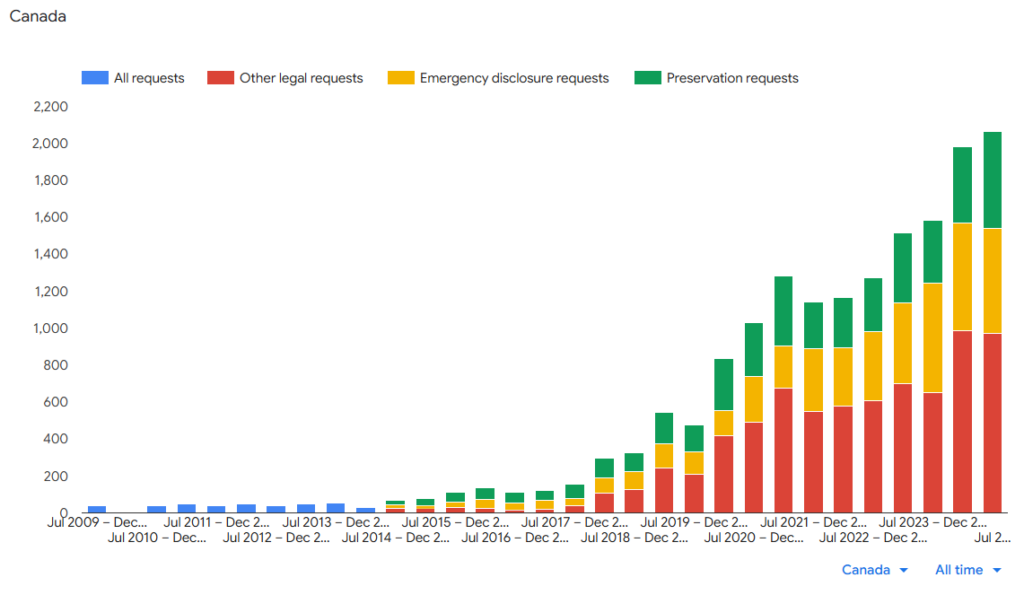
Google receives increasing requests from Canadian government agencies
Google’s Transparency Report shows the rise in requests from Canadian government agencies for user information for civil, administrative, criminal, and national security purposes and reports that data is provided for around 80% of the requests:
Feedback
Proponents
Mayor Mitch Panciuk praised the initiative, saying it will not only help to apprehend criminals and rescue people much sooner from the beginning of a call, but it also can help the city successfully prosecute individuals using the evidence.
Sometimes eyewitnesses are great because they’ve seen (an incident), but sometimes eyewitness recollection isn’t always so accurate,
To be able to back it up with this type of footage is going to be great.
Mayor Mitch Panciuk
Others
There have been police partnerships with surveillance system networks emerging over the past several years, particularly in the United States
It is a little bit newer in Canada, but it has been happening for some time.
We don’t really have firm proof or evidence that would support whether this is useful or not useful
There have certainly been examples in the United States that call into question its utility, including to law enforcement.
So there are certainly concerns around the idea of people, homeowners [and] business owners acting as almost like agents of the state by performing the surveillance on behalf of police, which can raise tensions in ways that I would think [are] different than what we’ve seen ….than when someone just has a camera on their front porch for their own sort of internal purposes
People should, at minimum, approach these kinds of partnerships with a lot of caution. But I personally would not opt into something like this myself.
Kristen Thomasen, associate professor at the University of Windsor Faculty of Law
I think you have to be very careful. We do not want to become a surveillance society.
If you enjoy living in a free and open society, then you value privacy. We need to protect it.
former Ontario privacy commissioner Ann Cavoukian



Comments
We want to hear from you! Share your opinions below and remember to keep it respectful. Please read our Community Guidelines before participating.