
The following entry in the Jane Forrester Park timeline documents correspondence, personal accounts, and formal objections submitted directly to Belleville City Council by a local resident between August 2025 and April 2026. Speaking on the condition of anonymity – citing their physical proximity to the developer and a relationship that has since broken down – the resident shared the detailed sequence of events they alleged led up to the land transfer decision.
The assertions regarding the developer’s underlying intent and the characterization of the process represent the sole opinions and perspective of the resident and do not reflect the opinions or editorial position of Open Council.
Residents who live in the neighbourhood near the Jane Forrester Green Space claim to have noticed survey stakes and boreholes on the Green Space in August 2025. They then asked the applicant and prospective transferree – a local developer who also lives in the neighbourhood – about it.
Residents allege developer’s intention is to scrape the soil off the Green Space to place it onto 41 South John
Council will also recall that the proponent’s original intent for gaining ownership of the land was to remove surface soil from this open space onto his adjacent property at 41 South John. Theoretically this would raise his property above the floodplain restricted area as defined by Quinte Conservation. Even if this increase in elevation was permitted the proponent’s property will still lie within the required 15M setback from a floodplain. This would restrict a building permit to the existing footprint and the square footage of the existing building.
If these hurdles with Quinte Conservation and Ministry of Environment were overcome the proponents stated intention is to build a home(s) on the property that is larger than currently permitted by the floodplain restrictions.
This has always been the clear and driving motivation for this proposal. The concept of a “private park” was added to sweeten the pot and distract from the primary goal of development for profit.
Realtor Doug Peterson to Quinte News
It is well known that the Transferee’s intention is to scrape the top portion of soil from Jane Forrester Park and push it onto his own property at 41 South John in order to raise the grade of his property above the floodplain demarcation. He has described this plan to his neighbours, the City and Quinte Conservation Authority.
QCA has declined this proposal at least once.
He has been open about his intention to raise the grade of 41 South John St. to avoid City and Quinte Conservation floodplain restrictions. He stated his intention is to build two homes on this property. Without any change redevelopment of the property would be restricted to the footprint of the current structure.
Resident
Representative for Rentx Group says allegations are false
Over the past several weeks, there has been significant public speculation suggesting that this transaction involved “backroom deals,” preferential treatment, or improper conduct by city staff or council. We want to be very clear: those allegations are entirely false and unsupported by any evidence.
Josh Supryka of Rentx Group
Applicable regulations
One of the methods of managing contaminated soil is to bury it under a 1.5m “cap” of clean soil and limit what can be built there, which has reportedly been done to the Jane Forrester Green Space. This extra soil would explain why a portion of the property sits above the 100 year floodplain:
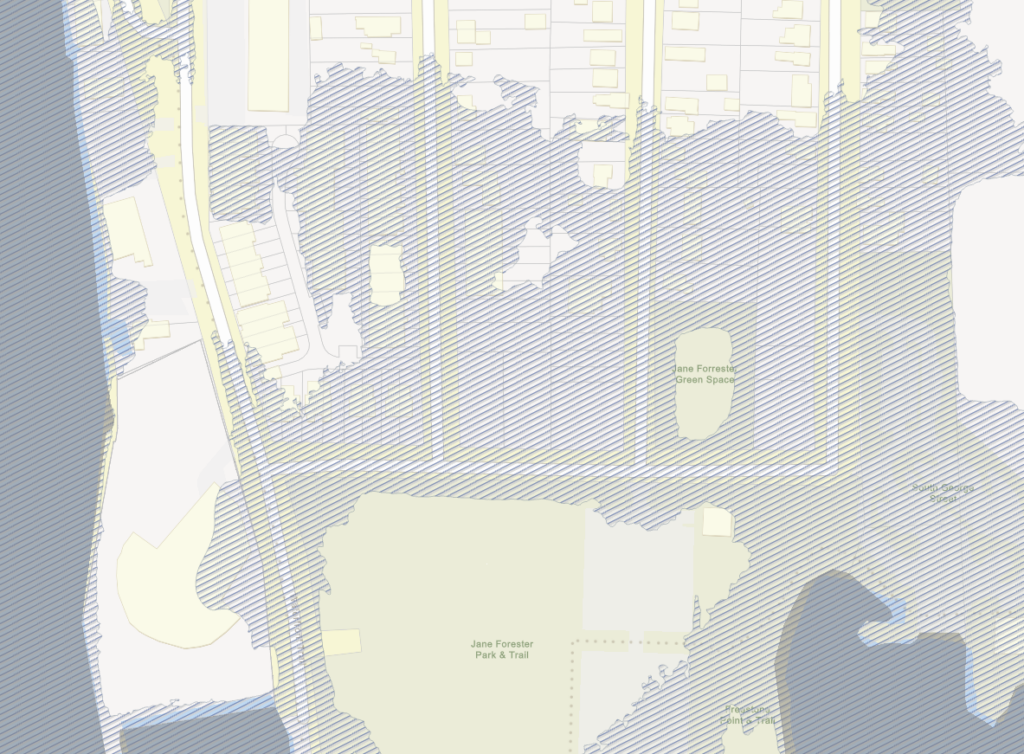
Quinte Conservation regulations limit building in floodplain to existing building’s footprint
Quinte Conservation Authority regulates development activities in the floodplain including the temporary or permanent placement of fill, grading, removal of fill, or site alteration as per Section 1 of O. Reg. 41/24 and requires an approved permit application before any development.
Their regulations state building on floodplain property is allowed only if there is an existing structure and:
the building or structure does not exceed the original footprint, is of the same use, same square footage and same number of storeys;
5.5.1.2
Quinte Conservation regulations require soil added to a floodplain property be balanced by an equal amount of soil removed from the same floodplain area
If soil is to be added (fill) to a floodplain, it must usually be balanced by an equal amount of soil removed (cut) from the same floodplain area in order to prevent displacement of water storage capacity. If you bring soil in without taking some out, water levels rise elsewhere.
Balanced Cut and Fill: The removal and replacement of suitable fill material at equal elevations to maintain the flood storage capacity of a property. Material must be removed and replaced either adjacent to or at opposite location of one another so as to achieve equality of stage-discharge within an approved watercourse reach. This must be illustrated on engineered plans.
Appendix A of Quinte Conservation Watershed Regulation O.Reg. 41/24 Policy Manual
In certain situations a flood plain storage compensation (balanced cut and fill as per the definition in Appendix A) study using accepted scientific and engineering principles may be completed by a qualified professional to adjust the regulatory flood plain boundary for development activity proposals. These studies are to be done at the applicant’s expense and must be completed to the satisfaction of QC staff. As a condition of approval, the applicant may be required to demonstrate that:
a) the purpose of the cut and fill is not to create a building envelope on vacant land located in the hazard;
Section 5.5.3.6
While the ideal source of soil is from the same site, fill material “originating on the site or elsewhere” is allowed as long as clean soil is used (proof of origin required) and the provided the net change to the flood plain’s volume remains exactly zero. A project requiring imported soil follows a sequence:
- Cut (excavation): Dig out a specific volume of native soil from an approved area of the flood plain at the same elevation band as your proposed build site.
- Export (trucking out): Take that excavated native soil and completely remove it from the flood hazard area (trucking it off-site entirely).
- Fill (importing): Truck in an equal volume of clean, “inert fill material” from outside the flood zone and place it where you need it (e.g., building up a safe driveway access).
Record of Site Condition (RSC) is required to change a property’s use
A Record of Site Condition (RSC) is required before changing property use from a commercial or industrial use to a more sensitive use like residential. It shows that a qualified person has assessed the property and shown that it meets the applicable soil, ground water and sediment standards for the proposed property use.
An RSC requires a Phase I ESA ($2,000 to $5,000) be conducted “to determine the likelihood that one or more contaminants have affected all or part of the property”. A Phase II ESA may also be required, which includes sampling and analysis of the property (i.e. of the soil, ground water or sediment) to determine the location and concentration of one or more contaminants in the natural environment.
To be used for a Record of Site Condition (RSC), a soil study must be done by a Qualified Person (QP) as defined under Ontario Regulation 153/04.
These activities and the filing of a RSC demonstrate that a property previously found to have contamination, or suspected of having contamination, now meets the applicable standards. An RSC must be filed before a building permit can be issued for construction related to that change in use.
An environmental site assessment may be carried out for purposes such as a sale of property between parties, to obtain financing or a mortgage, or to obtain approval from a municipality for a land use change or building permit.
Section 4
Residents claim developer said he performed soil analysis on City property and found the soil is not contaminated
In a conversation with the applicant last August he informed me that he had test bore holes done to measure the levels of contamination and they revealed the soil is not contaminated.
Resident
Apparent breach of confidentiality and Code of Conduct violation by a member of council
On April 10, the resident emailed their concerns to all councillors and the mayor to oppose By-law 2026-046 which would transfer the land to the developer and would be decided during the council meeting on April 13. resident refused. Only the 9 members of council were copied on the email.
On April 12, two days later, the resident claims they were approached by a representative of the developer who asked the them to contact council and withdraw the objection to the Bylaw. The resident claims they later received a phone call from the developer asking him to withdraw his objection. The
This order of events appears to indicate that one of the members of council leaked the resident’s private communication with council to the developer without the resident’s permission.
When I consider what appears to be fast tracking of the bylaw (section A), the seeming disregard of pertinent City Bylaws (A&B above) and the unethical forwarding of my email to the applicant and the applicant’s comment “it’s a done deal” it causes me to question what processes are used and how decisions are made by the current mayor, staff and city council and what kind of “back room” deals may be involved.
Resident
Members of council have a duty to protect individuals’ personal information
There are strict boundaries regarding how private communications with the City must be handled as laid out in the:
- Code of Conduct for Members of Council
- Municipal Freedom of Information and Protection of Privacy Act (MFIPPA)
Sharing private communications without the author’s permission would be a violation of privacy laws.
Private information must remain confidential
Belleville’s Code of Conduct prohibits member of council from disclosing any information that is not yet public that was obtained by virtue of their position in Section 4.0 d).
Municipalities and members of council are prohibited from disclosing any personal information in its custody or under its control unless a specific statutory exception applies, for the purpose for which it was obtained or with the individual’s consent under MFIPPA.
Use of personal information
An institution shall not use personal information in its custody or under its control except,
(a) if the person to whom the information relates has identified that information in particular and consented to its use;
(b) for the purpose for which it was obtained or compiled or for a consistent purpose; or
(c) for a purpose for which the information may be disclosed to the institution under section 32 or under section 42 of the Freedom of Information and Protection of Privacy Act
Section 31 of MFIPPA
Personal information is recorded information about an identifiable individual and explicitly includes an individual’s email address, telephone number, personal opinions, and correspondence sent to an institution that is implicitly or explicitly of a private or confidential nature under Section 2 (1) of MFIPPA.
An email sent to Council opposing a development that contains the resident’s personal views, name, and private contact details would make the record protected personal information under the legislation.
Council members must not extend preferential treatment to any individual or organization
The Code of Conduct also says that:
Members shall not extend preferential treatment to any individual or organization.
Section 6.0 f)
Sharing a private objection with a developer before it becomes public record would likely be viewed as “preferential treatment” for that developer.




Comments
We want to hear from you! Share your opinions below and remember to keep it respectful. Please read our Community Guidelines before participating.