The Alto High-Speed Rail (HSR) project aims to build 1,000 km of high-speed (300 km/h+), passenger-dedicated, fully electrified, railway lines from Toronto to Quebec City to efficiently connect the 18 million Canadians who live in the Toronto-Québec City corridor. It is one of the largest infrastructure projects in Canada’s history.
It was created in 2022 by the Trudeau government after decades of studies and “false starts” in developing high-speed rail in the Quebec City–Windsor corridor. As of 2025, Canada is the only G7 country without a high-speed rail line.
The high-speed rail project is being developed based on a public-private partnership (PPP) model between:
- Alto, a federal Crown corporation of the Government of Canada providing the strategic vision and oversight, and
- Cadence, the private developer partner consisting of a group of Canadian and international companies with experience in building large-scale transportation infrastructure selected by the Government of Canada to develop the project and operate the trains:
Cadence is a “consortium” consisting of:
- CDPQ Infra, developer for major public infrastructure projects owned by the Quebec Pension Plan
- AtkinsRéalis, publicly-traded construction company formerly known as SNC Lavalin
- SYSTRA Canada, Canadian subsidiary of private transportation engineering and consulting group based in France
- Keolis Canada, Canadian subsidiary of public transport system operator owned by France’s state-owned railway company SNCF
- SNCF Voyageurs, passenger train operator owned by France’s state-owned railway company
- Air Canada, publicly-traded airline and competitor to high-speed rail service.
Route corridor
The proposed route runs from Toronto to Quebec City through Peterborough, Ottawa, Laval, Montreal and Trois Rivieres:

Northern and southern route options
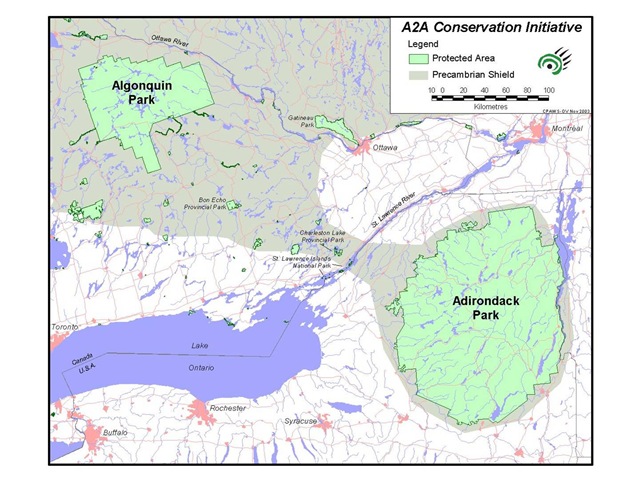
There are two options for the route between Peterborough and Ottawa: Northern and Southern. Both options pass through the Frontenac Arch, the hourglass-shaped geologic landform or “bridge” connecting the Canadian Shield to the Adirondack Mountains in New York that narrows considerably as it crosses the St. Lawrence River:
High-speed rail track must be very flat and straight to accommodate high speeds.
The northern option crosses a wider portion of the Arch, including about 85 km of uneven Canadian Shield granite terrain, which requires costly “cut and fill” (blasting through rock ridges and using that rock to fill the swamps).
The southern option parallels much of the Eastern Ontario Trail and crosses a narrower 40 km portion of the Arch. The track is less direct, and runs closer to the more densely populated 401 corridor through more valuable farmland and suburban lots which would cost more to acquire. Note: it does not include an additional stop near Belleville/Kingston.
Leaving Ottawa toward Peterborough, two scenarios are under study:
- Northern option: more direct, crossing the Canadian Shield and counties such as Lanark, Frontenac, and Hastings. This reduces travel distance and community impacts but involves complex work in remote and sensitive areas.
- Southern option: through eastern Ontario, in agricultural and resort areas with higher population density. This approach simplifies construction and operations.
Approaching Peterborough, located between Ottawa and Toronto, the alignment would favour existing corridors (highways, rail lines, power lines) to limit impacts on agricultural, forested, and recreational areas. The station could be located near major roads, with a connection to bus services.
Leaving Peterborough toward Toronto, the corridor crosses agricultural and industrial zones where minimizing the footprint is a priority. Existing rail corridors, highways, and energy corridors offer possibilities. Near the Greater Toronto and Hamilton Area, the corridor widens and existing infrastructure provides opportunities for integration.
Arriving in Toronto presents challenges due to dense urban development. We are studying options to reach downtown from the north or the east, using existing corridors or solutions such as tunnels or elevated tracks to reduce impacts.
For the Toronto station, several locations are being considered:
- Union Station and surrounding area: strong potential for connectivity and accessibility.
- Eastern site: close to public transit and the financial district.
- Western site: would lengthen travel time but bring the station closer to attractions like the CN Tower and Rogers Centre.
In all cases, sites must provide sufficient space to accommodate the station.
Reinventing travel between Toronto and Quebec City
Stops
- Toronto
- Peterborough
- Ottawa
- Montréal
- Laval
- Trois-Rivières
- Québec
The first segment to be built will connect Ottawa and Montréal.
Departures are estimated to be every 30 minutes during peak periods depending on the route.
Travel times
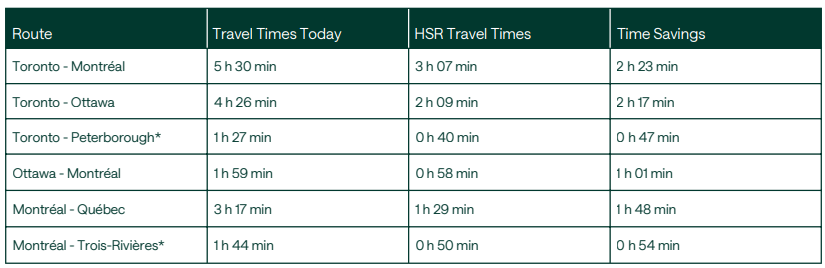
High-speed rail project will allow people to travel from:
- Ottawa to Toronto in 2 hours
- Montréal to Toronto in 3 hours
- Montréal to Ottawa in 1 hour
- Montréal to Québec City in 1.5 hours
Timeline
- 2019-2020 – Government of Canada establishes a Joint Project Office (JPO) between the Canada Infrastructure Bank (CIB) and VIA Rail
- July 6, 2021 – Government of Canada announces first steps of the procurement process
- March 9, 2022 – Government of Canada issues Request for Expression of Interest (RFEOI) with multiple national rail operators from France, Spain, and Germany coming forward.
- March 24, 2022 – Creation of the Alto project
- July 20, 2023 – Government of Canada selects 3 groups to submit Request for Proposals (RFP):
- Cadence – CDPQ Infra, SNC Lavalin, Systra Canada, Keolis Canada, Air Canada
- Intercity Rail Developers / Développeurs Ferroviaires Interurbains – Intercity Development Partners, Meridiam, Kilmer Transportation, First Rail Holdings, Jacobs, Hatch, CIMA+, RATP Dev Canada, First Group, Renfe Operadora, DF Canada Infrastructure Group Inc.
- Partenaires Ferroviaires QCONNEXION Rail Partners – Fengate, John Laing, Bechtel, WSP, Deutsche Bahn
- October 13, 2023 – Request for Proposals (RFP) issued
- 2023 to 2024 – Pre-development: start of technical analyses and environmental studies
- July 10, 2024 – VIA HFR first annual public meeting
- July 24, 2024 – Air Canada joins the Cadence team for the HFR project
- September 2024 – Report by Standing Committee on Transport, Infrastructure and Communities makes 18 recommendations to the Trudeau government
- February 19, 2025 – Cadence selected by the Government of Canada and awarded $3.9 billion over six years, starting in 2024-25 for the Co-Development phase
- March 19, 2025 – Pre-development agreement (PDA) between Alto and Cadence signed, start of the co-development and pre-construction phase
- December 12, 2025 – Ottawa–Montreal chosen as starting point
- January 15 to March 29, 2026 – Public consultation on the corridor under study
- Spring/Summer/Fall 2026 – Conducting field studies
- Summer 2026 – Presentation of the results of the public consultation on the corridor under study
Currently in the development and pre-construction phase, which includes:
- Corridor analyses to determine the most appropriate route
- Detailed design of the electrified rail network
- Collaboration with stakeholders, including provincial and municipal authorities
- Public consultations, including with Indigenous communities, to incorporate community aspirations
- Environmental studies and the impact assessment process to obtain the necessary approvals for construction
The duration of the development and pre-construction phase is estimated at four years, until 2029-2030. The high-speed rail proposal will then be submitted to the Government of Canada for approval to proceed.
Construction will be carried out in phases, each estimated to last between 8 and 10 years. Commissioning will also be progressive, as soon as a section is completed. The first section will connect Ottawa to Montréal.
Benefits
- Saving time – Cutting travel time in half to save up to 155 million hours every year.
- Reducing congestion – Equivalent to taking approximately 100,000 cars off the road each year.
- Economic development – Annual economic impact of $24.5 billion, a projected 1.1% annual increase to Canada’s GDP.
- Improve affordability – Thousands of families will be able to live in less expensive areas and commute to cities for work to reduce transportation and housing costs. Higher-density transit-oriented developments can be built near the train stations. Car travel costs users an average of $0.68 per kilometre, more than double the cost of travelling by rail ($0.12 to $0.32).
- Reduce greenhouse gas emissions – Remove the equivalent of 100,000 cars from the roads each year by reducing the use of short-haul flights across the Québec City–Toronto corridor. Alto will run on Ontario’s electricity grid which is 69% renewable and non-emitting sources, while Quebec’s is 99% renewable energy.
- Increase safety – Reduce road accidents by providing a safe intercity transportation alternative. High-speed rail is one of the safest modes of intercity transportation.
Cost
Early estimates by Alto place the project cost between $60B and $90B (2024 dollars).
Oversight
The project is subject to the Impact Assessment Act of Canada, ensuring a transparent process that conforms to laws and regulations, in consultation with local stakeholders.