
In January 2018, the Province of Ontario enacted Ontario Regulation 588/17: Asset Management Planning for Municipal Infrastructure under the Infrastructure for Jobs and Prosperity Act, 2015.
One of the key drivers of the Ontario Regulation 588/17 is to help ensure that all municipalities are actively managing finances to achieve “financial sustainability”. An infrastructure gap is very common across most municipalities.
The regulation requires municipalities to:
- Develop an Asset Management Plan based on Current Levels of Service by July 1st, 2022, for core assets, which include roads, bridges, culverts, and pipes.
- Apply it to all other municipal infrastructure by July 1st, 2024.
- Advanced Asset Management Plan (Proposed Levels of Service) required for all assets by July 1st, 2025.
Goals
- Gradually reduce the infrastructure funding gap
- Build the Asset Management Reserve Fund
- Avoid breaching debt policy, which typically limits debt repayments to a maximum of 12% of own-source revenue. The maximum Annual Repayment Limit (ARL) set by the province for most municipalities is 25%.
Physical condition and replacement value

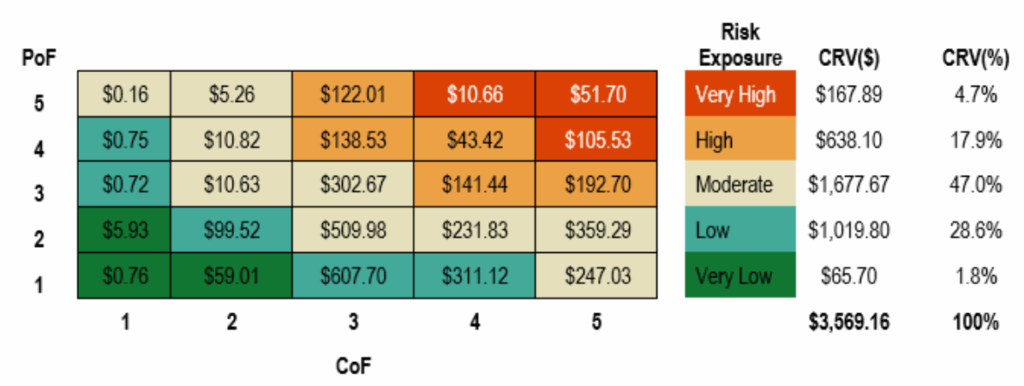
Risk management strategy
The systematic process of identifying, assessing, and mitigating risks to achieve organizational objectives. In AM, it often focuses on risk of asset failure impacting service delivery.
Ensures a systematic process for prioritizing projects across asset classes.
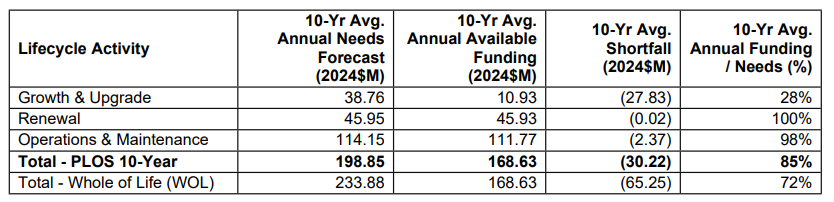
Infrastructure gap
The difference between the cost to maintain assets at the desired Level of Service and the available funding. Indicates a shortfall in investment.
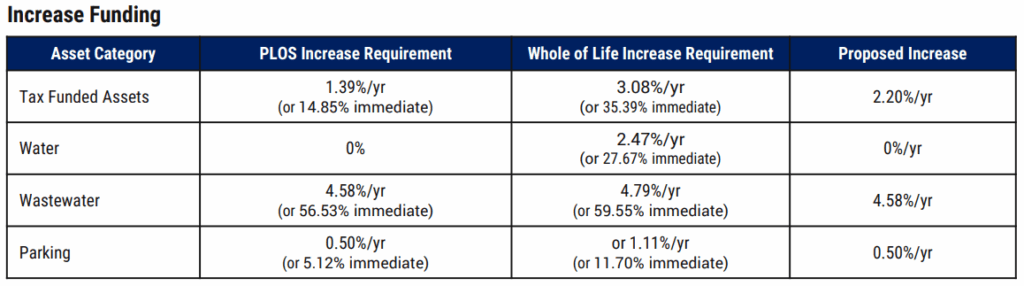
Financial sustainability options
One of the key drivers of the Ontario Regulation 588/17 is to help ensure that all municipalities are actively managing finances to achieve “financial sustainability”. Based on current calculations it is evident that the City has an ‘infrastructure gap’. Although this gap exists, it is very common across most municipalities.
Options
It is a municipality’s responsibility to ensure that the its assets are managed sustainably. Typically, this is achieved through:
- Increasing revenue (raising property taxes)
- Accepting increased risk
- Accepting lower level of service
It should be noted that there is no singular method for addressing the ‘infrastructure gap’. Often this is an iterative process to balance cost, risk, and LOS, through consultation with the community, particularly in relation to ‘willingness to pay’ for services.
Increased funding
Where assets are supported by “user pays” rates (such water and wastewater services) this might involve review of the current rates levels. This is not possible for all City infrastructure. Some communities also operate an “Infrastructure Levy” which is charged to all taxpayers to support those assets which are not covered by a “user pays” model (such as Transportation).
Increased risk
Although not always desirable, it may be possible to accept a higher degree of asset risk at the City to help lower ongoing asset costs such as conducting less frequent inspections or maintenance of less critical assets (i.e. minor/small culverts which have less impact of city service).
It should be noted that deferring work may result in a reduction of the City’s ability to reliably achieve the desired service standards (higher complaints and reduced performance) and may increase the asset total lifecycle ownership cost.
Accept lower level of service
Municipality must balance public (community) expectations, their objectives, risk and affordability. If the City is not able to sustainably fund the current level of service it may be beneficial to seek opportunities for adjustment to service standards through public consultation. It is critical in this process to link consideration of the public expectations with understanding of constraints such as financing, resourcing, and affordability and the options for addressing these (higher taxes). Only after these constraints have been considered will it be possible to determine public expectations and willingness to pay for these services.
An example of this could be deferring projects that aim to increase road capacity through road widening. The deferment eliminates approximately $40.5M of total investment need (or an annual need of $4.05 M) of capital investment and the associated future infrastructure liability (O&M requirements). However, this option will likely increase risks from road usage exceeding the road capacity and may result in higher customer complaints.



Comments
We want to hear from you! Share your opinions below and remember to keep it respectful. Please read our Community Guidelines before participating.