
A long-term care committee of management is a provincially-mandated local board that ensures that long-term care homes are properly maintained and staffed to a standard satisfactory to the physical and emotional needs of their residents as per the Fixing Long-Term Care Act and the associated Ontario Regulation 246/22: General.
Long-term care refers to care for individuals with chronic health conditions, disabilities, or mental health issues who cannot fully care for themselves and require personal, social, nursing, or medical services over extended periods of time. Mainly concentrated on seniors, these services are provided either formally by professional nurses or personal support workers, or more commonly, informally by family members, friends, or community members in a variety of settings.
IMFG
Every single-tier and upper-tier municipality in Ontario (service managers) (outside the northern part of the province) has been required by the Ontario government to maintain at least one long-term care home since the passing of the 1949 Homes for the Aged Act:
Every southern municipality that is an upper or single-tier municipality shall establish and maintain a municipal home and may establish and maintain municipal homes in addition to the home that is required.
Section 122 of the Fixing Long-Term Care Act (FLTCA)
Long-term care homes (or nursing homes, personal care homes, assisted living, supportive care facilities, and continuing care residences) are publicly funded and operated by municipalities, not-for-profit organizations or private organizations and regulated by the Ministry of Long-Term Care.
102 long-term care homes are owned and operated by municipal governments (almost 20% of the total), with a total capacity of 17,000 beds. Across Canada, 46% of these facilities are publicly owned, with the remainder owned by 29% private for-profit and 23% non-profit organizations.
Governance
The council of a municipality establishing and maintaining a municipal home or the councils of the municipalities establishing and maintaining a joint home shall appoint from among the members of the council or councils, as the case may be, a committee of management for the municipal home or joint home.
Section 135 of the Fixing Long-Term Care Act
The committee must consist of at least 3 members appointed by municipal council:
A committee of management appointed under section 135 of the Act shall,
(a) in the case of a municipal home, be composed of not fewer than three members; and
(b) in the case of a joint home, be composed of not fewer than two members of the council of each of the municipalities maintaining and operating the joint home.
A committee of management that existed under section 132 of the former Act continues as a committee of management under section 135 of the Act.
Section 330 of Ontario Regulation 246/22
Members must go through screening measures, set out in Sections 252-256 of the Regulation, including a Police Record Check:
Every licensee of a long-term care home shall ensure that screening measures are conducted in accordance with the regulations before hiring staff and accepting volunteers.
The screening measures shall include police record checks, unless the person being screened is under 18 years of age.
Section 81 of the FLTCA
Members are appointed for a term of 4 years and may be reappointed:
For the purpose of determining the membership of a board, the districts for which the boards have been established are divided into the areas set out in the Schedules to this Regulation.
(2) For each board described in the heading of a Schedule, the number of members, the areas in a district that they represent and the manner of their appointment shall be that set out in the Schedule.
(3) A member shall be appointed for a term not exceeding four years.
(4) A member may be reappointed.
Section 337 of Ontario Regulation 246/22
An individual is qualified to be a member of a board if the individual,
- (a) is at least 18 years of age;
- (b) is a resident of the district for which the board is the board of management; and
- (c) is not employed by the board of management or any of the supporting municipalities.
An individual ceases to be a member if the individual,
Section 336 of of Ontario Regulation 246/22
- (a) is convicted of an indictable offence;
- (b) becomes incapacitated;
- (c) is absent from three consecutive board meetings unless the absence is authorized by a resolution of the board; or
- (d) ceases to be qualified under subsection (1).
Committee meetings must be open to the public (as with all municipal committee meetings), with some exceptions. Committees are subject to requests under the Municipal Freedom of Information and Protection of Privacy Act (MFIPPA).
Responsibilities
Submit an annual Declaration of Compliance as part of the Long-Term Care Homes Service Accountability Agreement (LSAA) with Ontario Health.
Example
Submit a Quality Improvement Plan (QIP) to Health Quality Ontario each year to identify goals for improvements and the change ideas associated with each goal.
Example
Budget
Long-term care is cost-shared between the Ontario provincial government and municipal governments. In 2018, Ontario municipalities spent approximately $1.8B on long-term care (54%) (both operating and capital costs) and 46% of this total offset by provincial transfers.
The federal government does not transfer money directly to municipalities to fund long-term care, but some funding comes from bilateral agreements between the federal and provincial governments.
For example, in 2017, the federal government reached separate agreements with provinces and territories to strengthen home care, community care, mental health, and long-term care for seniors.
Example: Hastings/Quinte Long-Term Care
In 2025, Hastings/Quinte Long-Term Care had $49.3M in operating expenses and $42.9M in revenue for a net operating cost of $6.4M. $2.5M was spent on capital projects for a total net cost of $8.9M. This amount is then split amongst the municipal partners’ operating budgets.
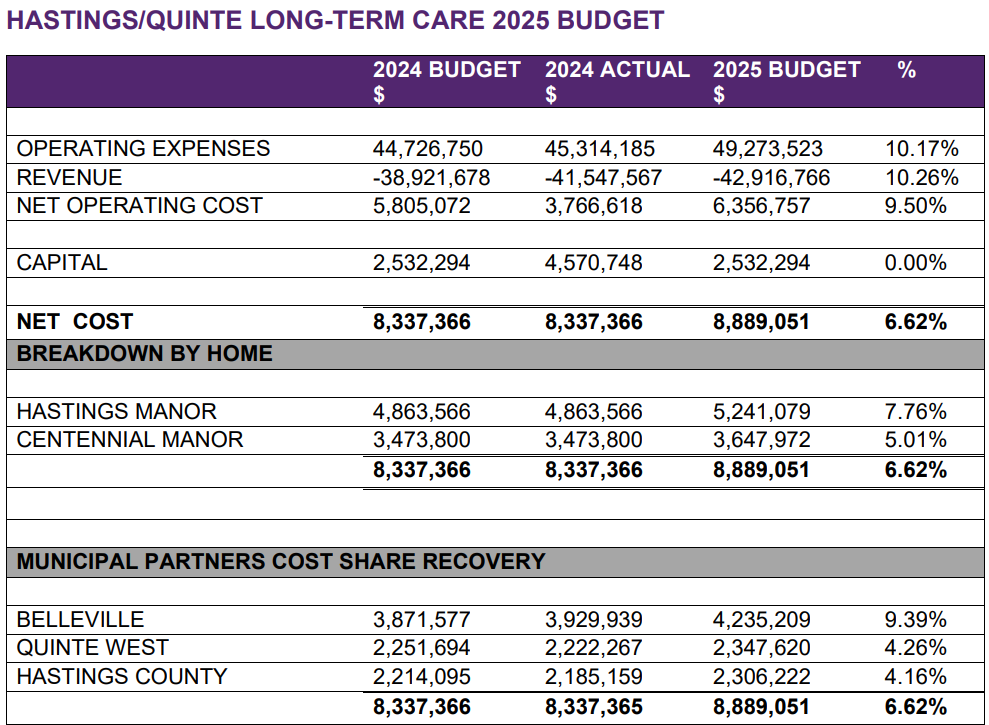
After provincial funding and collected revenues cover most expenses, the net cost is split between the partner municipalities in the Service Manager’s service area based on their share of the total value of all properties, adjusted by their tax ratios (ie. weighted assessment) using Current Values determined by Municipal Property Assessment Corporation (MPAC).
For Hastings Manor (1 of 2 homes), the net costs were distributed based on share of beds (Resident Days) and Weighted Assessment:



Comments
We want to hear from you! Share your opinions below and remember to keep it respectful. Please read our Community Guidelines before participating.