Municipal Property Assessment Corporation (MPAC) is an independent, not-for-profit corporation funded by all Ontario municipalities, accountable to the Province, municipalities, and property taxpayers through its 13-member Board of Directors.
It assesses and classifies all properties in Ontario in compliance with the Assessment Act and regulations set by the Government of Ontario. There are close to 5.7M properties with an estimated total value of approximately $3.2T in Ontario.
MPAC determines the current property Current Value Assessments for all properties in Ontario. Municipalities separately determine how much property tax revenue they need to pay for municipal services in the annual operating budget, set municipal property tax rates to raise that amount, and collect property taxes.
They are also responsible for:
How does MPAC assess properties?
MPAC conducts a province-wide Current Value Assessment (CVA) process as outlined in the Assessment Act every 4 years to update the assessed value of all Ontario properties.
Current Value is the measure of a property’s value as defined by the Assessment Act. It is not the latest price a property on your street sold for, and it is not determined by the municipality. The Current Value of a property can be found on your Property Assessment Notice, at AboutMyProperty.ca or by inspecting the municipality’s assessment roll.
The last assessment was carried out in 2016, in which all property owners received a Property Assessment Notice. The assessed property value is then phased in over the four-year cycle, with the last cycle being 2017 to 2020. The Ontario government has postponed the planned reassessment that was scheduled in 2020 to 2023.
This means that assessments for the 2022 and 2023 taxation years will continue to be based on the same valuation in effect for the 2021 taxation year unless there have been any physical changes to the property.
Other factors considered under the three approaches include the highest and best use of the property and market rents.
Residential
Residential properties are assessed using the sales approach which compares the value of the subject property to the sale prices of similar
and surrounding properties.
In addition to sale prices, MPAC looks at up to 200 factors when assessing residential properties, however 5 factors account for approximately 85% of the value:
- Location
- Lot dimensions
- Living area
- Age of the property
- Adjusted for any major renovations or additions
- Quality of construction
More: Valuing Residential Properties in Ontario (2016) – MPAC, How we assess residential properties
Commercial
Properties such as rental apartments, retail centres, and office buildings are valued using the income approach, which capitalizes an income stream using a standardized rate of return to produce an estimate of the value of the property.
- Commercial Property Assessments
- Airports
- Commercial Properties
- Hotels
- Motels
- Marinas
- Office Buildings
- Shopping Centres
Industrial
Industrial properties are valued using the cost approach, where much of the value is on improvements to the land, involves estimating the cost of
replacing the improvements on a property (less any depreciation that has occurred) and adding the land value.
Other
- Casinos
- Entertainment Attractions
- Farms
- Golf Courses
- Grain Elevators
- Retirement Homes
- Landfills
- Mining Properties
- Sports Stadiums
- Sawmills
- Seasonal Campgrounds
- Long-Term Care Homes
- Lands in Transition
- Special Purpose Properties
Properties exempt from assessment and taxes
Section 3 of the Assessment Act exempts the following properties in Ontario from assessment and taxation:
- Crown lands (land owned by Canada or any province)
- Cemeteries, burial sites, and crematoriums, as well as land owned by a religious organization or municipality for “bereavement related activities”
- Churches (and associated land)
- Schools, colleges, and universities
- Non‐profit philanthropic, religious, and education seminaries (up to 50 acres)
- Public hospitals
- Children’s treatment centres that receive Provincial aid (owner‐occupied portions only)
- Care homes with charitable status
- Highways and toll highways
- Municipal property
- Boy Scouts and Girl Guides property
- Houses of refuge
- Charities
- Children’s aid
- Societies
- Scientific, literary, agricultural, and horticultural institutions
- Battle sites
- Exhibition buildings of companies
- Machinery and equipment
- One acre of forestry for every ten acres of farmland up to 20 acres (and subject to several other conditions)
- Mineral land, minerals, and associated machinery and equipment
- Certain property of telephone and telegraph companies
- Improvements on land with residential units for seniors and persons with disabilities (subject to conditions)
- Additional residential units for seniors (subject to conditions)
- Amusement rides
- Airports
- Conservation land
- Large non‐profit theatres (subject to conditions)
- Hydro‐electric
- Generating stations
- Poles and wires
- International bridges and tunnels (including duty‐free stores)
- Land owned by religious organizations used for recreation
- Land owned by the Navy League of Canada
- Land used by veterans
When are properties assessed?
MPAC does a province-wide reassessment every 4 years.
The last assessment was done in 2017, with all assessment values based on January 1, 2016.
November 4, 2021 – The 2020 Assessment Update was postponed by the Ontario Government in the Fall Economic Statement due to the COVID-19 pandemic, stating that its priority was “maintaining stability for taxpayers and municipalities at this time.”
July 14, 2023 – The Association of Municipalities of Ontario, the Canadian Federation of Independent Business, the Ontario Chamber of Commerce and six other organizations sent a letter to Premier Doug Ford, urging his government to perform a reassessment, warning that the delay “is compromising the province’s economic competitiveness”.
Reassessments redistribute the tax burden so that properties whose values have increased relative to others pay an increased share of taxes. Frequent reassessments do not increase property taxes, but instead stabilize and make taxes more predictable
August 10, 2023 – Ontario government announced that it was again postponing the province-wide reassessment for 2024 to enable it to conduct a review focusing on “fairness, affordability and business competitiveness” in order “to enhance the transparency and equity of future assessments.” The provincial government has stated that its priority was “maintaining stability for taxpayers and municipalities.”
August 16, 2023 – Ontario government filed a regulation to amend the Assessment Act, extending the postponement of a province-wide reassessment through the end of the 2021-2024 assessment cycle.
On March 26, 2024 the Ontario government deferred the assessment indefinitely:
The government is undertaking a review of the property assessment and taxation system focusing on fairness, affordability, business competitiveness and modernized administration tools. Consultations have commenced to seek input on the scope and priority areas of the review. Consultations will continue with broader engagement of stakeholders from across the province starting early spring. To maintain stability for taxpayers, the provincewide property reassessment will continue to be deferred until this review is complete.
2024 Ontario Budget
Until the reassessment is completed, property assessments will continue to be based on fully phased-in January 1, 2016 current values. Adjustments occur only through new construction, supplementary assessments, property classification changes, or successful appeals.
What is the impact of postponing the assessment?
Outdated assessed values can create unfairness in property tax bills because changes to properties’ market values are not reflected in the taxes owed. Some properties become over-taxed and others under-taxed.
Since the shift to working from home, the office sector has been negatively impacted, resulting in higher vacancy rates, lower rental rates and thus lower property values. Meanwhile, industrial buildings have seen a surge in demand and value. Retail properties land somewhere in the middle.
This means that office buildings are currently paying a higher level of property tax and industrial buildings a lower level of tax than if MPAC had performed a reassessment. Some properties are paying up to 50% more property tax than they should be according to a report by the Altus Group.
Frequent and regular reassessments help to ensure that the distribution of taxes is as fair as possible.
How to look up a property
AboutMyProperty.ca has details on properties including:
- Current Value
- Roll Number
- Description
- Year Built
- Lot Size
- Square Footage
Roll Number and Access Key can be found on your Property Assessment Notice sent by your municipality, or you can request it at AboutMyProperty.
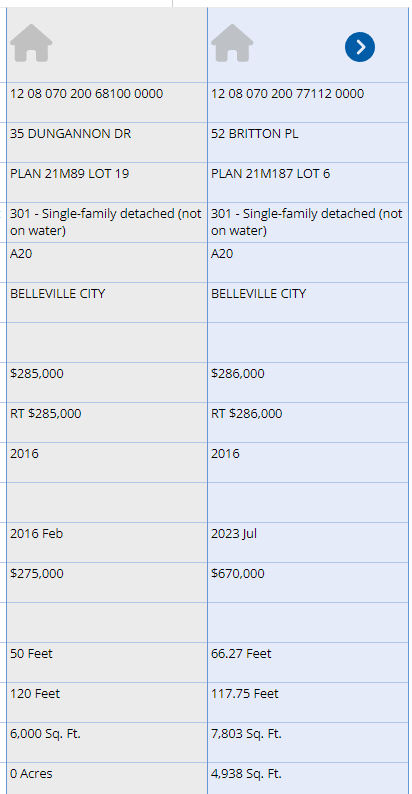
You can also find the Roll Number of residential properties using AboutMyProperty by adding it to your Properties of Interest list:
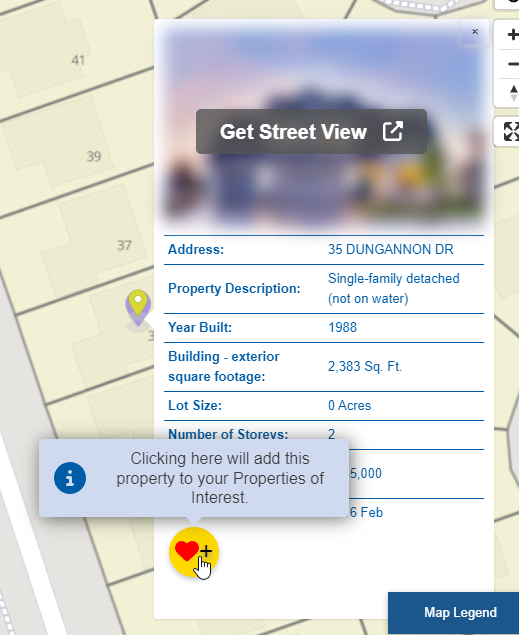
Favoriting the property:
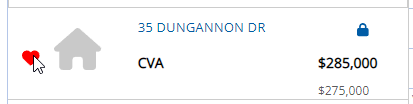
And the Roll Number of the property, assessed value and other details will show up in your favourites list:
Budget
MPAC’s annual budget is funded by all municipalities’ operating budgets in Ontario according to their share of Ontario’s assessment value and property count.
The Legislated Cost Recovery Formula is:
(A+B)/2 x C
- A – Municipality’s share of the total province’s assessment value.
- B – Municipality’s share of the total province’s property count.
- C – Total amount required by MPAC from all municipalities in the province as a payment for service.
Example: Belleville in 2025