
The City of Belleville retained Watson & Associates Economists Ltd. to prepare a Housing Needs Assessment with an assessment of current and future housing needs and strategic directions for Belleville.
The study included interviews with stakeholders from the non-profit, government, and private sectors to gather diverse perspectives on housing in Belleville.
The assessment considers macro-economic conditions, demographic trends, and regional and local real estate development trends that are influencing current housing trends across Belleville. These consultations highlighted the challenges faced by vulnerable groups, including those affected by homelessness, domestic violence, aging, and low income.
Increasing Pressure on Housing Affordability: Affordability remains a major challenge in Belleville. Stakeholders observed that rents have increased significantly, with many residents – especially students, seniors, and low- to moderate-income earners – struggling to find suitable options. Shared accommodations are becoming more common, not out of preference but necessity. Participants widely agreed that the private market cannot meet the need for deeply affordable housing without external financial support.
Overview
As of 2021:
- 23,535 occupied dwelling units
- 62% low-density housing forms (single-detached and semi-detached)
- 11% medium-density units, such as row houses and duplexes
- 27% high-density apartment units
- 63% owner-occupied
- 37% renter-occupied (notably higher than the provincial average of 31%, indicating a greater reliance on rental housing)
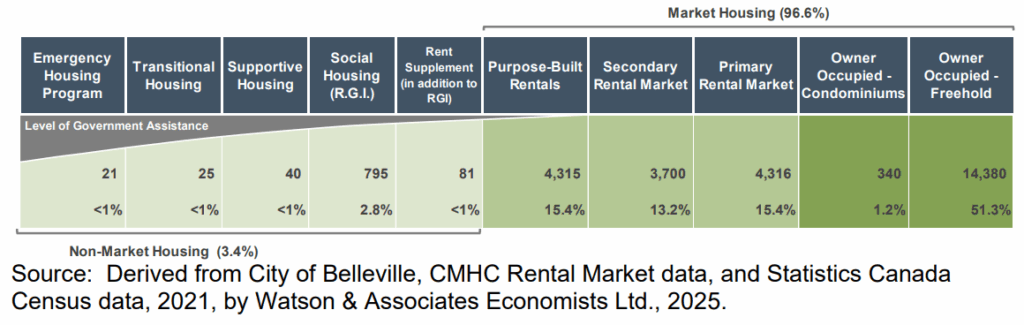
- 97% of the housing stock is market-based, while nonmarket options – such as emergency, transitional, supportive, and social housing – make up the remaining 3%
- Most purpose-built rental housing in Belleville was built between the 1960s and 1970s, with smaller additions in the 1980s and 1990s
- 13% (3,065) of households in Belleville were in core housing need – defined as living in housing that is unaffordable, overcrowded, or in poor condition, with no ability to afford better options in the local market. Significant proportion are led by vulnerable populations, such as single mothers, young adults, older seniors, and refugees. This was slightly higher than the Ontario average of 12%
- 27% are single mother households
- 22% are refugee claimant households
- 78% are renter-occupied and 20% are of those subsidized households
- >33% of these households are in severe core housing need, spending over 50% of their income on shelter.
- Average home price was $533,600 in 2024
- Average detached $554,600
- Average townhouses and row homes, despite fewer sales, averaged slightly more at $556,100 – likely due to limited supply and a concentration of newer builds
- Average condo $340,200 to $391,000
- Rental costs
- Between 2015 and 2024, average apartment rents rose by 56%, from $968 to $1,435.
- 3,125 households currently on the waitlist for non-market housing
- 229 individuals were identified as experiencing homelessness in Belleville, including 122 unsheltered residents and others relying on emergency accommodations.
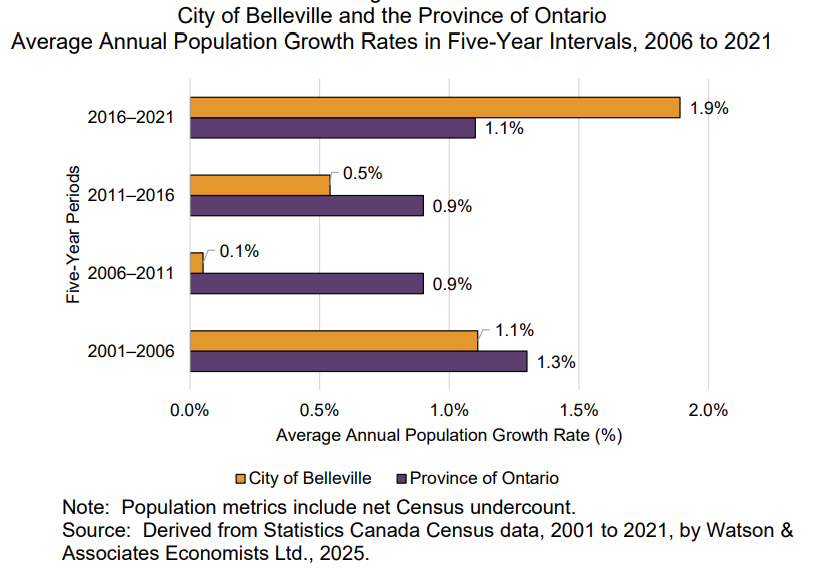
Population grew at a rate 73% above the Ontario average from 2016 to 2021
Over the 2016 to 2021 period, Belleville’s annual average population growth rate accelerated to 1.9%, notably higher than the provincial average of 1.1% over this same five-year interval. Belleville’s 2025 population is estimated at 61,150, representing a 6.7% increase from 2021.
Belleville is projected to continue experiencing substantial population and employment growth over the next 30 years. According to the 2022 Growth Study forecast, the City’s population is expected to rise from 57,300 in 2021 to 75,200 by 2051, marking a 31% increase. During the same period, the employment base is anticipated to grow to around 41,000, up from 31,700 in 2021, reflecting a nearly 30% rise.
Average age to continue to increase
Similar to the Province, the average age of the population base in Belleville is also aging due to the City’s large concentration of Baby Boomers.
65+ age group has grown considerably over the past 20 years and is expected to increase in both percentage and absolute terms over the next several decades.
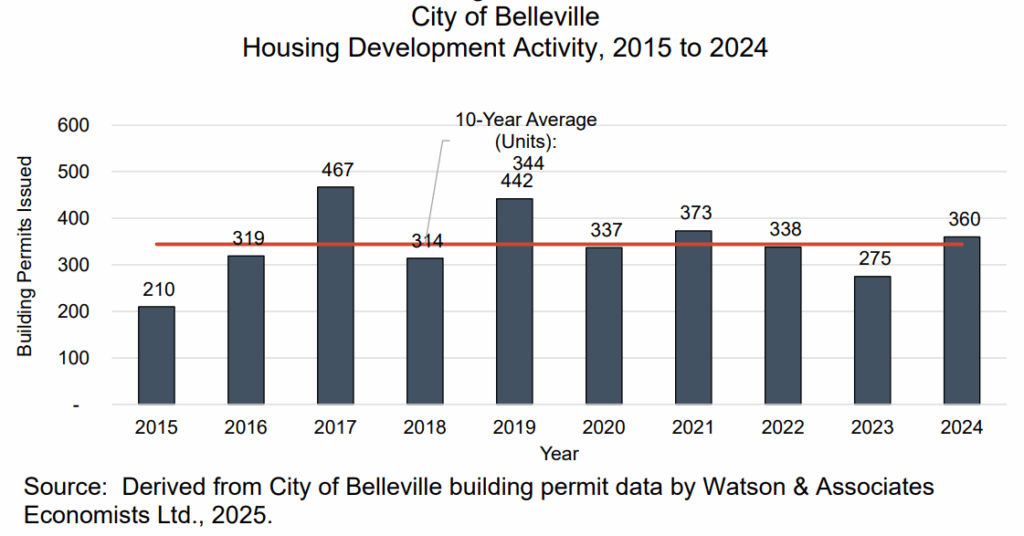
Housing construction stagnant at average of 344 units per year average
In Bill 23, the Province of Ontario has assigned municipal housing targets, identifying
the number of new housing units needed by 2032, impacting 50 of Ontario’s largest and
fastest-growing single/lower-tier municipalities in Ontario.The City of Belleville has a 10-year housing target of 3,100 households and is currently considered ‘On track’ towards this goal. According to the Ontario Housing Pledge Tracker, Belleville is one of the few municipalities that is either ‘On track’ or has ‘Exceeded’ its housing pledge.
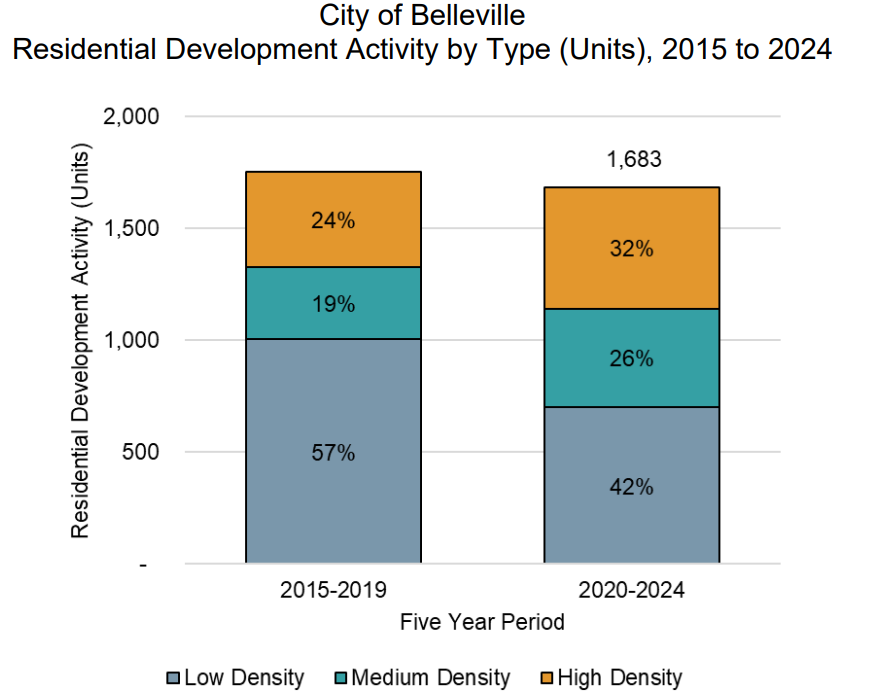
Housing construction shifting to higher-density
Source: Adapted from City of Belleville building permits data by Watson &
Associates Economists Ltd., 2025.
Housing affordability trend worse than Ontario average
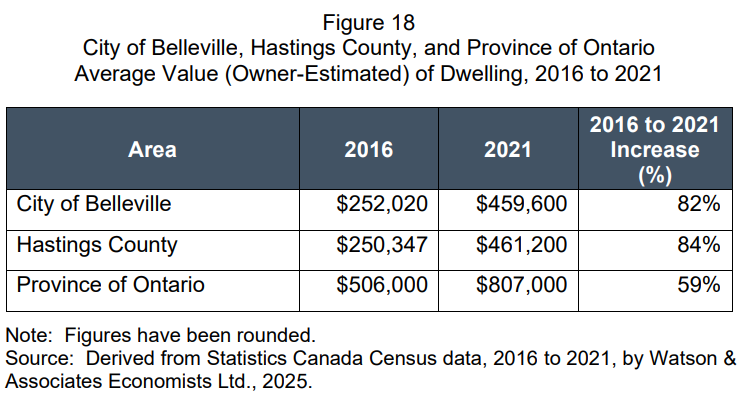
Average house prices in the City of Belleville and across Hastings County have continued to rise steadily, further exacerbating housing affordability challenges across the region.
This growth rate was notably higher than Ontario’s overall increase of 59%, which rose from $506,000 to $807,000 during the same period:
Detached homes remain the dominant housing form in Belleville and the surrounding areas, accounting for nearly 650 sales at an average price of approximately $554,600.
Notably, rows and townhouses achieved the highest average price at $556,100, with a total of 75 sales. This is likely due to less supply available in these housing types as well as a majority of the sales occurring in new residential builds, with less resale activity than the single-detached market.
Affordable home in Belleville should cost no more than $316,200
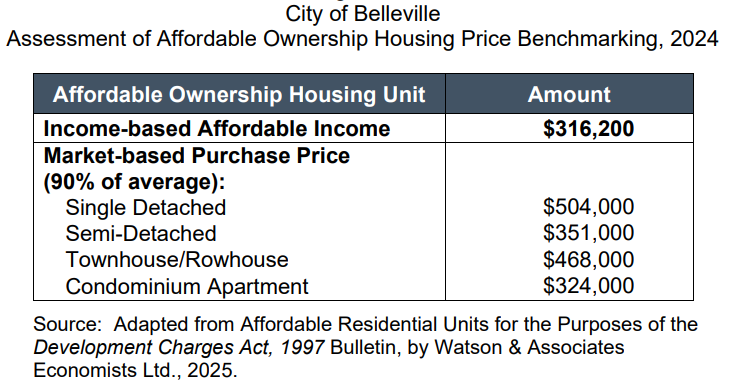
In Belleville in 2024, an affordable home has a purchase price of no more than $316,200 based on the Ontario governments definition of affordable for the purposes of exempting developments from development charges.
Rental rates experiencing persistent upward pressure
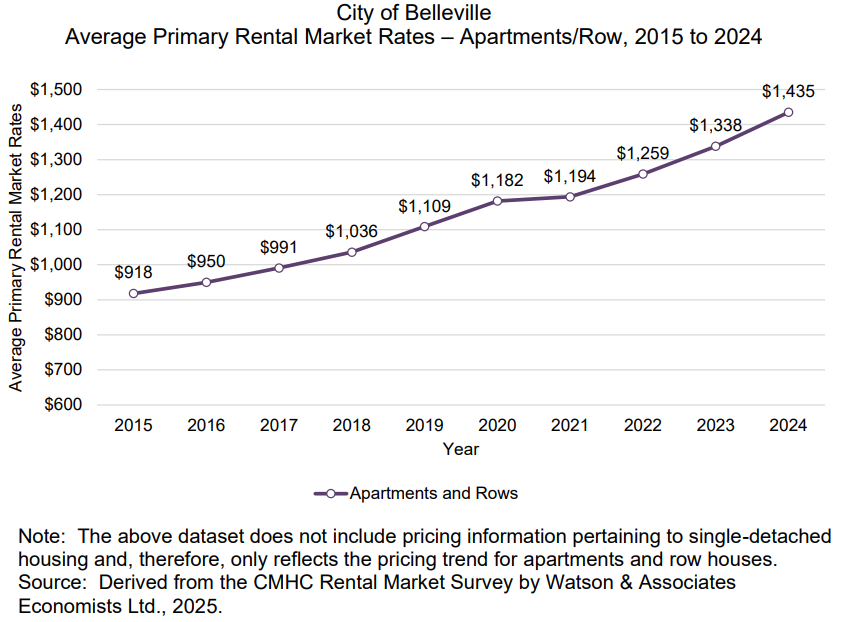
Between 2015 and 2024, the average rent for apartments increased by approximately 56%, rising from $918 in 2015 to $1,435 in 2024. This steady growth represents an average increase of roughly $52 per year over the 10-year period, signalling persistent upward pressure in Belleville’s rental market.
The increase reflects broader market trends of rising housing costs and growing demand for rental accommodations, particularly as higher interest rates and ownership costs have kept more residents in the rental market.
Affordable average rent for a 2-bedroom in Belleville is $1,404
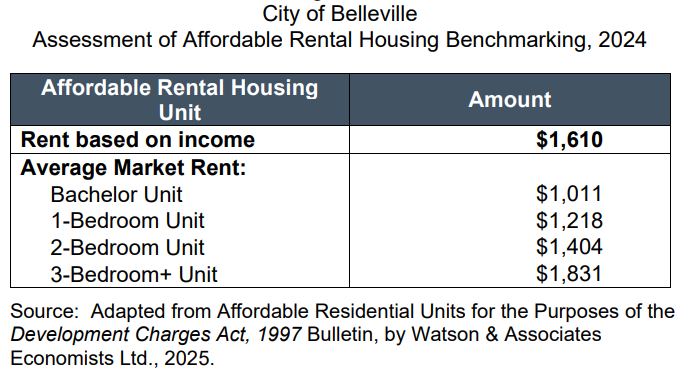
For rental housing in Belleville in 2024, affordable rent is:
- Bachelor unit: $1,011
- One Bedroom: $1,218
- Two Bedroom: $1,404
- Three+ Bedroom: $1,610
based on the Ontario governments definition of affordable for the purposes of exempting developments from development charges.
Larger renting households face more affordability pressure
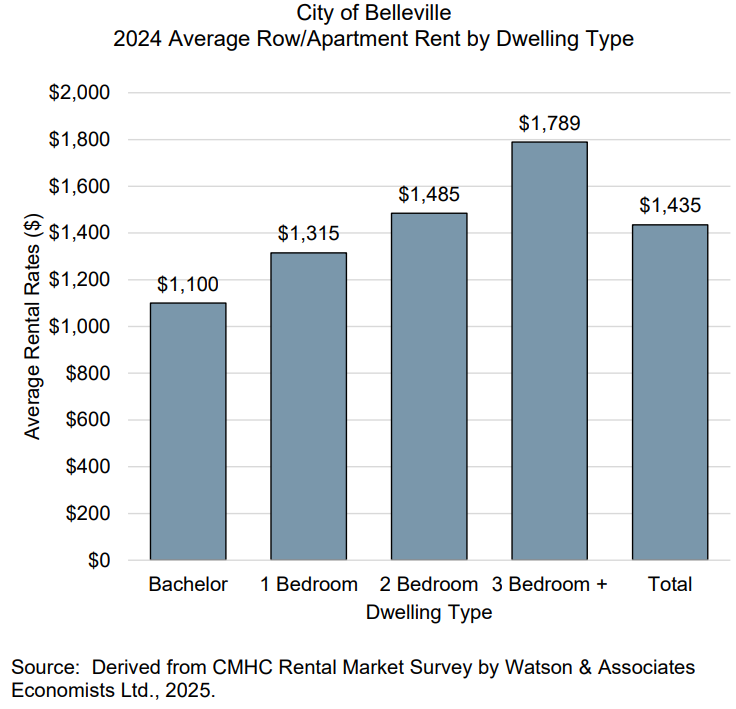
The overall average rent across all unit types is $1,435. These values highlight the additional affordability pressure faced by larger households. This significant price gap underscores the growing challenge for families and multi-person households in securing appropriately sized rental accommodations within the City.
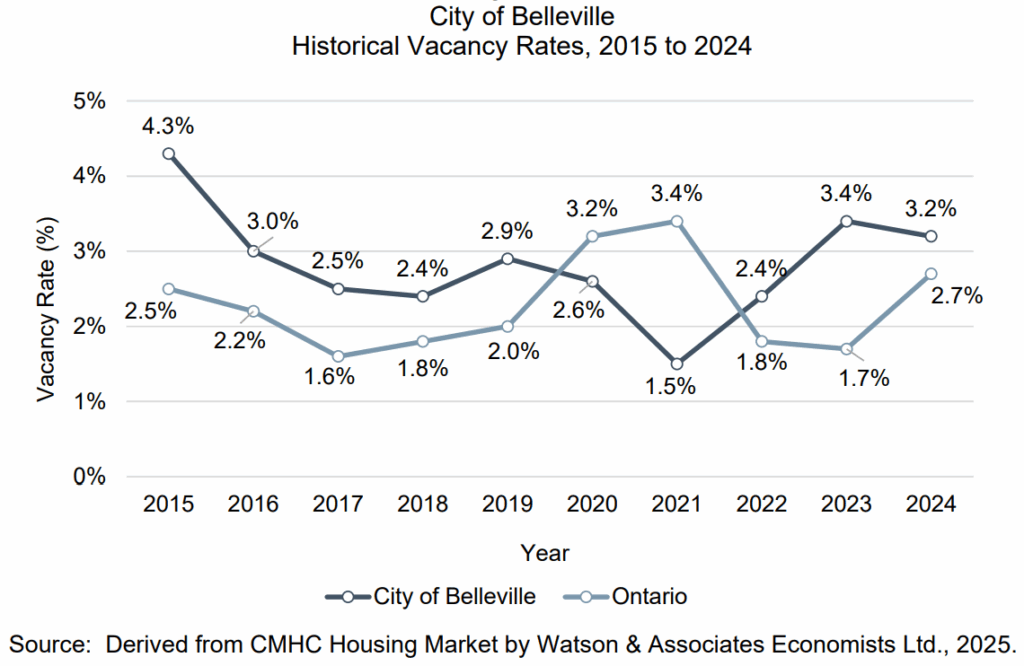
Belleville’s rental market is approaching a healthy vacancy rate
42 (+3%) new non-market housing units since 2012
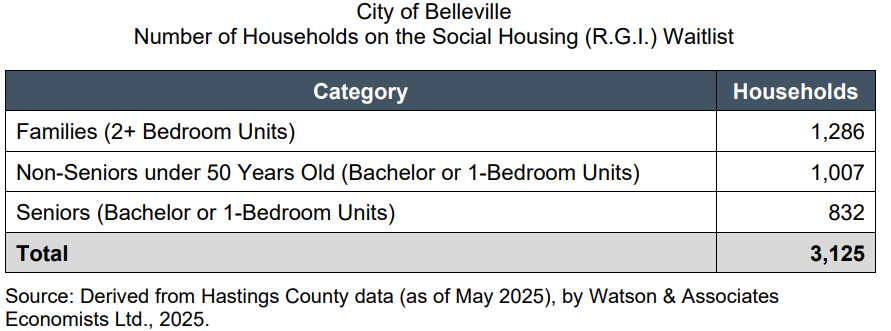
The City of Belleville has a total of 962 non-market housing units, which represent approximately 3% of the total housing stock in the City. These units are owned and operated by Hastings County Housing Corporation, which receives funding the municipalities located in the County, including Belleville.
- Emergency Housing Program – The Grace Inn offers approximately 21 units of emergency housing. These units provide immediate, short-term accommodation for individuals experiencing homelessness.
- Transitional Housing – The City has approximately 25 transitional housing units offered through Shiloh House, Enrichment Centre for Mental Health, and Three Oaks. These are designed to support individuals as they move from homelessness toward stable, permanent housing by offering temporary shelter combined with support services.
- Supportive Housing – Belleville has about 40 supportive housing units provided through Home for Good. These provide residents with affordable
- accommodations and access to a range of supports that promote housing stability and improved well-being.
- Social Housing (Rent-Geared-to-Income, R.G.I.) – Social housing forms the largest portion of Belleville’s non-market housing, with approximately 795 units. These units are typically subsidized so that residents pay no more than 30% of their gross monthly income or the maximum shelter allowance for social assistance recipients.
- Rent Supplement – Belleville’s rent supplement program provides approximately 81 units, helping to bridge affordability gaps in privately owned rental housing by reducing monthly rent costs to approximately 30% of household income or the shelter allowance maximum.
Low-density housing represented a majority (57%) of total construction from 2015 to 2019, the period from 2020 to 2024 showed a notable shift toward medium- and high-density units, which together accounted for 58% of new residential construction.
This trend suggests changing housing preferences and increased demand for higher-density living options within the City.
Clear need for affordable, rental housing
There is a clear need to support affordable housing in Belleville. While the strong real estate market is beneficial for many, it places affordability pressure on lower-income households, including those in minimum wage and service sector jobs, as well as other vulnerable groups.
Belleville requires approximately 3,990 new permanent housing units over the 2025 to 2035 period to accommodate its growing population. Within this forecast, the City will need around 1,640 rental units to meet increasing demand.
Most of Belleville’s purpose-built rental housing was built several decades ago, with the majority dating back to the 1960s and 1970s. A smaller portion was added in the 1980s and 1990s, and even fewer units were built before 1960. Recent construction has contributed only a limited number of new rentals, with relatively few built since 2000.
Full report
Belleville’s Housing Needs Assessment is to be updated every 5 years, or as deemed otherwise by legislation.


Comments
We want to hear from you! Share your opinions below and remember to keep it respectful. Please read our Community Guidelines before participating.