
Registered members of federal political parties can:
- Vote for the party leader
- Vote for the party’s candidate in their riding during a nomination contest
- Run as the party’s candidate in your local riding
- Help shape policies by participating in local or national conventions where members debate and vote on official party policies
Registering with a party is one of the best ways to engage in Canada’s democratic political system after voting in municipal, provincial and federal elections.
Other benefits include:
- Meeting likeminded, politically-engaged people who share your political values
- Open doors to internships, advisory roles, or political staffing jobs
- Common first step toward running for office
Register with a federal political party
Membership fees and requirements for each party:
- Liberal – Free
- Canadian citizen, have status under the Indian Act, or be a permanent resident of Canada.
- 14 years of age or older
- Not a member of another federal political party
- Agree to support the principles of the Liberal Party of Canada
- while Registered as a Liberal, not have publicly declared an intention to be a candidate for election to the House of Commons other than as a candidate of the Party.
- Conservative – $15/year
- Canadian Citizen or Permanent Resident of Canada
- 14 years of age or older
- Agree to support the principles of the Conservative Party of Canada
- Not a member of another federal political party
- My membership fees are paid from my own funds and no individual or organization will reimburse me
- NDP – Except in Quebec and Nunavut, individuals who join the federal NDP do so through their provincial/territorial NDP branch
- Canadian Citizen or Permanent Resident of Canada
- The minimum age to secure a voting membership is generally governed at the provincial or territorial level. It most regions, it is between 12 and 14.
- Not a member of another political party
- Green – $10/year (free for 14 to 29)
- Canadian Citizen or Permanent Resident of Canada
- 14 years of age or older
- Not a member of another political party
- Bloc Québécois
- No citizenship or residency requirements
- 14 years of age or older
Membership fees are not eligible for a political contribution tax receipt.
Membership fees to federal parties are not tax deductible
Any money that is used for a nomination contestant’s, a candidate’s or a leadership contestant’s campaign out of their own funds is a contribution for the purposes of this Act.
Exclusion — membership fees
(7) The payment by an individual during a year of fees of not more than $25 per year for a period of not more than five years for membership in a registered party is not a contribution.
Section 364 of the Canada Elections Act
Party leadership elections
Liberal Party of Canada
Each Liberal Party of Canada member has a right to vote in a Leadership Vote by casting a preferential (ranked) ballot online or by phone on which the voter indicates their preference among the candidates for leader. Leadership Vote Rules, Procedures for Leadership Vote
To be eligible to vote in the 2025 Leadership race, you had to register as a Liberal by January 27, 2025, at 5PM Eastern Time.
Approximately 75% of Liberals Party of Canada members (300,000 people) registered to vote in the Liberal leadership race in in the 3-week period before the January 26, 2025 deadline.
Ballots were cast by 151,899 of the around 400,000 members (163,836) had verified their identity and were eligible to vote) and 86.84% of those (131,674) voted to select Mark Carney. The runner-up received 11,134 votes. He went on to win the 2025 federal election.
Conservative Party of Canada
Each Conservative Party of Canada member has a right to vote in a Leadership Vote by casting a preferential (ranked single transferable) mail-in ballot by marking it with sequential numbers to indicate their Candidate preference. Rules and Procedures for the 2022 Leadership
In 2022, 675,000 members signed up for the CPC to vote for a new leader, which the party believes sets an all-time record for any federal political party. For comparison, the party says it had 270,000 members in 2020 when former leader Erin O’Toole was elected. MP Pierre Poilievre claimed he sold nearly 311,958 memberships through his website.
Ballots were cast by 437,854 of the 678,702 members who were eligible to vote (64.51% turnout) and 70.7% of those (295,285) voted to select Pierre Poilievre. The 2022 leadership election was not close, with the runner-up receiving 48,650 votes.
The party said some 6,500 non-compliant sales were cut due to violations of Conservatives’ internal rules and those of the Canada Elections Act, including those that were purchased for different addresses but using the same credit card or those bought with prepaid cards or corporate accounts.
Riding candidate nomination elections
Liberal Party of Canada
Registered members may vote to choose the party’s local candidate in the riding (electoral district) where they live by casting a preferential (ranked) ballot at a Nomination Meeting after the National Campaign Chair (or designate) opens the nomination process for a specific riding.
The nomination vote can be bypassed if the leader of the party appoints a specific candidate. If there is only one candidate, they are acclaimed and accepted as the candidate without a vote.
National Rules for the Selection of Candidates
Conservative Party of Canada
Registered members may vote to choose the party’s local candidate in the riding (electoral district) where they live by casting a preferential (ranked) transferable ballot wherein the voters numerically rank the Nomination Contestants in sequence of their choice at a Nomination Meeting organized by the Electoral District Association (EDA). If there is only one candidate, they are acclaimed and accepted as the candidate without a vote.
Conservative Party of Canada Rules and Procedures for Candidate Nominations
Why voting for party leader and candidates is important
Party leaders have final say and can appoint or deny the candidate in each riding
The Leader of the Liberal Party of Canada can pick candidates or remove candidates:
5.2 The Candidate of the Party for an Electoral District shall be the Qualified Nomination Contestant who is acclaimed, or chosen from the Qualified Nomination Contestants for that Electoral District by a vote of Registered Liberals eligible to vote in accordance with Rule 12 at a Nomination Meeting held in accordance with these Rules, provided, however, that if the Leader declares in writing that it will not be their intention to endorse such person pursuant to paragraph 68(3)(a) of the Canada Elections Act, such person ceases, forthwith, to be the Candidate.
5.3 The Leader has the authority to designate a person to be the Candidate in any election, without the need for the conduct of a Nomination Meeting as otherwise contemplated by these Rules.
National Rules for the Selection of Candidates – Liberal Party of Canada
Candidate nomination contests may be gateways for foreign interference
In 2025, Canada’s Foreign Interference Commission found that while foreign interference, did not impact the electoral system itself or which party formed government, it could have impacted certain riding results, particularly during candidate nomination contests:
Canada has intelligence indicating that irregularities in the Liberal Party of Canada (“Liberal Party”) nomination contest in Don Valley North (“DVN”) may have included activities undertaken by individuals close to People’s Republic of China (PRC) officials. This information originated from a variety of sources with various levels of corroboration.
Before the 2019 election, intelligence reporting, though not firmly substantiated, indicated that buses were used to bring international students of Asian origin to the nomination process in support of a candidate for the nomination, Han Dong, and that individuals associated with a known PRC proxy agent provided them with falsified documents to allow them to vote, despite not being residents of DVN. There were allegations that the students were told by PRC officials in Canada to support Mr. Dong if they wanted to maintain their student visas.
Mr. Dong denies any involvement in these matters.
…
The Commission’s mandate is not to determine what actually took place at the DVN nomination meeting in 2019. However, this incident makes it clear that nomination contests may be gateways for foreign states that wish to interfere in our democratic processes.
…
I cannot exclude the possibility that, if the PRC did interfere in the DVN nomination, this may have impacted the result of the nomination contest. The nomination race was “very close,” and it is not possible to determine the number of students who were on the bus or how they ultimately voted. Given that DVN was considered a “safe” Liberal Party seat, if foreign interference
Public Inquiry Into Foreign Interference in Federal Electoral Processes and Democratic Institutions Summary and Context
did impact the nomination race, this would likely not have affected which party held the riding. It would, however, have affected who was elected to Parliament. This is significant.
Right wing social media accounts encourage followers to register as Liberals to vote for the next leader
Tamara Lich, who helped organize the Canada convoy protest, encouraged followers to register for the Liberal Party to vote for Chandra Arya in the Liberal leadership race:
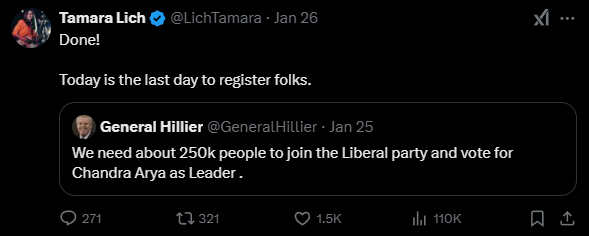
After Chandra Arya was disqualified, they moved to support Ruby Dhalla, who had posted to Instagram that the Toronto Sun described her as Canada’s female Donald Trump, and promised to deport every illegal immigrant living in Canada. Dhalla was later disqualified from the leadership race after 10 ‘extremely serious’ violations of the contest rules.




Comments
We want to hear from you! Share your opinions below and remember to keep it respectful. Please read our Community Guidelines before participating.