
Registered members of provincial political parties can:
- Vote for the party leader
- Vote for the party’s candidate in their riding during a nomination contest
- Vote for delegates to a party convention where they vote on numerous matters such as policies, bylaws and the members of the executive
- Run for local riding board and executive
- Run as the party’s candidate in your local riding
- Help shape policies by participating in local or national conventions where members debate and vote on official party policies
Registering with a party is one of the best ways to engage in Canada’s democratic political system after voting in municipal, provincial and federal elections.
Other benefits include:
- Meeting likeminded, politically-engaged people who share your political values
- Open doors to internships, advisory roles, or political staffing jobs
- Common first step toward running for office
Register with a provincial party in Ontario
Membership fees and eligibility for each party:
- Progressive Conservative Party of Ontario – $10/year
- Resident of Ontario
- 14 years of age or older
- Uphold the Party’s Constitution
- Not a member of any other provincial political party in Ontario
- Ontario NDP – $25/year ($5/year for youth, seniors, underemployed)
- Except in Quebec and Nunavut, individuals who join the federal NDP do so through their provincial/territorial NDP branch
- Resident of Ontario
- Uphold the Party’s Constitution and principles
- Not a member of any other provincial political party in Ontario
- Ontario Liberal Party – Free
- Resident of Ontario
- 14 years of age or older
- Supports the purposes of the Party
- Uphold the Party’s Constitution and principles
- Not a member of any other provincial political party in Ontario
- Green Party of Ontario – $10/year (free for 30 years of age and under)
- Resident of Ontario
- 14 years of age or older
- Uphold the Party’s Constitution, bylaws, policies and principles
- Not a member of any other provincial political party in Ontario
Membership fees can be tax deductible, depending on the party
A tax receipt must be issued for every eligible contribution (contributions solicited for the purposes of the Election Finances Act) to a registered political party.
An annual membership fee paid for membership in a registered political party
must be treated as a contribution unless:
- the total fee paid to the registered political party does not exceed $25 per person; and
- the registered political party keeps a membership list indicating the amount, expiry date of membership and allocation of fees paid by each member.
[Act reference 30]The registered political party must have a documented policy on how it will treat membership fees. It must be consistent in the amount charged for membership fees and whether fees under $25 are to be treated as a contribution. The total amount of membership fees greater than $25 must be treated as a contribution.
2025 CFO Handbook for Political Parties
Annual membership fees must be recorded and reported to Elections Ontario as part of the financial statements, but your membership status is not made publicly available.
Your personal information (name, address and phone number) may be used by the party to send you updates and be provided to candidates of party leadership and candidate nomination elections for the sole purpose of pursuing nomination.
Party leadership elections can be close
Progressive Conservative Party of Ontario
All party members are eligible to cast one preferential (ranked) electronic ballot using numbers to rank one or more candidates in order of their preference.
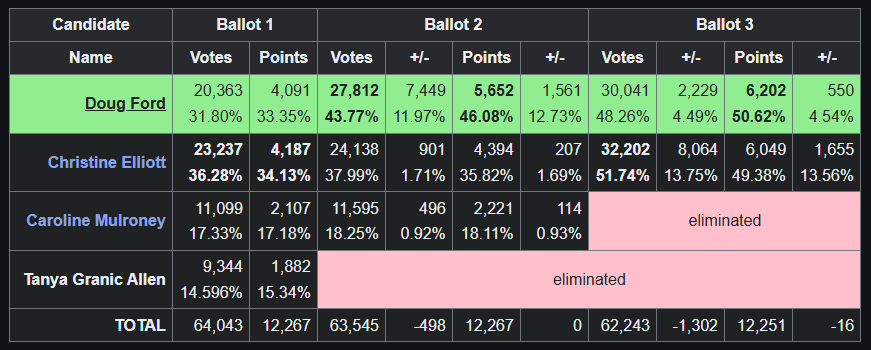
The 2018 leadership election was a close race:
- 64,043 verified members voted in the first round of the 2018 PC Party leadership race.
- Doug Ford received 2,161 fewer votes than Christine Elliot on the final ballot (Ballot 3), but won by 153 points
To be eligible to vote, members went through a 3 part verification process:
- Register with a unique verification number received in the mail,
- Upload an image of one piece of government issued identification, and
- Use a second access code during the voting period to vote online
Each riding in the province was worth 100 points, except for three in Northern Ontario where fewer than 100 members cast a ballot. Candidates were awarded points equal to their share of the vote in each riding.
The candidate that placed last, and any candidate with fewer than 10% of the Electoral Votes (points) was dropped from the ballot and not included in the next round of counting. The first candidate to get 50% of the votes is declared the new leader.
2018 Leadership Election Rules
Ontario NDP
All party members are eligible to cast one preferential (ranked) ballot using numbers to rank the candidates in order of their preference.
Votes are weighted as follows:
- 75% goes to individual members’ votes
- 25% is allocated to affiliated organizational members including trade unions, farm organizations, cooperatives, equity-seeking organizations and other appropriate organizations.
Candidates with the fewest number of weighted votes will drop off the ballot in subsequent rounds until one candidate receives a majority of the total weighted votes cast in that round.
In the 2023 Ontario NDP leadership election, Marit Stiles was the sole candidate and was acclaimed leader. Using the same weighted voting system, the 2009 leadership election during which the party had an estimated 23,908 members, saw the eventual winner Andrea Horwath receive 4,625.29 out of 12,455.89 weighted votes on the first ballot and 6732.34 out of 11,152.9 in the third and final ballot over runner-up Peter Tabuns’ 4420.66.
Riding candidate nomination elections
Progressive Conservative Party of Ontario
All members eligible to vote may vote to choose the party’s candidate in the riding (electoral district) where they reside (as defined by the Election Act) by casting a single preferential (ranked) ballot at a Nomination Meeting after all qualified candidates have had an opportunity to address those present.
To be eligible to vote, members must provide identification proving identity, name and address (eg. driver’s license, utility bill, birth certificate, etc.).
If there are 2 candidates, the candidate who receives the greater number of votes at the Nomination Meeting under the one member, one vote principle (no weighting of ballots is permitted) becomes the party’s candidate for the riding. In the event of a tie, the Chair of Elections shall cast the deciding ballot.
If there are more than 2 candidates and no candidate secures an absolute majority (50% + 1 of the valid ballots cast, excluding spoiled ballots), the candidate with the fewest votes is eliminated and the ballots redistributed accordingly.
The nomination vote can be bypassed if the leader of the party appoints a specific candidate. If there is only one candidate, they are acclaimed and accepted as the candidate without a vote.
Rules Governing Candidate Nominations
Why voting for party leader and candidates is important
Party leaders may have final say and can appoint or deny the candidate in each riding
The leader of the Progressive Conservative Party of Ontario can refuse the candidate’s elected by a Nomination Meeting and the nomination election process is repeated:
if the Leader declares in writing that it will not be his intention to endorse such person pursuant to section 28.1 of the Election Act, or revokes such endorsement, such person ceases forthwith to be the Candidate. In such event:
- (i) the Qualified Contestant or Candidate must forthwith take all necessary steps to withdraw as a Qualified Contestant or Candidate of the Party, and cease to represent himself or herself as a Qualified Contestant or Candidate of the Party; and
- (ii) subject to the provisions of section 19.1, the nomination process described in these Rules shall be repeated, except that any other previously Qualified Contestant shall not need to be re-qualified or reapproved
The leader of the Ontario NDP doesn’t have that same level of control over candidates. Instead, the party’s Provincial Council, made up of a couple dozen individuals from various backgrounds with various roles within the party, must endorse the candidates selected at Nomination Meetings before they can run:
The candidate selected at a nomination meeting must be endorsed by the Provincial
Council before they become the Party’s official candidate.If the Provincial Council decides not to endorse a selected candidate, the Provincial Council shall provide the constituency association and the selected candidate with a full explanation of its reason and, if requested, shall provide the selected candidate and the constituency association with a full hearing before the Provincial Council.
Ontario NDP Constitution
Candidate nomination contests may be gateways for foreign interference
In 2025, Canada’s Foreign Interference Commission found that while foreign interference, did not impact the electoral system itself or which party formed government, it could have impacted certain riding results, particularly during candidate nomination contests:
Canada has intelligence indicating that irregularities in the Liberal Party of Canada (“Liberal Party”) nomination contest in Don Valley North (“DVN”) may have included activities undertaken by individuals close to People’s Republic of China (PRC) officials. This information originated from a variety of sources with various levels of corroboration.
Before the 2019 election, intelligence reporting, though not firmly substantiated, indicated that buses were used to bring international students of Asian origin to the nomination process in support of a candidate for the nomination, Han Dong, and that individuals associated with a known PRC proxy agent provided them with falsified documents to allow them to vote, despite not being residents of DVN. There were allegations that the students were told by PRC officials in Canada to support Mr. Dong if they wanted to maintain their student visas.
Mr. Dong denies any involvement in these matters.
…
The Commission’s mandate is not to determine what actually took place at the DVN nomination meeting in 2019. However, this incident makes it clear that nomination contests may be gateways for foreign states that wish to interfere in our democratic processes.
…
I cannot exclude the possibility that, if the PRC did interfere in the DVN nomination, this may have impacted the result of the nomination contest. The nomination race was “very close,” and it is not possible to determine the number of students who were on the bus or how they ultimately voted. Given that DVN was considered a “safe” Liberal Party seat, if foreign interference
Public Inquiry Into Foreign Interference in Federal Electoral Processes and Democratic Institutions Summary and Context
did impact the nomination race, this would likely not have affected which party held the riding. It would, however, have affected who was elected to Parliament. This is significant.





Comments
We want to hear from you! Share your opinions below and remember to keep it respectful. Please read our Community Guidelines before participating.