
In Ontario, every Police Service Board (PSB) must prepare a four-year Strategic Plan guiding the police service in the municipality. The plan must be developed in consultation with municipal council and local community groups, be made publicly available online and be reviewed and revised at least once every 4 years.
Section 39 of the Community Safety and Policing Act (CSPA) requires the plan to:
- Explain how the Board will provide adequate and effective policing in line with community needs
- Set clear objectives, priorities and core functions for the police service
- Include quantitative and qualitative performance objectives and indicators across specified areas
- Be developed in consultation with a defined set of community stakeholders
This review assesses the Belleville Police Service’s 2026–2029 Strategic Plan against those statutory requirements.
Key findings
The Plan is modern, visually polished and community-oriented. It touches all the broad subject-matter areas contemplated by the CSPA. However:
- It does not clearly set out the core functions of the police service.
- It contains very few concrete, measurable performance objectives or indicators; most goals are directional statements without baselines, numeric targets or timelines.
- It does not demonstrate on its face that the Board carried out all the specific consultations required by Section 39, particularly with Belleville City Council, school boards and named groups representing diverse communities.
In short, the Plan looks like a modern strategic document, but it only partially meets the CSPA’s more demanding requirements for measurable performance and documented, targeted consultation.
The police service board shall, in accordance with the regulations, if any, prepare and adopt a strategic plan for the provision of policing, which shall address at least the following matters:
How the police service board will ensure the provision of adequate and effective policing in accordance with the needs of the population of the area.
The Plan gestures at how Belleville Police will provide “adequate and effective” policing, but only at a high level. It does not include:
- A clear needs assessment (demographics, crime trends, call volumes, projections), or
- Defined service levels, thresholds, or standards (for example, response time targets or minimum patrol coverage by zone).
Instead, it relies on vague commitments to “improve,” “optimize,” “enhance” and “expand” without specifying “from what to what, by when.”
The objectives, priorities and core functions of the police service.
Section 39 explicitly requires the Plan to address the “objectives, priorities and core functions” of the police service.
The Plan lists 3 priorities:
- Collaborative community safety and engagement
- Operational excellence
- People, culture and capacity
under which are 15 objectives and 57 goals, but does not contain a distinct section that sets out the core functions of Belleville Police (e.g., patrol, investigations, traffic, community safety, specialized units) and how they will be delivered.
Quantitative and qualitative performance objectives and indicators of outcomes relating to,
Section 39 and O. Reg. 399/23 require quantitative and qualitative performance objectives and indicators relating to at least:
- the provision of community-based crime prevention initiatives, community patrol and criminal investigation services,
- community satisfaction with the policing provided,
- emergency calls for service,
- violent crime and clearance rates for violent crime,
- property crime and clearance rates for property crime,
- youth crime and clearance rates for youth crime,
- police assistance to victims of crime and re-victimization rates,
- interactions with persons described in paragraphs 4 and 5 of this subsection,
- road safety, and
- any other prescribed matters.
- Drug crime and clearance rates for drug crime as per Section 3 of O. Reg. 399/23
The Plan identifies objectives in all these areas – with the exception of Drug crime and clearance rates, which is not explicitly mentioned – but almost always as vague, directional goals. Out of 57 goals:
- Only 1 includes a clear numeric target (“increase the percentage of female police officers to 30% by 2030”).
- Roughly half can be loosely described as “measurable,” but they lack baselines, timelines, or defined indicators. For example: “Increase clearance rates for all crime types including violent crime, property crime, and youth crime” does not say from what level, to what level, by when.
- 9 are simply commitments to continue existing activities.
The Plan repeatedly claims a “strong commitment to performance measurement and public accountability” and promises to track progress and provide updates. However, it does not:
- Specify baselines or targets for key indicators (e.g., response times, community satisfaction scores, clearance rates); or
- Describe when, how, or where progress will be reported (e.g., annual public dashboards, annual report metrics).
As a result, the Plan does not meet the CSPA’s standard for clearly defined quantitative and qualitative performance objectives and indicators.
Interactions with,
Section 39 requires addressing how the police service will interact with:
- youths,
- members of racialized groups, and
- members of First Nation, Inuit and Métis communities.
The Plan mentions these communities once, committing to ‘outreach messaging’ tailored to these communities on public safety, crime prevention and victim support. Interactions with First Nation communities are mentioned only in generic “Indigenous communities” language. There is no specific strategy for local First Nations (ie. Tyendinaga Mohawk Territory).
Interactions with persons who appear to have a mental illness or a neurodevelopmental disability
The Plan mentions training in mental health response, de-escalation, and harm reduction and collaboration with specialized crisis teams such as IMPACT (Integrated Mobile Police & Co-Response Team).
Information technology
IT has its own page and is one of the most specific sections of the Plan. It lists the key priorities for the next 4 years:
- Full rollout of Axon Electronic Notes
- Implementation of a new records management solution
- Deployment of a collaborative document management system
Police facilities
Facilities has its own page. It mentions one key priority: “facility expansion, particularly to support the growing field of digital forensics and investigative functions, evidence handling, and property storage, with clear accountabilities to ensure the integrity, security, and proper management of all materials.”
Any other prescribed matters
Consultation requirements
Section 39(3) requires the Board to consult with at least:
- (a) the chief of police;
- (b) the municipal council of any municipalities in the board’s area of policing responsibility;
- (c) the band councils of any First Nations in the board’s area of policing responsibility;
- (d) groups representing diverse communities in the board’s area of policing responsibility;
- (e) school boards, community organizations, businesses and members of the public in the board’s area of policing responsibility; and
- (f) any other prescribed persons, organizations or groups.
The Plan states that feedback was collected from:
- 110 Internal Members (police service)
- 24 drop-in centres
- 78 round table participants
- 23 Town hall participants
- 774 external survey participants (public at-large)
- 111 Chamber breakfast participants (businesses)
However, the Plan:
- Does not state that Belleville City Council was consulted as council (e.g., workshop, committee, or formal input into the Plan);
- Does not state that band councils for local First Nations (e.g., Mohawks of the Bay of Quinte) were consulted;
- Does not name any specific groups representing racialized communities, Indigenous communities, youth, or other diverse communities; and
- Does not mention consultation with school boards.
Additionally, it does not release, summarize, or discuss the results of the surveys or feedback from the different stakeholder groups.
When asked what groups, community organizations, business and individuals representing diverse communities were invited to participate, the Chair of the BPSB stated that the Board consulted with every group identified in Section 39 of the Community Safety and Policing Act, 2019:
Our Board consulted with every group identified in Section 39 of the Community Safety and Policing Act, 2019. The invitations to consult went out by email for the Round Tables on Feb. 24th, Feb. 28th and April 9th.
We conducted a poll of over 90 business professionals in partnership with the Chamber of Commerce on February 26th – at a Chamber of Commerce Breakfast, where survey questions were distributed in advance by the Chamber on our behalf.
Additionally, our Board has provided a paper copy of our survey monkey survey, which you indicated you had completed, to the Bridge Street Drop In Centre for input.
Board members distributed our survey link and QR code by attending the Quinte Mall on March the 8th and Walmart on March 15th and the Belleville Sens home game on March 15th.
Information regarding Town Halls is being included to the list of invitees to the Round Tables as well as being distributed by media. Paul Martin has done an article In Quinte and his Beyond the Headlines pieces on March 24th. Additional media advisory pieces will be distributed to all channels the week of March 24th and March 31st.
Chair of the Belleville Police Service Board
That assertion is not reflected or documented in the Plan itself. There is no list of invitees, no summary of feedback by stakeholder group, and no indication that the statutory categories were systematically addressed.
The absence of documented, meaningful consultation with local First Nations and Indigenous organizations is a particularly critical gap given the specific context in which the Belleville Police Service operates. Consulting these voices is especially important considering the demographic reality of the region and the urgent need to repair relationships strained by recent high-profile interactions between officers and Indigenous residents.
Belleville’s Indigenous population is nearly twice the provincial average
Given Belleville’s higher-than-average Indigenous population (5.6% vs 2.9% Ontario-wide according to the 2021 Census) and proximity to Tyendinaga Mohawk Territory, and the fact that Indigenous people continue to be overrepresented in Canada’s criminal justice system as both victims and those accused of crime, the absence of clearly documented engagement with Indigenous governments and organizations is a significant gap.
Belleville officers break Indigenous man’s rib and finger over alleged stolen Powerade
In December 2023, Belleville Officer Jeffrey Smith was found guilty of assault for a takedown of a Mohawk man at a Taco Bell on the evening of Nov. 15, 2019, because he did not have grounds to arrest Mario Baptiste Jr. a gas station owner from Tyendinaga Mohawk Territory after he was called to the scene for the alleged theft of a Powerade.
Impact on accountability
While the Belleville Police Service Strategic Plan uses modern, community-oriented language and addresses all required subject matter areas, the failure to define SMART goals and demonstrate mandated consultation severely undercuts its effectiveness as a governance document.
The CSPA mandates the Strategic Plan be reviewed and revised at least every four years. The absence of specific, measurable metrics for key areas such as clearance rates, response times, and community satisfaction means there is no clear benchmark against which the Board can assess the Service’s performance during that four-year cycle.
Without these metrics, the Police Service Board cannot hold the Chief of Police and the Service accountable for achieving “adequate and effective policing” in 2029, which is the foundational goal of the entire CSPA requirement.
Other police services’ Strategic Plans
Quantitative performance indicators
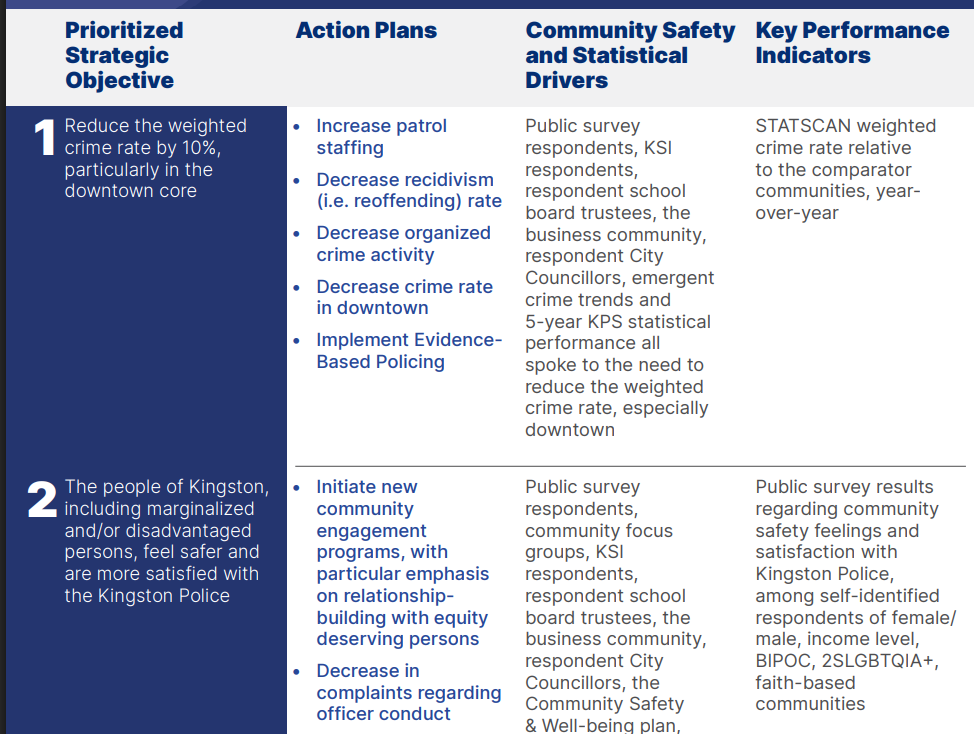
Kingston Police list specific objectives with KPIs
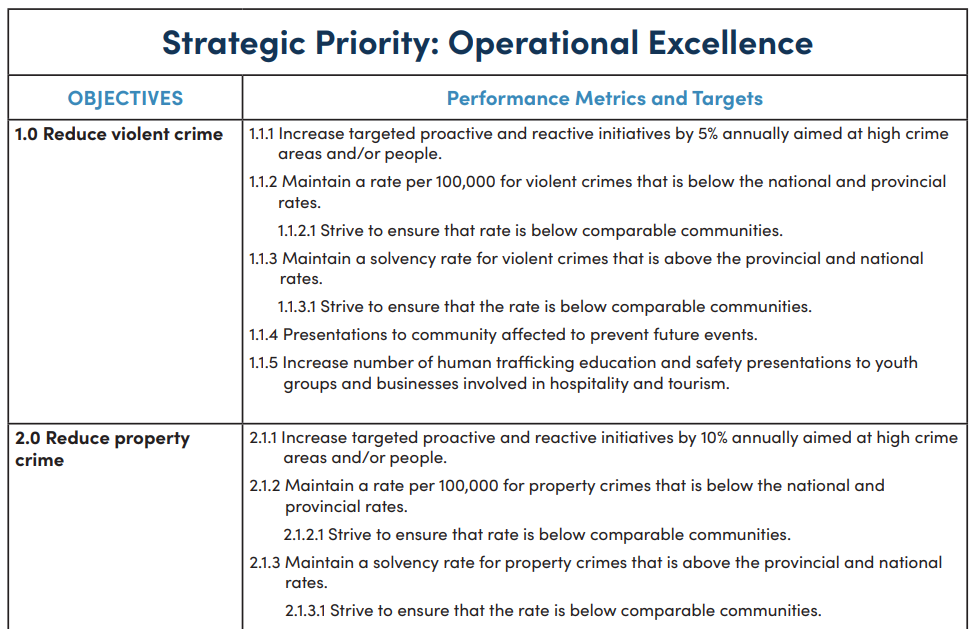
Cobourg Police lists objectives and measurable performance metrics and targets
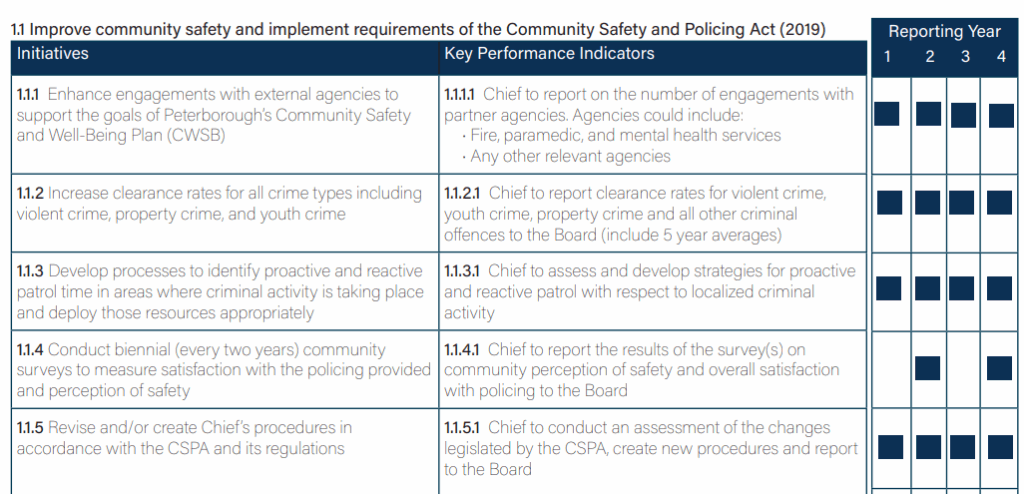
Peterborough Police commits to reporting on KPIs on a certain frequency
Halton Police
Commits to specific thresholds:
- Achievement of the highest weighted clearance rate among comparator police services
- Achievement of 80% or better community satisfaction with the HRPS
- Improved HRPS member wellness, job satisfaction, and engagement
- Reduced per capita property crime rate, including, through partnerships and collaboration, a 50% reduction in auto theft
Consultations
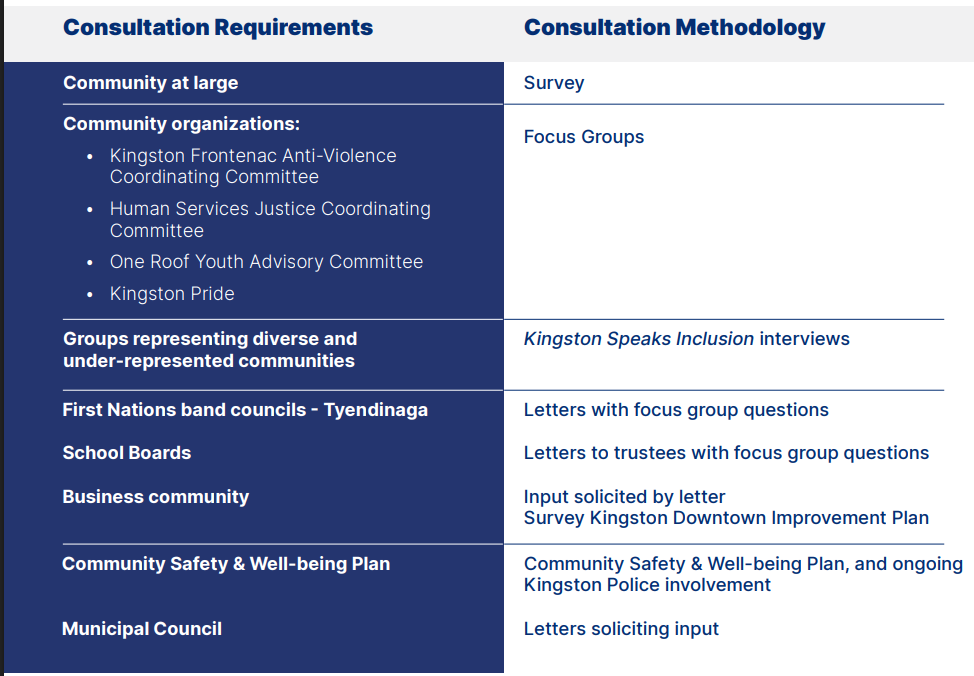
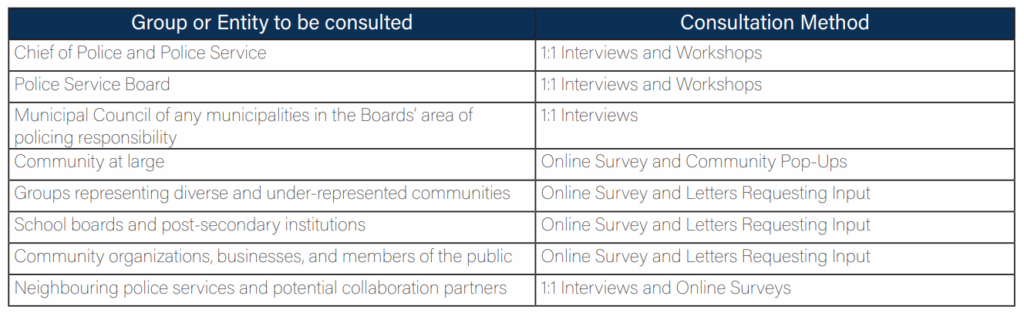
Kingston Police lists the organizations consulted and the methodology used
Peterborough Police gathered feedback from a wide variety of community organizations, Municipal Councils, Indigenous leaders and School Boards to attend both virtual and in-person sessions.
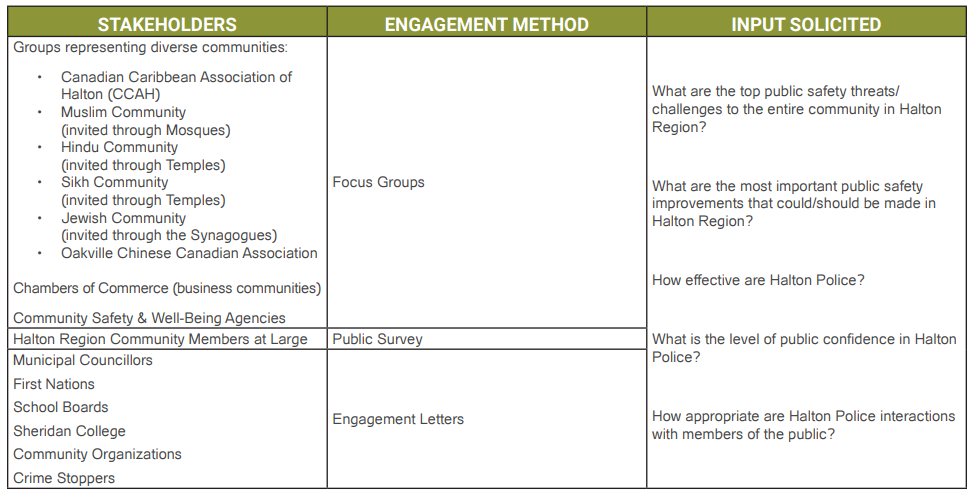
Halton Police listed the stakeholders, methodology and questions asked
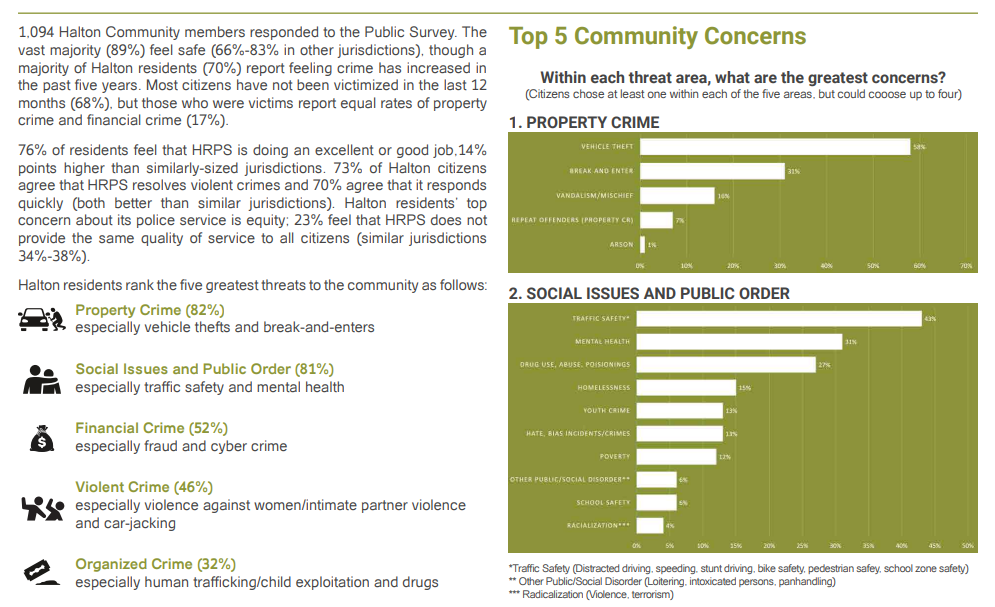
And provided an overview of the survey results:


Comments
We want to hear from you! Share your opinions below and remember to keep it respectful. Please read our Community Guidelines before participating.